on walls and the people who bump into them

April 24, 2020

I like to quote Rousseau’s origin myth for humanity:

THE first man who, having enclosed a piece of ground, bethought himself of saying “This is mine,” and found people simple enough to believe him, was the real founder of civil society. From how many crimes, wars and murders, from how many horrors and misfortunes might not any one have saved mankind, by pulling up the stakes, or filling up the ditch, and crying to his fellows, “Beware of listening to this impostor … (Discourse on the origin of inequality p. 23)

And again:

THE strongest is never strong enough to be always the master, unless he transforms strength into right, and obedience into duty (The social contract I.3)

For Durkheim ([1918] 1966), and then Lévi-Strauss ([1960] 1976), these statements introduce the fundamental problematics of sociology and anthropology: there is the making of an arbitrary mark among a population, and then obedience, and then duty. I tend to agree with this, but not with the exact phrasing, or its development into the more particular problematics of the social “contract” apparently entered into by adults meeting in some neutral place who come to an agreement that this would be the grounds of their relationships. And then, it is imagined, they arrange for this contract to be enforced (for example by hiring teachers to drill students into the way a language should be spoken or written).

Continue reading on walls and the people who bump into them

On Responding to Corona: modeling consent and resistance

My earlier posts were mostly about ways to analyze the evolution and spread of Corona as what Mauss called a “total social fact” ([1923] 1967).

I will now focus on the moments of encounter with Corona that are but an instance of any encounter requiring further action by those made to participate. What is it that can happen, next?

Most simply, to any statement requesting action the response can be:

  • . Yes!
  • . No!
  • . Let me think about it! (Play with it, dissemble about it, undermine it or build it up outside the box set up by the statement)

The classical case I generally use when teaching about what makes a classroom a classroom (building on Mehan 1979) involves the question “what time is it?” To this question, human beings have been documented to respond with such statements as:

  • . “it’s 5 o’clock”
  • . “it’s my watch, man!”
  • . “it’s not time yet.”
  • . “time to go to bed”

These responses are themselves statements allowing for, or requiring, a further response. All sorts of these second responses (in a third step) have been documented. Famously, the first response can lead, in a third step, to such statements as “Thank you!” or “Good (for being able to read a watch)!” In each case, the statement reveals and constitutes broader constraints, whether polite encounters with strangers in the street, routine encounters between teacher and student in a classroom, or possibly tense interactions when some decide that one has “screwed around” and need specific “instruction” (Garfinkel 2002: 257). Continue reading On Responding to Corona: modeling consent and resistance

Modeling Corona pathways

This post is an exercise in imagining what social scientists need to do in order to learn about the spread of Corona, from the point of view of an anthropology steeped in the epistemology of ethnography. The appearance of Corona in all our lives is also an opportunity to understand better how real (not imagined) worlds are constructed by human beings, as well as what are the consequences of the particular worlds actually constructed on the everyday lives of people in the populations caught in that world, whether they bend to the new constraints, resist them, or (deep) play with them. In other words, for those who work off Foucault: how does governmentality actually work?

I introduced what I am exploring here in my earlier post about the speech acts which, as I drove west, closed restaurants (March 28, 2020). These speech acts traveled down pathways from some source to a local establishment where it will be experienced, say by a restaurant manager, and then lead to some response, or, rather, many responses. I first “felt” Corona on March 9, when it was announced that classes at Teachers College would be “online” only starting two days later. By the 12th, I, along with everyone else at Teachers College received a message from our president, forwarding the message that the president of Columbia had sent to all on some enormous mailing list (the “Columbia community” as it was deemed). I know less about the Corona pathways in France, I imagine that university presidents there did not have to deal with trustees, lawyers or insurers. What they had to deal with, and how they had to announce local decrees is worth investigating, particularly for those still interested in the culturing of human action
The message mentioned the World Health Organization and the Center for Disease Control and it made it appear as if the “University” was the acting subject. No mention of any internal mechanism was indicated in the key sentence “we now need to take further steps.” Who is “we” here, ethnographically? Given that the conversations that led to the decision are “privileged” (i.e. secret except to a few), I imagine that the participants included trustees, lawyers, insurers. I imagine conversations among the presidents of New York University, Cornell and perhaps others. And I imagine calls to the state governor or his staff.

The conversations that led to the announcement of what “we” would do next will remain secret for 30 years at least. But they must have been all the more intense that the WHO or CDC or NY state suggestions and decrees left some matter to local interpretation and improvisation on the overall Corona theme. It is a matter of public information that universities of Columbia’s standing did speech act with different consequences for their students. On March 9th, talking with some colleagues at Indiana University we wondered about Harvard’s decision to abruptly close all student residences, with apparently little concern with whether students actually had a “home” to go back to. Eventually Columbia went a different way, “strongly urging” students to go home, but accommodating those who could not (for example the many students from China).

It will however be possible to get a sense of who and who is involved in local decisions by reading public statements such as this one from Columbia that mentions an “Infectious Disease working group” that makes local decisions about what to sanitize when and how often.

Ethnographers will rarely be given permission to take notes when speech acts affecting millions if not billions are being performed. Few of us can study “up” so we will have to find settings that will allow us to observe, collect, take notes, etc. among people relatively “down” from our status. In particular anthropologists will be able to document what some people did as they responded to decrees by governors (presidents, first ministers, superintendents, chiefs—whatever they may be called in this or that world). For a few days for example, some of us at Teachers College imagined (hoped?) that the “closure” was not an absolute one. We exchanged e-mails about whether someone could water the plants in my office. As we did, we came to understand the depth of the closure and the not-at-all symbolic strength of Corona. I do not know whether my plants are surviving though it may be that one of the few human beings who can still enter the building is watering them.

As with all ethnography, this little vignette does not seem to mean much. And yet it can be the grounds on which one can model the Corona pathways and the activity of human beings when caught anywhere in what is essentially a daedalus.

So, in summary, and in a very preliminary fashion:

— A consists of some human beings who can decree what B, C, D, n…. must do or else some punishment may ensue. The people of A meet, deliberate and then they decree.

— B (C, D, n…. ) consists of some other human beings who receive the decree and translate it so that it makes sense for them. In the process, after meetings, deliberations, etc. they come up with further decrees to those over which they have more focused authority Ba, Bb, Bc, Bn….

–Ba (Bb, Bc, Bn…) then, meet, translate, deliberate and, perhaps come up with still further specific decrees on Ba1, Ba2, Ban…

Thus:

— (A) the governor of NY state decrees that all non-essential businesses should close;

— (B) university presidents decree that all teaching would be online using Zoom (rather than Skype)

— (Ba) individual faculty members on sabbatical and traveling to give lectures must decide whether to continue driving, etc. This response is made in collaboration with children, in-laws, etc.

(Ba) is where ethnographers will be enter to the world of Corona and give evidence as to what people who had no voice in the making of some policy do as they translate the particular mandate they received into their own lives among their most significant others.

The point is that people, everywhere and everywhen, when the recipient of a decree that makes a very real world for them, will make something else with the decree that those who made the decree cannot predict or control. As I argued in Educating in Life (2019), building on Rancière, a powerful event in one’s life will lead to a whole set of “next” steps sensitive to the actual practical character of the event, the resources available, the more or less significant others with whom one will try to construct a next, and then the response to the responses by those who produced the event in the first place.

Remember Alice and the flamingo!

[print_link]

on “Corona”

Again, C19 may kill you, Corona closes restaurant. (March 28, 2020)

So, what is “Corona”? In my younger days, I might have meant it as the word (Saussurian signifier) pointing to an object (Saussurian signified). This may still be common sense, even after the “ontological turn” in anthropology which, as I understand it, is meant to make us consider the “thing-ness” of a possible entity such as “Corona.” The question is actually a classical one in anthropology: when talking about something social (“social structure”) are we talking about an object or about a model built by observers to manipulate? This was the core of the debate between Radcliffe-Brown and Lévi-Strauss (1953). For Radcliffe-Brown, the matter was common sensical. He had made it simple in a foundational text:

If I visit a relatively stable community and revisit it after an interval of ten years, I shall find that many of its members have died and others have been born; the members who still survive are now ten years older and their relations to one another may have changed in many ways. Yet I may find that the kinds of relations that I can observe are very little different from those observed ten years before. The structural form had changed little. ([1940] 1965: 192-3)

We could translate it into Corona (from my experiences in Wyoming and New York City:

As I drove 2100 miles, none of the people that I met, directly or indirectly in Jackson, Wyoming moved with me. In a small Jackson grocery story, a table had been put between the cashier and the customers to increase the distance between them. In New Rochelle, another such table had been set up in a small bakery. The structural form was the same.

The problem, as Lévi-Strauss saw it, is that the “structural form,” what we might now call the product of a social construction of reality, is actually not accessible to the anthropologist’s senses. Quite before Geertz told us that what anthropologists actually do is “write,” Lévi-Strauss told us that what they must do is make a model (a form of writing) based on observations (including observations of the models participants might have themselves made of their relations). That is the anthropologist-as-scientist must do something similar to what the biologists investigating C19 are doing, that is transform what they get to see using a massively cultural machinery (electron microscope and all that they entail) into something they can manipulate (for example by coloring various parts). In other words, biologists must ‘write’ C19 to manipulate it.

Given all this, what is to be modeled by an anthropologist investigating the social response to C19 that made a total institution (in Goffman’s sense) for 6.8 billion people, and its consequences?

The simple, negative, answer is: I am not going to model a “social structure” or “system.”

Anthropologists of my generation suspected that this was the case and, to a large extent, nobody writes about “social structures” any more, though some are tempted to re-introduce the concept, for example those investigating “structural racism.” Those who know my work also know that I always resisted Geertz’s pessimism (encouraged by Derrida’s ‘deconstructionism’): it is NOT all words. If something is a “social construction,” then it is VERY real, an object that stands in the way of the human beings who bump into it. In my work with McDermott we traced what makes schooling a problem by focusing on the consequences that something made to serve all children so that “none are left behind” actually identifies 50% of all children as “below average,” in need of identification, help and remediation (Successful Failure 1998). Schools in the United States and around the world are determinedly made up (cultural, artificial, arbitrary). McDermott and I summarized all this by writing about the  “School” (capitalized) as a “thing,” made up of ongoing events of some sort, for example the School is set up to weigh human beings on all sorts of statistical scales. How could that be? McDermott and I responded that it had to do with “America” in the School that it made over the past centuries.

Ten years later, Jill Koyama (2010), quite rightly criticized Successful Failure  for not tracing the mechanisms that keep re-producing the School. Pointing at America without specifying the mechanisms is insufficient, and possibly dangerous if it leads some to assume that America is made by … encultured, habituated, Americans.

To make her point, Koyama followed a subset of another one of the major pieces of the many legislations which, over the past centuries were aimed at revitalizing the public school. She looked at the life of “Supplemental Educational Services,” a small part of an act to ensure that “No Child [is] Left Behind.” Rather than “deconstructing” the act, she followed its life for some of those who could not escape it: corporate chiefs, mayors, principals, teachers, parents for whom the act was either resource to use (particularly for the large corporations that were contracted to “deliver” the services) or obstacle to navigate. Koyama was inspired in this analysis by Latour’s Actor-Network-Theory, and particularly by that aspect of the theory that insists that a “network” is never closed. A network is not a system or a structure. A network is not even really a “thing” so much as a set of pathways through which the stuff that happens, particularly government decrees, travel though a population and activate something in them.

In that perspective, “America” is an actor-network. So is Corona in my writing. That is, when I write “Corona can close restaurants,” I am asking social scientists to look for the linkages along which a governor’s decree move, as well as all the sub-decrees that various people in the network have to enact so that this restaurant here at this time is indeed closed.

Modeling Corona (in one or another of its instances) can then allow us to compare it to other such events in human history—say the School.

More on that in another post.

References

Koyama, Jill   2010     Making failure pay: For-profit tutoring, high-stake testing, and public schools.. Chicago: The University of Chicago Press.

Lévi-Strauss, Claude   [1952] 1963     in Structural anthropology, pp. .277-323 Tr. by C. Jacobson and B. Schoepf. New York: Basic Books.

Radcliffe-Brown, A. R.   [1940] 1965     “On Social structure.” in Structure and Function in Primitive Society, pp.188-204 . New York: The Free Press.

1963 .. (First published in 1952)

[print_link]

Corona as culture

Corona is neither simply juxtaposed to nor simply superposed over COVID-19. In a way, Corona substitutes itself to COVID-19, in another way Corona uses and transforms COVID-19 to realize a synthesis of a higher order.

The above is a translation of the best two sentences about culture and humanity ever written by an anthropologists. In the original Lévi-Strauss ([1949] 1969: 4)) possibly meant it optimistically (Boon 1982: Chapter 4). Translated into the Corona epoch, it may or may not be so. In any event it is essential for an anthropologist to keep the virus (that is the material and biological — C19 here) distinct from the human response (that is the social and cultural—Corona here). The response to C19 produced a “synthesis of a higher order,” Corona that has caught about all 7.8 billion human beings on the planet. For the million and a half who have been identified as carrying the virus, for their kin, and for those who treated them, C19 may be a matter of direct experience. For everybody else, what is experienced is Corona in the reports by the media, in the regulations by government, in conversations among kin, friends, colleagues. As an individual, I am lucky that noone in my first degree network has experienced C19. But we all have experienced, and continue to experience, Corona.

Continue reading Corona as culture

On the speech acts that are making Corona

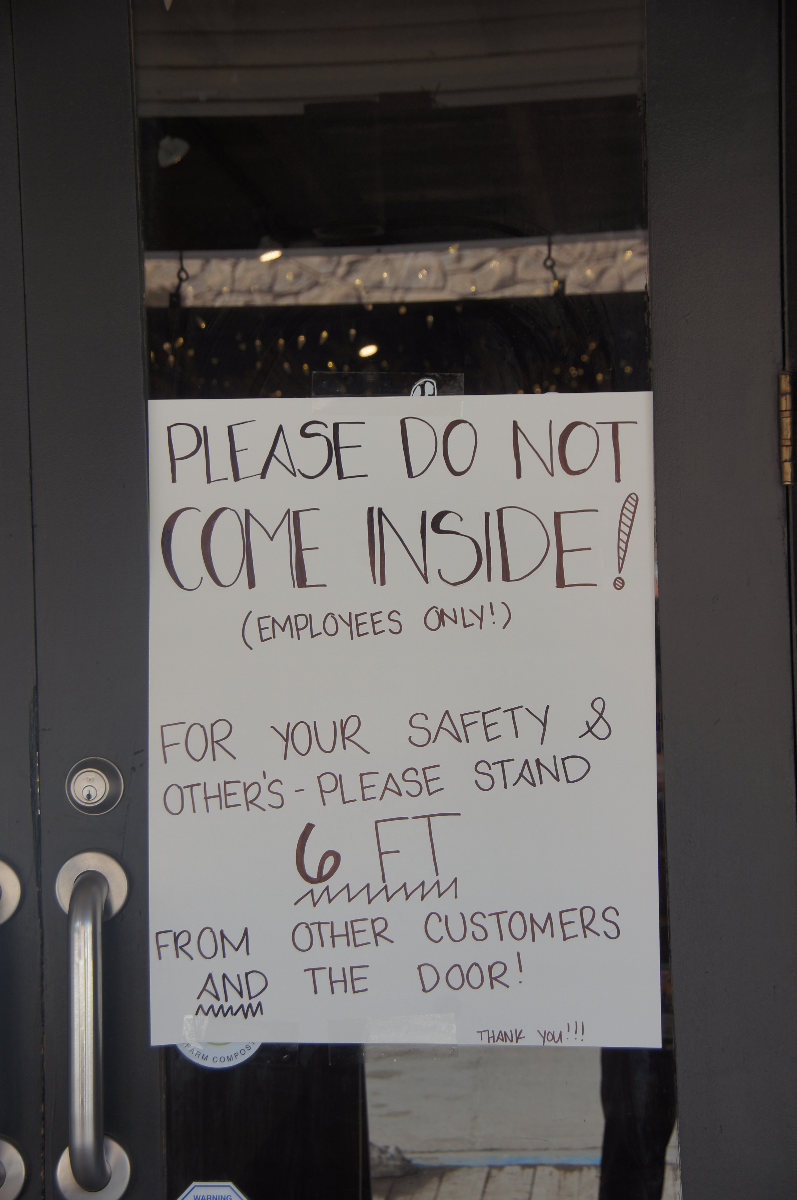
do not enter sign
Do not come inside!

Let’s settle one thing first. A virus can kill a body but cannot close a restaurant. Only some people can do the latter. To close a restaurant some one must speak, with authority so that the consequences follow (restaurants to close, restaurant owners to speech act to potential customers).

At some point, say in February 2020, Corona was something one read about in the media. And then it became consequential in my everyday life as the President of Teachers College told the faculty that classes would be suspended and would continue online. I was struck about his exercising an authority that is vested in him—though I was also struck that he was following what had been done by the President of Columbia. For those who do not know the peculiar organization of Columbia, the fact that Teachers College is a separate corporation means that acts like “suspending classes” must be performed twice, first by the President of Columbia, and then by the one of Teachers College. As I was driving on a lecture tour that had not yet been interrupted I mused about who these Presidents consulted and who was involved in making the closing a sensible one, as well as one that could not be contested through the usual channels. Actually, I suspect that it was not simply a sensible response, it was one they had no particular choice making. I mused about lawyers and insurance companies. But mostly I mused about de Blasio, the mayor of New York City, and Cuomo, the governor of New York State as they exercised their own authorities as the responsible governing agents.

By the time I reached my first stop at Indiana University, everything was still “pre-Corona” though it had become a subject of anxious conversations as everyone expected Indiana to also close (go on line, stop such events as lectures by outsiders, etc.). We discussed Harvard shutting its dorms. We wondered about Columbia (which decided not to, though it encouraged students to leave). And we waited for the next shoes to drop.

Three days later, all my other scheduled lectures at Minnesota, Arizona, California State, Stanford were cancelled and Corona started to directly affect my everyday life. On some matters I still had some control. So I decided to continue westward. North Dakota, Montana, Wyoming, the states I was going to cross had not performed any Corona related speech acts (and New York was starting to possibly be a bad place to be—as was discussed among my extended kin). By the time I reached Wyoming, this had changed as the state closed restaurants, etc. Within these State strictures I could still make certain decisions so that, three weeks into Corona, I am settled in a beautiful place and in a hotel I can afford.

I am expanding on the original speech act theorists (Austin 1962; Searle 1965) by taking into account all that conversational analysis and linguistic anthropology has taught us: speaking that has consequences, that is “speech” that “acts,” always involves a set of earlier utterances to which the speaking respond, including a pre-figuration of what future speakers might then do.

To do this, I performed many more or less consequential quasi speech acts, from those I made to myself, to those I made when I asked for a room, etc. All of these were, at the time, sensible responses to many strictures including the new constraints imposed by various agencies, from state governors to local health authorities. These responses were performed under my own authority over myself and could thus be deemed “voluntary.” However, having to respond is not something under my control so I would, as actor, deem the whole process involuntary. In Foucault’s terms ([1975] 1978), I am now imagining myself in a panopticon, disciplining myself so that I might not be punished.

Footnote:

References

Austin, J. L.   1962     How to do things with words. London: Oxford University Press.

Foucault, Michel   [1975] 1978     Discipline and punish. Tr. by A. Sheridan. New York: Penguin Books.

Searle, John   1965     “What is a speech act.” In Philosophy in America, ed by Max Black. Ithaca: Cornell University Press. pp. 221–239

[print_link]

Ignorant School Teachers

Rancière is altogether optimistic about “ignorant school masters” ([1987] 1999 ). He advocates for a radically “democratic,” non stultifying education that is not about students repeating what they are told by some teacher. As Joseph Jacotot has demonstrated, anyone can teach anything they do not know… as long as they do not invoke knowledge. The best school master is the one who is ignorant of what the students under his authority are trying to learn through exercising their intelligence in community with others also doing it. Rancière is tempted by Jacotot’s radical revolutionary democracy as it was dreamed up by the young French of 1789 (who also produced the Terror). He is tempted to doubt any claim to knowledge, expertise, etc. from philosophers, particularly when they are also placed at the service of some political cause or State.

One can seriously doubt whether this is something that is to be “applied” in the case of anything that involves the medical care of our bodies by modern medicine (vaccines, viruses, traumas, etc.). In such cases it would be hard to claim that we do not need expert teachers, who were taught by fully knowledgeable teachers, and who keep learning from such. We might also hope that some of them will think beyond the various boundaries set by their teachers so that they can actually find something no one else could have taught them. But that is a boundary case.

But one should not doubt the importance of Rancière’s major point: that people continually teach each other what they do not know as well as exercise their intelligence to figure out what to do next given their conditions, including all the advice others, and particularly experts, give them. This is something everyone should take into account, and particularly people with power and authority leaning on experts. “Official” education is always going to be challenged by the non-official.

This is very general, and, as I teach it, completely in line with the most classical forms of cultural anthropology. Humans would not be where they are, anywhere in the world, if they had not continually been involved in challenges to any order established earlier.

Now, in the particular case of Corona, we have a different kind of “ignorant school masters.” As I argued in my earlier post, most of the population of the United States (France, Italy, etc.) learned about COVID-19 from the media, that is from announcers or journalists translating what others had said, including politicians and experts. They continually invoke authoritative knowledge (as well as play on the emotions of their audience). “Stories” generally include reference to the “CDC,” a Dr. X “expert from [famous] hospital,” etc. How these stories are written, by whom, under what kind of control is something that specialist in media studies might teach me. But I strongly suspect that the experts themselves do not control the final wording (that is the curriculum) or the manner of the delivery (that is the pedagogy) of the education dispensed by the media. And I am about certain that the journalists themselves are not expert, or have any decision making authority such as those of governmental officials. The media people are teachers, but they are of the most ignorant type.

In the past few days, I have gotten further teaching documents that many if not most will never get. I have statements from university presidents, some colleagues, and such. They are statements by people outside the media that the media people may translate into their stories. The anthropologist Mica Pollock, for example, sent anthropologists of education these links from Ariadne Labs at Harvard: This is Not a Snow Day and #KidsHomeSafe: Advice on Social Distancing for Families. Here is expertise over expertise reiterating, or being the source of, action by the State.  Again, education from beyond the school

But the social reality remains the same, and is sometimes hinted at in these documents. If one has to be told that this is NOT a snow day, then it is probably because the author of this title is aware that many do take the current regulations as equivalent as snow days, vacations from school or work during which one should also have some fun with friends and family. Most medical doctors know well that many patients do not follow their advice, leading to a huge literature on the matter.

For an anthropologist of education/knowledge, the questions remain. Outside to the realm of experts, and the politicians who listen to them, what becomes accepted knowledge among a certain group? That is a social question since, as an anthropologist, I am less interested in individual knowledge than about communal one. I am interested even more in the establishing of (probably very temporary) agreements about what to do next. I can imagine some mother reading the texts produced by Ariadne Labs and then trying to establish what to do over the next day that husband, children, neighbors, etc. will actually implement.

It is about these processes that cultural anthropologists may have some expertise.  On the basis of this expertise, we can criticize another story from Ariadne Lab titled “Resistance and change” (about some surgical procedure). The post starts with “ Humans resist change. Maybe it’s a survival mechanism from our evolutionary past.” The reality is, of course, that humans continually change, that their conditions and resources for survival change, so that, actually and eventually, modern medicine does evolve over its past and towards some uncertain future.


References

[1987] 1999 The ignorant schoolmaster: Five lessons in intellectual emancipation. Tr. by K. Ross. Stanford, CA: Stanford University Press.


[print_link]

Educating into Corona, in life

In my case, and while on the road, about everything I have learned about the virus I learned through the media, mostly from the “traditional” media (New York Times, Le Figaro, etc.) and somewhat less traditional (Yahoo summaries, etc.). I have watched some television, mostly in restaurants where it was on. I hope that people in the medical profession, as well as various politicians and “officials” with power and authority, are learning from other sources—though we will never quite know where Trump or Pelosi, Cuomo or de Blasio, etc., are getting the information on which they base their decisions.

Obviously, no one among all those (except perhaps the medical people) learned any of all this at school, though some may remember some high school class, taken decades ago about viruses and the like.

So, this virus has not (yet) been taught in school. More interestingly, whatever one learns about it is not verified by a more knowledgeable person (say, a school teacher). There are no tests. And one receives no diploma for whatever knowledge one has gotten. The “media” (journalists, TV announcers and such) are the main teachers. But they are not school teachers. Not only can they not give tests, they have no way to control what their “students” are learning. It is not even clear to me where their “curriculum about the virus today” comes from and who vets it (producers? lawyers? “officials”?). They are all very much “distance teachers” with little feedback about their impact.

Most importantly, the students are not isolated from each other as they might be in a test-driven classroom where their knowledge is supposed to be assessed independently so that they can be sorted into more or less knowledgeable. The students (me, my family, my peers, people I briefly encountered in stores or hotels) talk to each other, and they teach each other. As soon as they hear or read something presented as “knowledge about the virus,” they start discussing this knowledge in all sorts of forums with different co-participants, etc. They dispute, disagree, criticize, suggest, cajole, enforce, etc.

All this could be said to be “Cremin 101″ (1976) as I and my students developed it recently (2019). I will be using “teaching/learning Corona” for the rest of my career. I strongly encourage students who might be reading this as the event still unfolds to keep an “educational journal” focusing not only on themselves but on the others with whom they engage (very significant others, parents, friends, etc.).

[Note that this is the first of a series of posts I will be making over the near future in my role as senior anthropologist of education. This will be accompanied by a developing web site with notes and further elaboration. Note also that everything said here is under my own responsibility and does not in any way represent the position of Columbia University, Teachers College, or my colleagues and peers]

References

Cremin, Larry   1975     “Public Education and the Education of the Public.” Teachers College Record 77:1-12

Varenne, Herve et al.   2019     Educating in life. Routledge


[print_link]

on “Hervé Varenne” as object with properties and affordances

This is going to get complex fast, and will take several posts.

This is also a development on my last post (1/3/2020) and on earlier others (“On Identity”). It is also a development on matters discussed in the coda “On collaboration” to Educating in Life (2019) as well as a paragraph in the paper with McDermott “Reconstructing culture” (2006: 8).

The question: who is writing this blog post? Answer #1: “Hervé Varenne” as an identity(-fiable) imperfect processing machine that might, in perhaps the not so distant future, be reproduced identity(-cally) by some AI that will keep churning out Varenne’s style blog posts in a perfected form. Answer #2: “I” as the radically uncapturable subject who must use HV (as “Hervé Varenne” will now appear in here) to respond to all those ‘I’ encounters and to whom ‘I’ attempts to communicate an experience other “I’s” addressed as identifiable “me’s” will then have to translate into their own experiences in an ongoing process with no end.

So, let’s sort this.

HV is multiply identified by a host of State agents, and particularly by the State agents that have made HV a State agent “him”-self (imposed pronoun as “stated”–pun intended–by identity cards, passports, etc.). This identification (that ??? is HV) HV would have been ??? before birth and can at any time become a question mark again if, as he once discovered when, attempting to travel with a passport that had “expired” a few days earlier, he lost many rights and some privileges.is particularly consequential for particular purposes–for example traveling across State lines. At various times, and in various settings, noone involved, and particularly not HV, can escape his casting as father, professor, department chair, etc. These identifications could probably best be understood as “affordances” that can then played with in actual practice–but that is a matter for another post. Each of these identifications come with various rights and privileges (as well as responsibilities and limits) that can be enumerated but soon fall under the “etc.” principle.  HV can buy and sell property, grade student papers, vote on certain matters but not on others, sign wills and DNR statements.

HV is also a less regulated agent in settings that the State has not fully entered. Encounters with friends, family members, and indeed colleagues and students always involve more possible identifications than the State ones, particularly when some of those are altogether inappropriate under State strictures (that are different from State to State, and keep changing). That is, some State identifications (e.g. “father” according to HV’s children birth certificates) can interfere when they intersect with another identification (e.g. “professor”) either in HV’s office at Teachers College, or at home. To take a somewhat uncontroversial identification, HV’s age is a fundamental property multiply recorded.  All sorts of privileges are attached to it (voting, drinking, Social Security). Age is also something that the American State (but not the French State) has constituted as an un-mentionable by specific institutional agents (e.g. employers). And while there are no State regulations as to what to mention in public presentations of self (e.g. professional web sites), many of my colleagues at Teachers College do not mention the date of their doctorate, and some not even the date of the publications they list. And yet, not surprisingly, age hovers over much daily interactions, including the moments when HV, as institutional agent (department chair), must remind (or be reminded by) interlocutors not to mention age.

If HV/I understand(s) it correctly, the “conversation” about “identity” is mostly about the less regulated settings when sections of an identity seeps into the practice of another. Thus HV is classified as “White” for particular purposes by particular agents (NY State driver’s licenses do not mention race; University admission forms ask for it; the French state forbids mention of it).  But, many argue, this identification gives HV certain advantages at moment when it should not, and further handicaps others.  At birth HV was identified as “du sexe masculin,” an identification HV never disputed though ‘I’ might dispute what many would include as the ongoing properties of this identification for interactional or interpretative purposes. HV is also, in no particular order, a father, grandfather, French, a senior citizen, in overall good health (though he should exercise more), the owner of this kind of car and this kind of houses, and so on and so forth in a list that is anything but closed. HV discovered a few years ago that some would say he is “cisgender.” HV keeps being told that all this is “changing” and “negotiable.” HV is quite sure that identifications keep changing. But he keeps wondering with whom he is negotiating what, what arguments (or weapons) might be used in this negotiation, and who is to have the “final” word, that is the accountable word for interaction in some future setting.

As a professional anthropologist (another of HV’s regulated identities) HV can go on and on about the interactional, communal, that is “cultural” (in HV’s terms) structuring of experience through the symbols, discourses, practices all human beings must work with. The question for this series of blog posts is: does the ensemble of symbols that can by used in conversations with and about HV, that is HV’s identity for all accountable purposes, constitute, that is make consequential for future purposes, not only HV but also the ‘I’ that all involved may imagine they have “captured”—in the sense that painters are sometimes said to “capture” the “soul” of the person they are painting.

But the word “capture” has more ominous connotations. Syntactically, in English, and all other posts by HV,  ‘I’ is an index to just “HV.”  But ‘I’ is also a symbol that may be used to point to something beyond words, some thing (of course not a “thing”) caught in a “web of meaning” in which one is not so much “suspended” as englued, waiting for the spider.

More on that next.


  [print_link]

A warning to apprentice anthropologists: on “identity” in the New York Times

The New York Times is a major adult education institution in the United States. Mostly it educates implicitly but, quite regularly, it gives mini-lectures, in the style of encyclopedia entries. On December 15th, Max Fisher posed the question “What is national identity?” And then he made authoritative statements like a college professor might do. In brief, Fisher taught “The concept [of identity], scarcely 200 years old, holds that humanity is divided among fixed communities, each defined by a common language, ethnicity and homeland. Those communities are nations; membership is one’s national identity” (New York Times, Dec. 15, 2019).

Identity, community, nation are thereby collapsed into each other, authoritatively. Continue reading A warning to apprentice anthropologists: on “identity” in the New York Times

Musings about possibilities in the scholarly life of a professor of education and anthropologist