about the arbitrariness of processes in time and population, and the implications of this for research and practice. (contributions to a further development of Boasian and Saussurian cultural theory)
Learning with others is, necessarily, a political matter. Thus my insistence on writing about “polities” of practice. Still, it remains that “learning” post participation risks being taken as a somewhat automatic process in the movement towards “fuller” (political) participation. Through participation one may move from apprentice to master but focusing, as we must, on movement does not tell us much about the everyday activities of the one who moves (or of the activities of those who encourage the movement—or put blocks on the way), and particularly about the activity of sorting out what to learn (what to prioritize, what to ignore, etc.).
I thought about this in the interstices of other activities I was not able to escape these past weeks. I found myself, much against my will, and my hopes, in the position of apprentice to “next of kin” practices, first in in the neurological intensive care unit of New York/Presbyterian Hospital, and then in the regular neurological unit, and then in a rehabilitation center. At 70, it is the case that I have never been in that position, legitimately or otherwise, and that I have had much to learn even as I worried about much more than learning.
The programmers at Google (mostly human, I will grant) have a problem: how to make their robot (car) make eye contact with non-robotic drivers so the robot does not get paralyzed at four way stops.
Actually, some humans (particularly of the French kind, at apéritif) are sure all humans must have this problem since it rationally impossible to determine who has priority when four cars approach together a four way stop.
Practically, of course, there is no problem: humans, in each case, make up a way to solve the “problem,” one four way stop at a time, using all their tools (eye contact, inching forward to assert right of way, withdrawal to avoid possible confrontation, etc.).
Anthropologically (in the broadest sense of finding out what humanity is all about), all this is about the tension between rationalism and pragmatism: do human beings act from rules or do they make it up as needed?
As I understand it, Durkheim granted pragmatism what it said about the ongoing constitution of humanity and its local and temporary truths (culture) but returned to scientific rationalism as the ground for saying that, precisely, pragmatism (cultural anthropology, ethnomethodology, etc.) must be granted primacy when the goal is systematic understanding. Affirming that, on the basis of a century of research, it is more likely that human beings “make it up” rather than they follow rules learned earlier, is an act of scientific rationalism. (The development of scientific rationalism being by this very research a historical product of attempts to deal with new conditions from the ‘0’ to the printing press to the … robot car!)
Where does that leave the Google programmers?
And how are we to talk about the many who, soon I suspect, will want to prevent error-prone, “irrational” if not criminal humans from driving now that rationality (in the guise of Google programmers) has triumphed?
The first question is a question about communication theory that it will a lot of fun to ponder and discuss. The robot car is also an ethnomethodological experiment to delve more deeply into the conduct of everyday practical life on the highways of life (hint to doctoral students: there are many dissertations here). But first the programmers will have not to blame humans for not following the letter of the law…
Which leads to the second question and the probable development of new forms of arbitrary forms enforced by new forms of arbitrary powers-that-be. Among these:
. Insurance companies keen to lessen their losses (“bonuses” for people who let their cars drive);
. Advocacy groups for a safer world free from “bad” drivers (get ready for much moralizing);
. State agents reacting to the others and developing authoritative regulations for what is to count as bad (if not now illegal) driving.
. Lawyers, …………….
Along with all this, imagine the many forms of resistance. Imagine what will happen when resistance gets institutionalized. Imagine the resulting rules, regulations, customs that transform what happened earlier and become, for a population, that which is the real they must now deal with (see for examples the multiplication of the responses to global warming across the globe)… Negotiating the institutionalization of robots will not be a rational process, but one more akin to driving through a four way stop, and, for a few seconds, making a uniquely adequate and multiply arbitrary immortal social fact (culture).
One thing I discovered does not happen in Port-au-Prince: traffic paralysis. How can this be given the about total absence of the traffic flow signs, lights, etc.? Without these, one is told in Europe and the United States, cars and people cannot move in dense cities. But they can, in Port-au-Prince!
It’s certainly not the case the traffic (cars, motorbikes, pedestrians) is light. Quite the contrary, it may be more dense, per street area, than anywhere I have been. The streets around my hotel were narrow, with small sidewalks on which cars park. The layout is mostly on a grid with many crossings, and only two or three traffic lights in the about 100 square blocks I got to know. Driving, turning, walking, all involve constantly checking what everyone else is doing who might prevent you from continuing (if not hit you). To add to the challenge matters are major pot-holes, missing sewer grates, piles of gravel, etc.
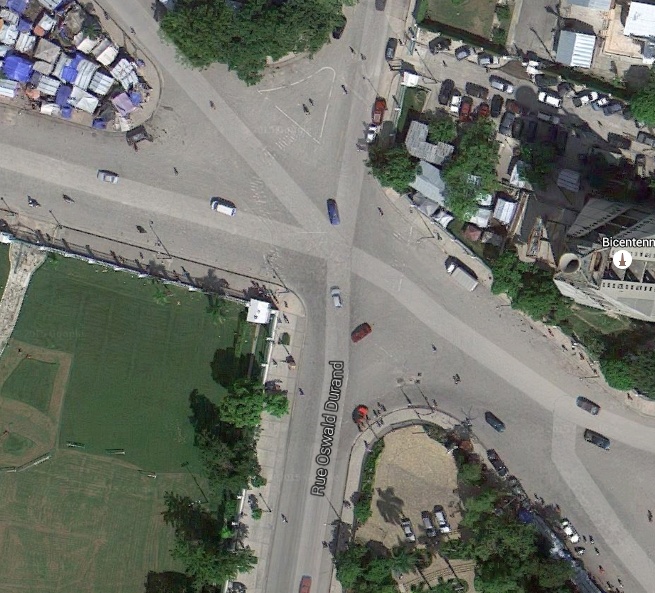
Google Earth image
So what do people do at major intersections when several avenue intersect with none of the external help one might expect?
They proceed — with care I am sure ! Even a New Yorker like myself can remain intimidated. I guess the “rules” are simple: it can be done, there are gaps between cars and motorcycles, do not hesitate or change your mind, others will interpret a movement and act accordingly (people will zip behind you if it appears clear that you are moving; they will zip in front of you in the space you have not yet reached–unless of course something is coming in the other direction to which you should also pay attention).
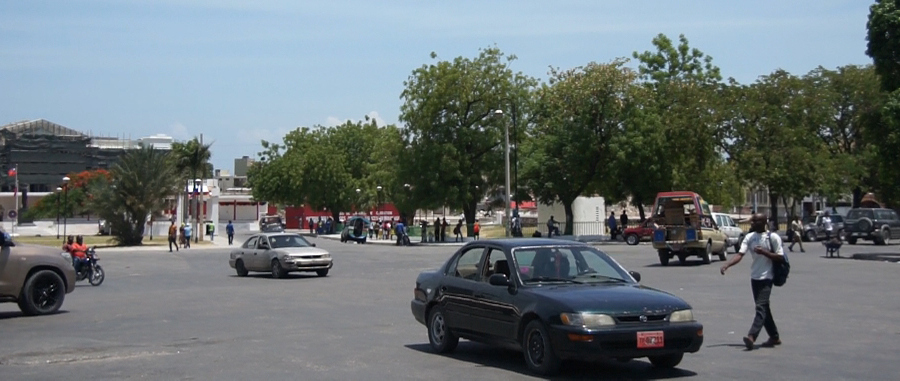
Photo by Herve Varenne
Check the man on the photo. Everyone is moving. Note how he strides confidently towards the space that will soon be freed by the passing car. “Knowing the rules” will not help him. There is no time to plan when everything is moving fast. You have to keep crossing streets that are not quite the same at the middle of your crossing as they were at the beginning. And yet, several million times a day, people in Port-au-Prince do it! After several hours of walking and being driven around, I did not see an accident. They must happen, and there is probably statistics showing that the rate of injury is higher here than elsewhere (at least I hypothesize it may be). But modern life with cars, motorcycles, large number of pedestrians in narrow streets proceed in an altogether orderly manner.
Of course, those who read this blog should know where I am going: the next time I teach Garfinkel on driving in California, I will talk about doing it in Port-au-Prince: that is the challenge for sociology. How do people do what they can be seen as doing in difficult, scary, life-threatening situations: they check around for what others are doing, and they do it! At times, they even stop and wave one across!
Those who follow this post will not be surprised by the preceding paragraph. But, mostly, when teaching Garfinkel, I leave aside “bioanthropology” (the new moniker for “Biological Anthropology”?) and sociobiology, as well as, more problematically, cultural anthropology.
So what would a sociobiologist say about crossing the street in Port-au-Prince? The urge to survive? The need to take risks to survive? What would our selfish genes say?
More interesting are the less theoretical sociologists and social anthropologists who might want to write about the economics (neo-liberalism?) or politics (neo-colonialism? failed state? misguided NGOs?) responsible for the absence of traffic lights at the very ceremonial center of Port-au-Prince. True enough. But is this the end?
Is there any place for a cultural analysis? To the extent that the ensemble of the proximate “causes” for the conditions that make this kind of traffic pattern what individuals must struggle with now, are unique and may not last long (I saw a few newly installed traffic signals in the say 100 traffic corners I experienced), then the situation is “cultural” (historical, a matter of partial diffusion, borrowing, and refusal to borrow). But I would like more: is the traffic pattern also “arbitrary” in the sense that it is not a product of functional adaptation, but also of some kind of collective imagination? Are traffic lights necessary? Or are they the product of an evolutionary conceit about orderliness, separation of functions, etc.?
And so, it seems that trafficking is not only a matter of instruction into not getting killed here and now. It is also a matter of complex deliberations…
Cultural anthropologists must appreciate the following job description, as local (in time and place) work of linguistic
artifacting?
artificiality?
artfulness?
arbitrary?
The Director of Enterprise Applications Service is responsible for application planning, development, testing, support and operations and project management of Teachers College’s application architecture and strategy. The Director of Enterprise Applications will forge sustainable relationships with IT directors in the business units and provide consultative support to the business units. This position will report to the Chief Information Officer and will interact across the academic and administrative technology services leveraging people, process, technology across the college by analyzing existing enterprise applications portfolio and define the road map for that portfolio as the college’s needs and opportunities change. This position will also be responsible for the college data warehouse and business intelligence environments. (Retrieved from LinkedIn on February 18, 2015)
Whether the formal esthetics of this description is “neo-liberal” (as temporarily label for an epoch perhaps following “post-modernism”) or not, it will remain a product of a time and place: 2015 in some global sphere. I suspect Teachers College has never had a “Director of Enterprise Applications Service” and that it will never have another one (as classifications and procedures change).
Reading this job description made me wonder about the form of the text. Minimally, it would lead to examining the vocabulary (“application,” “sustainable,” “enterprise,” “Chief,” “data warehouse,” etc.) and adjectival phrases made up of nouns (“Enterprise Application Service,” “Chief Information Officer”).
And it made me wonder about a question anthropologists of neo-liberalism rarely address (if at all): what process produces such forms? This is a different question than the one we (my faculty and student peers) debated in my graduate school days (1968-1972). We wondered about the production of texts given a form (“structure”). We (the students) reviewed hypotheses our faculty and their peer had developed. Most of those now look wild, particularly when they are about the transformation of “deep” structures (matters of “competence”) into “surface” manifestations (matters of “performance”), as well as the analysis of the deep given accessible surfaces. (And, of course, this remained the problematics in Bourdieu’s opus).