Category Archives: proposing research

The ultimate ignorant school master?

[ORIGINALLY POSTED ON FEBRUARY 17, 2024]

One of our doctoral students, Ms. Mako Miura, recently challenged me with a question I had never entertained. We were discussing Jean Lave’s model for learning through participation (1991). We were focusing on some of the examples Lave mentions that point to the asymmetry between those in the “peripheral” position and those in the “full” position. Prototypically, we have an apprentice, initially ignorant but granted the legitimacy to participate, and the master who granted this legitimacy and eventually gets the apprentice to “learn” through participation that which characterizes a particular “shop floor” (to index Garfinkel). I emphasized that Lave is building a “model” to help us through initial analyses of the “educational” (“instructional,” “learning”) aspects of the organization of any floor. And I proposed we approached the encounter between first time parents and their child as just such a floor where a very legitimate participant will be learning everything that already makes this particular “family” (to keep it simple): familial configuration, ethnic or regional particularities, language, “culture.”

As this point, Miura asked: “could we argue that, on this floor, it is the child who is at the center and the parents who are on the periphery as they will have to ‘learn’ parenting?”

I must say that, whenever I have taught Lave (& Wenger)’s book, I have never pondered whether we should also consider the possibility of a feedback learning whereas the apparently “full” person discovers what apprentices are like, how they are learning, and what these apprentices are doing with that. I do not think that Jean Lave (or Ray McDermott with whom I once participated with her in a joint seminar on “ignorance” ) ever considered such a possibility. And yet, particularly if we approach the issue after reading Rancière’s Ignorant Schoolmaster ([1987] 1999), as we did in the class, then the question is one we should take seriously.

The issue is a classic one in cultural anthropology, particularly in the Boasian traditions led by M. Mead and many others who build on what appears to be a common sense generalizations. Here is the way Geertz once put it:

One of the most significant facts about us is that we all begin with the natural equipment to live a thousand kinds of life but end up in the end having only lived one.” (1973, 45)

In other words related to ignorance and knowledge, one starts knowing nothing (but able to learn anything) and immediately gets taught in the language, styles, religion, etc., of one’s population, and infant on an educational floor: who is teaching what to whom and how? thereby limiting further and further what one can do with the rest of one’s life. Cultural anthropology is, also, about the ongoing restriction on possibilities (and the powerful ones reenforcing these restrictions).
Continue reading The ultimate ignorant school master?
Barbie and their people

[ORIGINALLY POSTED ON SEPTEMBER 3, 2023]

I would probably not have gone to see Barbie (the movie) if I had not read so much about it over the past few weeks. So, here is another take, including a take on the takes.

In brief, I was entertained by what might have been intended, by movie makers, their financiers, and above all Mattel as a little bit of fluff that would make careers and money. I knew that this was not a movie for most of my sections (the list would be long)—except perhaps for one: after all I am an anthropologist of America and this movie is an event in the history of the United States, a performance that triggered many other performances (particularly by my peers in the American intelligentsia). So, in the spirit of ethnography I will first focus on aspects of the film as object, and then ponder about what future anthropologists might do with this total social fact.

Continue reading Barbie and their people

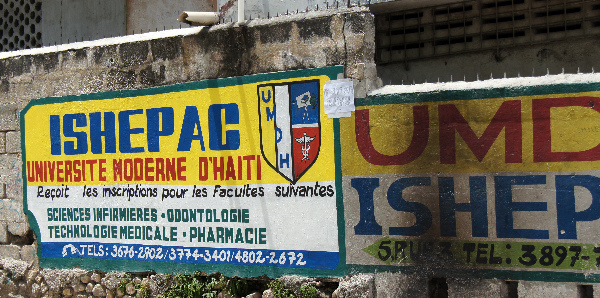
What about these schools in Port-au-Prince?

For students looking for a dissertation topic in anthropology and education: what about all these schools in Port-au-Prince?

a school in Haiti
Photo by Herve Varenne

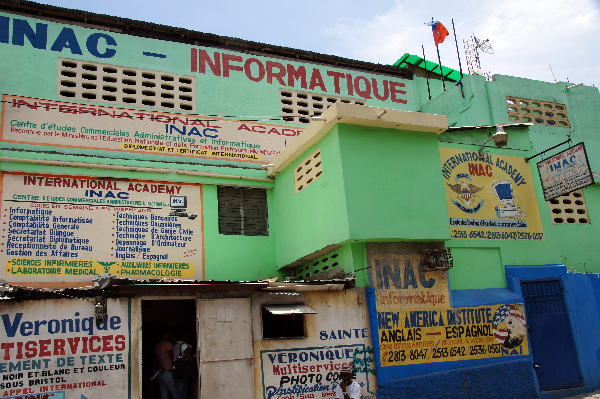
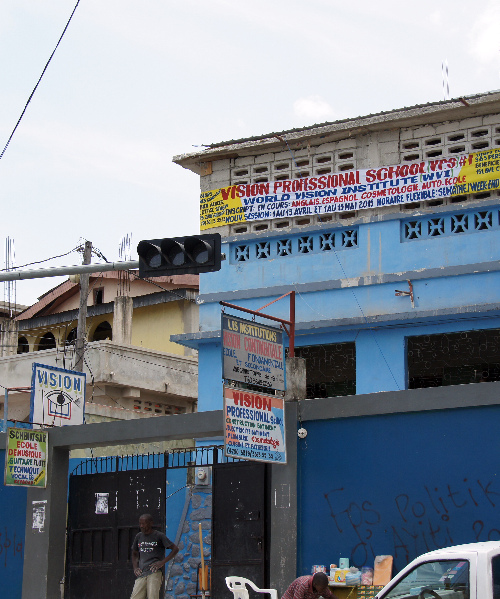
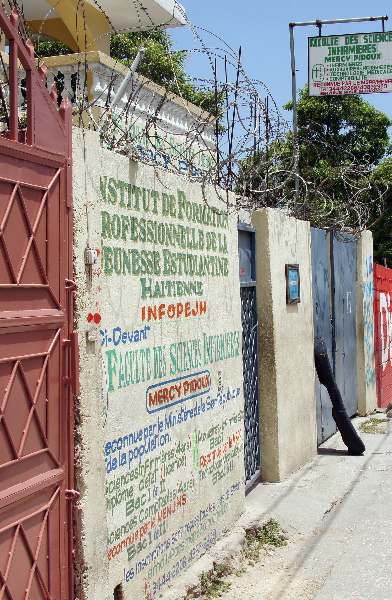
This may have been my second surprise after I landed in Port-au-Prince and took a walk between the Hotel Olufson and the Champs de Mars: what about all these schools?  The walk down Rue Capois is about 15 blocks.  There are about one school every other block.  There are at least as many on the parallel Avenue Christophe and, I found out many many more in the neighborhood southwest of the hotel where I was driven.  This area is but a small area of the city and so I have no sense of what is happening, school-wise, in the rest of the city.

A few of these schools are clearly marked as governmental like the Lycee Dessalines.  Others are linked to a church.  But many more do not appear to be either and they are the ones that fascinate me: who attends? Who organizes? Who set curriculum and pedagogies? Who funds? Who teaches? How are the teachers recruited?  When were they set up? How many are being set up?  How many fail?  How do the students pay? What do the alumni do? Etc.

a school in Haiti
Photo by Herve Varenne

When need ethnographies of something that should blur further the useless distinction between formal and informal education.  These are schools.  They must be formal but not quite in the same manner as state school in Euro-America must be.  They are also the product of an informal process as various entrepreneurs, and people with little access to government schools, come together they “do school” for purposes that may have little to do with “education”–as one’s skepticism makes one imagine.

While shopping for some souvenir to bring back, I had a brief conversation with a young man in charge of the store.  He spoke quite good English (but no French).  I asked him where he had learned.  He gave me the name of a non-governmental school, affirmed he had learned English in three months and that was all he needed from that school.  This made a good story I could not “verify” but it hints at processes that are more akin to those that interest Rancière than to those that interest Bourdieu: if one is to run a tourist business, learning English is essential.  This is an intelligence working at education in an altogether “informal” manner, even if it briefly involved a “formal” step (though I am very curious about the pedagogy used in the school!).

Note that someone I met mentioned the number of people in Port-au-Prince that could converse in Portuguese and other languages brought into Haiti by the United Nations.  How did they do it?

These, of course, are all very poor people who have lived throughout their lives in the most difficult conditions imaginable (very weak governments, misguided help from NGOs and the “international community,” an earthquake, a cholera epidemic, more misguided help further blurring the lines of governmentality).

a school in Haiti
Photo by Herve Varenne

So we need more ethnographies.  And we need ethnographies from other parts of the world if, as I suspect, Haiti is not unique.  Jessica Garber, for example, is doing a pilot project in Phnom-Penh, Cambodia, where she was told there may be thirty “international schools” (for a population of two millions)!  I once heard a fascinating paper on “Crazy English” in China.  I am sure there are many other examples of the ways human beings around the world are taking their conditions and producing instructional “techniques” (in Mauss’ sense) never before seen by humanity.

a school in Haiti
Photo by Herve Varenne

They will help us construct further an anthropology of the world at the beginning of the 21st century.  My hope, as some of the students I have worked with closely know, is not to stop the analysis with a simple call to “globalisation” or “neo-liberalism.”  Labeling epochs by attaching labels to them does do much.  Moralizing about greed, the will to power, or desperation does not do much either.  We must discipline our own motivations so that we can report on what human beings can do.  It will remain the pride of anthropology that it will illustrate what can happen locally when certain forms of governmentality and national sovereignty morph, and thus limit the temptation to over-generalize.

[print_link]

detouring the internet and making it legal

Two news items caught my eyes recently as more examples of the kind of activities I deem “educational” and that I encourage doctoral students to investigate.  Here is another set of “free dissertation topics” to expand our collection of case studies of what so many of our colleagues ignore.

The first item is from Afghanistan, the other from Guinea by way of New York City.  Both deal with people in serious trouble figuring out what are their conditions and trace a path through them (“enunciate their landscapes” to cross-reference Merleau-Ponty/de Certeau’s jargon).  In both cases the people are caught in mid-stream, successful-so-far in surviving, but with no guarantee that the future will be less difficult than their recent past has been.  Watching them struggling can teach us much about the world we, ourselves, also face–for it is the same one they do face.

Afghans working on laptop
Volunteers have built a wireless Internet around Jalabad, Afghanistan, from off-the-shelf electronics and ordinary materials (NY Times, 6/12/2011)

On Sunday June 12, the New York Times reported, on page 1 no less, that “U.S. underwrites internet detour around censors.”  The subject of this headline, not surprisingly is “the U.S.”  The subject is further specified in the first paragraphs as “the Obama administration,” “the State Department,” “a fifth-floor shop on L Street in Washington.”  It is, by the Time standard an “American effort.”  The picture that accompanies the piece, placed smack center at the top of the page, is of two Afghan men and an Apple laptop.  The laptop is set precariously on a chair on a roof.  It is tied to some machines.  One man sitting on the edge of the roof is peering down at the screen, one hand to his mouth, in the classical pose of the person who waits for a computer to complete an important task, or who is trying to interpret what the computer has provided.  The other man is peering into the distance through binoculars.  The legend below the picture says: “Volunteers have built a wireless Internet around Jalabad, Afghanistan, from off-the-shelf electronics and ordinary materials.”

Who are these “volunteers”? How were they trained? By whom? What exactly does it mean to “build a wireless internet”? Who else might also be building wireless internet that bypass state controls?  What are the other controls that may not be bypassed? How does one get an Apple laptop to Afghanistan (and the power to recharge it, etc.)?  (According to Google, there are Apple stores in New Delhi and Lahore, but apparently not in Kabul.)  There are many other subjects there than the “U.S.” and probably a lot of “fifth-floor shops” where the actual possibilities made available to local “volunteers” are explored, exploited, transformed.

The other story implies the existence of other kind of “fifth-floor shops,” this time in the Bronx “where many in New York City’s small Guinean population have blended in among other West African immigrant groups in neighborhoods like High Bridge, north of Yankee Stadium, Claremont and Morrisania” (NYT June 15, 2011).  The story is brief biography of the woman who is accusing Dominique Strauss-Kahn of sexually assaulting her.  The details that struck me are the following:

It is not clear how the woman gained entrance to the United States. In the 12 months ending in September 2002, the United States issued 4,410 visas to Guineans, a vast majority for business trips or tourism, officials said.  But by the time she began her job as a housekeeper at the Sofitel in 2008, she had legal status and working papers, her lawyers said.

village in Guinea
The village of Thiakoulle, Guinea, where the hotel housekeeper who accused Dominique Strauss-Kahn of sexual assault grew up (NY Times 6/15/2011)

How does one get legal status?  How does one do that, in the details of the peoples, bureaucracies, financial resources that must be involved?  How does one figure it out?  One can imagine the moment when it becomes clear that there are routes that can be followed to go from the village of Thikoulle, Guinea, to New York City, the efforts to find these routes among the maze of other routes that would take one elsewhere, and then the struggles to do whatever it takes to actually follow the route, and then, as is still going on for this woman—for there is no end to all this—, to recast one’s plans as one faces new obstacles and new possibilities.  At every moment and point the woman “learned” something and this something became almost immediately moot since the task that had been accomplished would not repeat itself, while new tasks appeared.

In this case, the one matter that would be worth investigating closely is the network of people who are involved in getting “legal status and working papers,” and to sort out what exactly one has to do.  I am sure that the State Department (or is it the Department of Homeland Security…) has web sites with instructions to follow.  But we also know (as per Garfinkel 2002) that these instructions cannot possibly be enough.  The bureaucratic rules have to be translated though not exactly into a different ‘language’.  Rather, they have to be re-written to become useful at the particular moment when a particular person has to perform whatever it is the rule says this person should do next.  Even more important to investigate are the processes when one finds out that the rules exist, and which of the millions of rules is the one a person should pay attention to now whether to imagine a possible route, or to get through the next gate along the way.  Doing something may just be secondary to finding out that it has to get done.