Category Archives: consciousness and knowledge

reflections on the consciousness of experience, whether “practical,” or “discursive” or fully “modeled.”

The ultimate ignorant school master?

[ORIGINALLY POSTED ON FEBRUARY 17, 2024]

One of our doctoral students, Ms. Mako Miura, recently challenged me with a question I had never entertained. We were discussing Jean Lave’s model for learning through participation (1991). We were focusing on some of the examples Lave mentions that point to the asymmetry between those in the “peripheral” position and those in the “full” position. Prototypically, we have an apprentice, initially ignorant but granted the legitimacy to participate, and the master who granted this legitimacy and eventually gets the apprentice to “learn” through participation that which characterizes a particular “shop floor” (to index Garfinkel). I emphasized that Lave is building a “model” to help us through initial analyses of the “educational” (“instructional,” “learning”) aspects of the organization of any floor. And I proposed we approached the encounter between first time parents and their child as just such a floor where a very legitimate participant will be learning everything that already makes this particular “family” (to keep it simple): familial configuration, ethnic or regional particularities, language, “culture.”

As this point, Miura asked: “could we argue that, on this floor, it is the child who is at the center and the parents who are on the periphery as they will have to ‘learn’ parenting?”

I must say that, whenever I have taught Lave (& Wenger)’s book, I have never pondered whether we should also consider the possibility of a feedback learning whereas the apparently “full” person discovers what apprentices are like, how they are learning, and what these apprentices are doing with that. I do not think that Jean Lave (or Ray McDermott with whom I once participated with her in a joint seminar on “ignorance” ) ever considered such a possibility. And yet, particularly if we approach the issue after reading Rancière’s Ignorant Schoolmaster ([1987] 1999), as we did in the class, then the question is one we should take seriously.

The issue is a classic one in cultural anthropology, particularly in the Boasian traditions led by M. Mead and many others who build on what appears to be a common sense generalizations. Here is the way Geertz once put it:

One of the most significant facts about us is that we all begin with the natural equipment to live a thousand kinds of life but end up in the end having only lived one.” (1973, 45)

In other words related to ignorance and knowledge, one starts knowing nothing (but able to learn anything) and immediately gets taught in the language, styles, religion, etc., of one’s population, and infant on an educational floor: who is teaching what to whom and how? thereby limiting further and further what one can do with the rest of one’s life. Cultural anthropology is, also, about the ongoing restriction on possibilities (and the powerful ones reenforcing these restrictions).
Continue reading The ultimate ignorant school master?

on the grounds of instruction into grammaticality

… scholars and other shamans might be as puzzled as two senior professors when they read the title of an edited volume by de Oliveira et al.  It goes: Multiliteracies in English as an additional language classrooms (2021).  As members of the audience addressed by this volume, they wondered whether there was a typo someplace, whether the title was ungrammatical or proof of bad editing, whether it was an attempt to Joycean play or a form of Jabberwocky.

Then a less senior professor pointed out that “English as an additional language” is to be treated as a package as it is the current proper way to say what used to be said as “English as a second language.” Thus the title should be parsed as “Multiliteracies in EAL classrooms” and is thus fully grammatical. It is also indexes that the authors are up to date in expected academic education research writing about the topic. The whole thing is normal and orderly and it allows for two senior professors to be shown ignorant and in need of an EAL teacher. And it also allows for a suspicion that they were being somewhat disorderly and in need of instruction into the appropriate.

Given that the two professors pride themselves on their work on literacy, language, culture, power, etc., they could not just stand corrected. They also had to wonder what exactly is grammatical in English and how it is established. If, as someone quipped a long time ago, a “language” is a dialect with an army—as well as schools of education, school teachers and other institutions in charge of publicizing the proper or normal (orthography, word order, pronominal usage, etc.), then one may wonder how this army exactly does its work of ordering the normal when so many keep disordering it. If, as another great man once said “here comes everybody,” what will they do when they arrive?

So, I write:
“Ignorant education research one university faculty member blog writer says…” that he expects this string of nouns to be taken as acceptable, proper, normal (as well as pedantic) and does convey that “one writer of blogs who is member of the faculty of a university famous for its research is also ignorant …” I keep seeing such strings in the titles of articles in the New York Times, as well as in scholarly publications. Stringing nouns for titles must thus be considered “grammatical” in English. However, it is essential to note that it is not grammatical in the other “language” I “know” well: in French where, for example, “faculty member” must be rendered as “membre de la faculté” (and NOT as “faculté membre”). It is also essential to note that people with decades of speaking English (one who got to it as an “additional” language, and one for whom it has been the only one) can be puzzled by such strings.
Continue reading on the grounds of instruction into grammaticality

Experiencing life and constructing a local “next”

If a “lived experience” is one that one has, personally, experienced, then I have never experienced COVID (the virus). I have experienced Corona (the cultural epoch) but, to the extent that I have never been sick from the virus, and have not even ever tested positive (so far?), then the virus is something I only know through conversational and textual means: I have talked a lot about it with many people. I have read a lot about it. And I have written about it. I have experienced the pressure to explain myself when (not) wearing a mask. In contrast, these past few months I (lived) experienced open heart surgery or, more precisely, the weeks leading up to it, and the recuperation after it: anesthesia does make it impossible to experience the surgery itself!

Various authorities requested that I be tested and this has happened such a number of times that I have lost count. Those requests (actually orders) concern, in my analysis, Corona as cultural fact. As for the virus, I’d say that my experience is, at most, “vicarious” or, in jargon, “entextualized.” I do know people who had close relatives who died. I do know people who were seriously sickened. I also know people who tested positive and showed (“experienced”?) no symptoms. But this “knowledge” is conversational—that is I was told about these cases but did not have to deal with them personally
Continue reading Experiencing life and constructing a local “next”

“Lived experience”: mind and words

In recent years, students have heard me wince when they talk about “lived experienced.” “Could there be ‘dead experiences’?” I quipped. But they persisted as they are well aware of the terms one must use to pass as a well-educated participant in current academic intellectual life.

For a full philosophical argument that is said to have inspired Derrida, Ricoeur and Latour, see Bachelard on fire (1949) or closets (in [1957] 1964).
Still, perhaps I am wrong in dismissing something that appeared late in my career. Maybe it is about the mystery that, after eating a banana (living the experience of pealing a banana, putting it in my mouth, chewing it, wondering whether it is under ripe or over ripe, etc.) I can talk about the eating (as I am doing now) but cannot actually tell anyone who has never eaten a banana what it tastes like. Try explaining the difference between blue and green to someone who is color blind, or the difference between velvet and silk (or the various types of silk) to someone who has never touched any of them.

During the “culture is text” Derrida moment in my anthropological career, I ranted against those who appeared to say that all is words, that there is no “center” behind the words, and so on. When eating the banana we are not eating the word even if the word is all we have to communicate with other human beings about the eating.  There is something about the world that is not constructed (at least not by the experiencing human who had nothing to do with a construction).

Continue reading “Lived experience”: mind and words

Saussure, thought, bodies and expression

September 20, 2021

Last week, I introduced students to the short passage in Saussure on “linguistic value” ([1915] 1966: 111-122 ). The high point of this passage is the illustration of the segmentation of thought. Saussure on the segmentation of thoughtI had always dismissed the easy and common critique for the apparent mentalism of the explanatory paragraph. I always took all this as a model drawn to make us think (…), rather than as the description of a state of being or of some substance. Still, one cannot take Saussure literally when he writes:

 this quote about the absence of “pre-existing ideas” is the basis for the extreme elaboration  by Derrida in Grammatology,.  This elaboration may be based on a misreading and yet had a massive consequence in the development of “deconstruction” and “post-modernism.”
“Without language thought is a vague, uncharted nebula. There are no pre-existing ideas, and nothing is distinct before the appearance of language…. Thought, chaotic by nature, has to become ordered in the process of its decomposition.([1915] 1966: 112)”

We now know, post Freud et al., as well as Bourdieu et al, that, as Geertz once put it:

“A century-and-a-half of investigations into the depths of human consciousness … have uncovered vested interests, infantile emotions, or a chaos of animal appetites, ([1967] 1973: 112)”

or a Bourdieu did, our psyches (personalities, identities) are shaped by:

“disposition inculcated in the earliest years of life and constantly reinforced by calls to order from the group, that is to say, from the aggregate of the individuals endowed with the same dispositions, to whom each is linked by his dispositions and interests” ([1972] 1977: 14-15). ”

So, our brains are not just “a vague, uncharted nebula.” But brains are not actually Saussure’s concern. What he wants us to ponder is: how are we to tell what our brains are signaling?

One student wondered, quite properly, about music as a medium possibly particularly well suited to express what we are experiencing, and better at this than words. I agreed with the sentiment, and taught the usual instance of the Saussurian (and Boasian) analysis by using our experience of light vs. the naming of the light into “colors.” Anthropologists have debated about this a lot more than about music (or the experiences produced by our other senses since we are now talking not solely about “brains” but also about “bodies”). This may be proof of anthropological “ocularcentrism” (a new distinction I just discovered in the long catalogue of Western epistemological biases). As I wrote this and started thinking further about the other senses, I remembered my wonder at how specialist try to describe the taste(s) of wine . “classic expression of Cabernet Sauvignon, displaying dark fruit notes of raspberry, currant, and blackberry jam with subtle hints of cocoa.”
All our senses participate in producing our experience of life–including, and this is where anthropologists, as well as Saussurian linguists, add something essential, our experiences when finding out that we are not hearing well, not seeing some colors, or tastes when the (in-)ability has been labeled and then made consequential by a governing (hegemonic) institution or another. That is, not only do we experience what our senses are signaling but also our positions in the many social worlds we also live by.

Given all this, what is it Saussure can continue to tell to students apprenticing themselves to anthropology? That telling our experience, and imagining that of others, involve segmenting it into units that have a “form” but not a substance. “Green/blue,” “blue/red,” “(not) on the autism spectrum,” “getting an ‘A’ rather then a ‘B’ on a test,” all do much more (and much less) than communicating something about our visual acuity, our political affiliation, mental health, education.

And the segments produced by language are always:
. Arbitrary (not motivated by function)
. Arbitrary (the product of an institutional “arbiter” whether a king or obscure “authorities”)
. Drifting and in need of reconstruction
. Making history in an altogether Marxist sense

[more on this]

References

Bourdieu, Pierre   [1972] 1977     Outline of a theory of practice. Tr. by R. Nice.. Cambridge: Cambridge University Press.

Derrida, Jacques   [1967] 1997     Of Grammatology. Baltimore: John Hopkins University Press

Geertz, Clifford   [1967] 1973    “The cerebral savage.” in The interpretation of cultures.. New York: Basic Books. pp. 345-359.

[print_link]

Constructing the virus and the defense against it in the Corona epoch

On March 5 2020, I left New York City headed for California. I was to give a series of lectures along the way. I had recently read about a virus that was agitating the media. My university announced that “nonessential events … would be cancelled.” Three days later I did lecture at Indiana University, and then at Wisconsin and at a college in Minneapolis. And then I was told that all other lectures had been cancelled. I continued driving West, noticing how various governors were responding. On March 29th, as I was threatened with having to spend 30 days in my hotel room, I drove back home where I locked myself up in my house. I was by then fully caught into what I will keep calling the “Corona” epoch officially known, in American Corona speech, “the Covid pandemic.”

A year later to the day, I received the second dose of the Pfizer vaccine. In one year, the world population went from “discovering” (experiencing for the first time, bumping into…) something new to finding a way to live with that which was discovered so that it does not hurt too many people any more. But, of course, to talk about “world population” is to beg all questions about who did what when for me (and now hundreds of millions of humans) to get vaccinated. Who would do what had to be distributed on the basis of earlier distributions. Sorting out this distribution and its synchronization, is something that should not be guessed or assumed. It must be investigated, in details.

So let’s play at modeling as a guide for future research:

Continue reading Constructing the virus and the defense against it in the Corona epoch

On fishes, water, and consciousness

It would hardly be fish who discovered the existence of water. (Kluckhohn 1949: 11).

If we describe a community as an ecological system we describe it not as the members of that community themselves think of it. They are ignorant of a science of ecology. (Redfield 1960: 32)

Could it be that the fish do know much about just what, about water, makes the most difference as they continue swimming? (Varenne 2019: 25)

Recently, a student wondered how I could write what I did about fishes swimming in their water and quote Redfield approvingly (at least in general).

The issue is even more complicated if we add another version of the underlying issue concerning consciousness and knowledge:

The anthropologist will be dealing on the one hand with raw phenomena and on the other with the models already constructed by the culture to interpret the former. Though it is likely that, …, these models will prove unsatisfactory, it is by no means necessary that this should always be the case. As a matter of fact, many “primitive” cultures have built models of their marriage regulations which are much more to the point than models built by professional anthropologists. Thus one cannot dispense with studying a culture’s “home-made” models for two reasons. First, these models might prove to be accurate or, at least, to provide some insight into the structure of the phenomena; after all, each culture has its own theoreticians whose contributions deserve the same attcmion as that which the anthropologist gives to colleagues. And, second, even if the models are biased or erroneous, the very bias … are a part of the facts under study and probably rank among the most significant ones. (Lévi-Strauss [1952] 1963: 282)

In many ways I do not have much to add to Lévi-Strauss beyond trying to make more concrete what we might do if we are inspired by what he says about “home-made models” (a phrase I prefer to “models constructed by the culture”). How would we, anthropologists, recognize a “home-made model”?

As an easy example, I will follow Lévi-Strauss’s lead about models of marriage regulation and quote a statement about marriage by one of America most authoritative institutions, the Supreme Court:

No union is more profound than marriage, for it embodies the highest ideals of love, fidelity, devotion, sacrifice, and family. In forming a marital union, two people become something greater than once they were. (2015 Last paragraph of the Obergefell v. Hodges, written by Justice Kennedy)

In my own work, and building on Schneider (1968), I used such statements in Americans Together (1978) to argue that “in America” “love” trumps all. I also emphasized that “love” is only one part of a model that also includes discourses and practices about “individualism” and “community.” I would probably write all this differently now but I would still say that, for people in the United States (the fish) experiencing their condition (water) when deciding whether to applaud or resist the Supreme Court, “love” remains the problem/solution that shapes practices and, particularly, disputes about practices. And so, I was not surprised by the Supreme Court’s decision, and even less by its justification.

Of course, many if not most social scientists, and not just Marxists, would question working with what they might label an “ideology” that masks “deeper” structural matters, and produces hidden consequences. Lévi-Strauss does argue that the same practices might be modeled differently and stresses that the differences themselves are useful for further investigation and analysis. Individualism/community/love is also neo-liberalism depending on how one models American practices.

How to handle such differences is something for another day. For now, I am just going to refer to Supreme Court opinions as an instance of (native) “discursive consciousness.” That is, writing such a statement, living with it, and resisting it, must involve and trigger “consciousness” by about any definition of consciousness. No fish swimming in American waters can fail to take into account the discourse and its practical consequences (even if, should the Marxists be right, this discourse mask properties of the water to which these fishes are blinded).

There is also what I call “practical” consciousness. This is the consciousness revealed by the actual practices of those who might not produce a discursive account of their experience. An easy example (based on something I overheard in the street):

Child (excitedly): “Mom, I singed yesterday, and it was great”
Mother (somewhat sternly): “Dear, say I ‘SANG’ yesterday.”

As all ethnographies of speaking with young children have demonstrated, parents all over the world intervene to require some change in the way the child is speaking. In other words, a parent (older sibling, etc.) will invoke some rule (and there are many!) about “speaking well” even if this parent could not produce a grammar of the language (and even less the full panoply of usage customs it would take long “ethnographies of speaking” for an anthropologist to produce).

Such moments of correction are ubiquitous and are probably the basic method for maintaining any arbitrary (e.g. ‘irregular’ verbs in English). There are many more some might find more significant as to ground any way of life. One example of this would be the generations of farmers in Bali who developed the complex agricultural practices that sustained millions over century (Lansing 2006). What exactly the farmers (and priests, rulers, etc.) “knew” about their ecology and technologies is a question that generations of colonial administrators and development specialists dismissed—to catastrophic consequences in some cases when the local populations followed the very discursive consciousness of those who esteemed themselves as experts. By every measures, the local “models” proved more useful than those developed by these others. In this case Redfield, though correct in principle as far as the “science of ecology” is concerned, is quite wrong in terms of survival requiring complex technological solutions involving a large crowd of people.

At this point one could bring to bear Ranciere on the wisdom of shoe-makers, or Gramsci on “organic intellectuals.” One might also note that there is great value in the specific form of consciousness (knowledge) developed in what is variously known as the “West,” “Euro-America,” the “Global North.”

To go back to the metaphor, it may be that the fish do not have a discursive consciousness of the water to the extent that … they cannot speak! However, everything about them, including the way they swim in the various waters this or that kind of fish might encounter, will tell much to the observer that the observer might not easily notice. And, of course, given that human beings are not fish, and that they do speak, what they say about their conditions is essential, even if it is not the last word on the matter—as they themselves might acknowledge as they dispute what they should do in some future.

References

Lansing, J. Stephen   206     Perfect order: Recognizing complexity in Bali. Princeton, NJ: Princeton University Press. 2006

Lévi-Strauss, Claude 1963 “Social structure.” Tr. by C. Jakobson and B. Schoepf. in his Structural Anthropology. New York: Basic Books. pp. 277-323.

Schneider, David [1968] 1980 American kinship: A cultural account. Chicago: University of Chicago Press.

Varenne, Hervé 1977 Americans Together: Structured Diversity in A Midwestern Town. New York: Teachers College Press.


[print_link]
High tech creationism?

One of the many after effects of Trump’s election has been an altogether astonishing flowering of high fallutin exercises in cultural analysis.  I particular enjoy those who play with popularized (populist?) deconstructionism.  So, let’s join the (deep?) play.

Most of my own intellectual education has been plagued by the fundamental mis-readings of Saussure and Lévi-Strauss led by Derrida ([1967] 1978) and others.  In various ways if have tried to write against deconstructionism, sometimes specifically (1994),
and mostly by implication.  And yet, I have also felt party to many of these debates, particularly when they involve plays with “facts” and fiction, truth and relativism, history and narratives, and indeed the nature of reality (ontology?).

So, when the New York Times, as it regularly does, plays with “truth … that is always changing” (NYT, “How to fix the Met,” 3/1/2107) I could not resist tweeting and playing with the Times nemesis (and vice versa)—the author of the wonderfully truthy “truthful hyperbole.”

Sam AltmanWhat I then found out in another exercise in cultural analysis was worth more than a chuckle. It involves an extended metaphor on Silicon Valley idealistic and nihilistic ontology (as reflection on the nature of being, existence, and reality).  This one comes from one of these mythical young white men that can claim, as does his Wikipedia page, that “the total valuation of Y Combinator companies has surpassed $65 billions”(read on March 2017). This young man is Sam Altman and the piece was written by Tad Friend of the New Yorker (October 2016 issue).

A few sentences from this piece were picked up by multiple media outlet under such titles as “Tech billionaires think we live in the Matrix and have asked scientists to get us out” (CNBC, 10/7/2016) or “Many of the world’s richest and most powerful people, including Elon Musk and Bank of America, think that we live in a simulation of the real world” (Independent, 10/6/2016)

I found this thread after coming to a not clearly authored page where the writer wonders about such “bizarre events” as the mistake at the Oscars, this year’s Super Bowl, and, of course, Trump’s election.  So, he (I will caricature him as male, but I am not sure) wonders whether:

“we are living in the Matrix, and something has gone wrong with the controllers. This idea was, I’m told, put forward first and most forcibly by the N.Y.U. philosopher David Chalmers: What is happening lately, he says, is support for the hypothesis that we are living in a computer simulation and that something has recently gone haywire within it. The people or machines or aliens who are supposed to be running our lives are having some kind of breakdown. There’s a glitch, and we are in it. [Such events] makes no sense at all in the ‘real world’.

There may be not merely a glitch in the Matrix. There may be a Loki, a prankster, suddenly running it. After all, the same kind of thing seemed to happen on Election Day: the program was all set, and then some mischievous overlord – whether alien or artificial intelligence doesn’t matter – said, “Well, what if he did win? How would they react?” “You can’t do that to them,” the wiser, older Architect said. “Oh, c’mon,” the kid said. “It’ll be funny. Let’s see what they do!” And then it happened. We seem to be living within a kind of adolescent rebellion on the part of the controllers of the video game we’re trapped in, who are doing this for their strange idea of fun. (crystalinks.com 2/26/17)

As written by Ted Friend, the statement attributed to Sam Altman on “two tech billionaires have gone so far as to secretly engage scientists to work on breaking us out of the simulation” is a paraphrase rather than a quote, and is not the main point of the piece.  But it is the sentence that caught the eye of many journalists in the United States and England.  I guess, it is “fun news” (somewhere on the continuum towards “fake news”).

Actually, it may be “fake news” that Sam Altman, or any of the other billionaires mentioned, actually “believe,” in the strong sense of the verb, that we are living in a Matrix-like simulation, whether run by wise aliens or trickster adolescents.  No sane person would believe that, would they?  Maybe Altman was just burnishing his image as not only a monument to successful greed but also as Silicon Valley seer and (pop) philosopher.  America has produced many such billionaire seers.  Altman will not be the last.

What is more interesting to me is that Altman is channeling a long and very real strain in Western philosophy: the idealism most extremely stated by Bishop George Berkeley in the early 18th century.  Most analysis of the Matrix movies prefer to mention Descartes (Plato, etc.) but Cartesian doubt was about epistemology (how to we know?) rather than ontology (how is ‘is’?).  In the 20th century, the early Derrida proposed a new version of classical ontological idealism when he wrote that, and I paraphrase, “there is no center that can escape the play of discourses” (1967: 411).  All is discourse (language).  There are no “hors-textes” (outside text) that might take us away from language.  Popularized, this late 20th century idealism can be developed in further texts affirming that we cannot be sure that an experience of snow falling outside a writer’s window has not been “written” by some very clever programmer and fed directly into some imperceptible artificial reality goggle: the Matrix.  Reality IS a text, written in mysterious algorithms.

There is of course no way to, rationally, disprove this hypothesis since the very arguments against it could have been written by the clever programmer.  The hypothesis seems to me equivalent to the biblical creationism that estimates the age of the universe at something like 6000 years: all the evidence that it is older (dinosaurs, echos of the Big Bang) could easily have been written by God into what only looks like a record of earlier events.

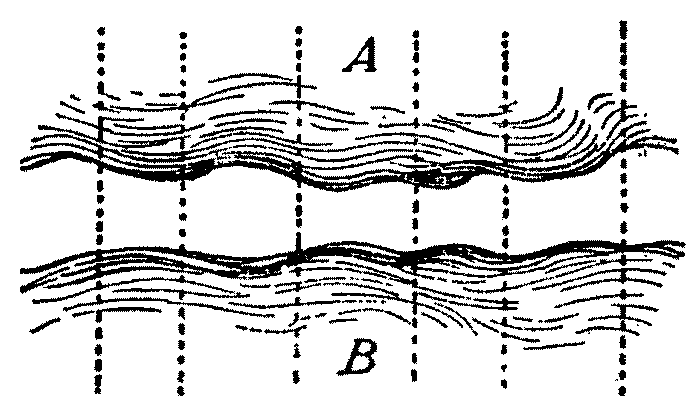
Now, of course, there are other ontologies that are well captured by Saussure’s wonderful, and easy to mistranslate, diagram about the segmentation of continuums ([1915] 1966: 112). Saussure on the segmentation of thoughtThere, the wavy lines are an attempt to capture the mystery that language imperfectly reveals as it works at representing this mystery using the vagaries of human affordances (vocal box, faces and arms, etc. Not to mention a peculiar brain).  If any of this was “designed” it was not by an efficiency expert.  As Merleau-Ponty once said, and I paraphrase and expand, “meaning is in the silence between the words” ([1969] 1973: 43).  Mystery is not empty.  Stuff (good and bad) happens.  Or, as another wise man put it:

There are more things in heaven and earth, Horatio,
Than are dreamt of in your philosophy.
Hamlet to Horatio Hamlet (1.5.167-8) ).

References

References

Derrida, Jacques   1967 [1978]    Writing and difference. Chicago: The University of Chicago Press

Merleau-Ponty, Maurice   1973 [1969]     The prose of the world. Tr. by J. O’Neil. Evanston, IL: Northwestern University Press.

Saussure, Ferdinand de   1966 [1915]     Course in General Linguistics. Tr. by W. Baskin. New York: McGraw-Hill.

[print_link]

While reading Rancière’s Althusser’s Lesson

Last week, I read Rancière’s tract against Althusser (Althusser’s lesson [1974] 2011) and Karen Velasquez’s first full dissertation draft.  The first has almost mythical status in the scholarship on Rancière.  And I looked forward to the second for its promise (now about fulfilled) of giving us more of the kind of work we need to produce what Rancière started calling for in the late 1960’s and throughout his career as philosopher and polemicist.

What struck me most in Althusser’s Lesson is that it is a kind of time capsule of a time when, as a 20 year old, in May 1968, I looked in much bemusement at the antics of my fellow college students and their impenatrable marxiscist discourses.  Soon most of us went on vacation; I left for the University of Chicago; and I about forgot about “Mai ‘68″ as it faded into myth.  It took me a long time to realize how much of an event the two or three years that led to the riots, strikes and evaporation of whatever it had been, had been for many of the elite French intellectuals of the time.  As I kept reading “May ‘68 established that Sartre bested Lévi-Strauss in the debate the latter had waged in La pensée sauvage.”  What reading Rancière (very long after the events have receded) has given me is an opening on another debate that raged in the late 1960s and early 1970s among the Marxist intellectual elites between, to simplify following Rancière, those who wished to work through the Parti Communiste Francais as against the Maoist “gauchistes.”  As Rancière wishes us to see, this was a fight among the elite of the intellectural elites about another fight (that of the students and the workers of the time) about which this elite knew very little–given that all their practical knowledge was designed to produce … future readers of Marx in elite universities! (Reading Capital being, of course, the title of the book by Althusser to which Rancière contributed as a student).  This elite was produced by the series of famously difficult examinations that lead to admission to the Ecole Normale Supérieure.  The list of famous alumni (Sartre, Merleau-Ponty, Lévi-Strauss, Foucault, Bourdieu, etc.) is altogether astonishing: I do not think there is anything like it in the United States and perhaps the world.  How can one institution be so powerful?

The debate was also conducted in a particularly abstruse language which only advanced students in philosophy and Marxism could decipher.  Reading 1974 Rancière reminded me why I was so relieved and satisfied reading ethnography at the University of Chicago in September 1968.

What then struck me—and it is deeply buried—are Rancière calls to pay attention to what the workers and students were actually saying in the 1960s, in the sites and at the times of their struggles.  The whole weight of Rancière’s argument is brought to bear against Althusser’s stance that they could not possible know what produced their struggles, that their discourses revealed their misconceptions, and that only the “scientific” analysis that intellectual Marxists would conduct could reveal conditions and the appropriate discourses.  There, of course, is the Rancière who, later, uncovered Jacotot—and could finally write without tiresome disquisitions about bourgeois sociology (the worst insult he hurls at Althusser is that he was just another Durkheimian!).

Two quotes:

In Besancon, however, when Lip workers began to speak, what they put forward was a coherent discourse about their practices.  There were none of the words, cries of indignation or formulaic sentences that leftist practice cuts from the discourse of revolt and pastes onto the discourse of the spokesperson for the universal proletarian.  What they gave us, instead, was a veritable theory of what they were doing, a theory where the ideas of May 1968 joined hands with the syndicalist tradition, but also one where we recognized a new kind of ‘fusion’: that of the experience of the workers’ struggle with a Christian ideology that yearns, it seems, to be something other than ‘the sigh of the oppressed creature’. ([1974] 2011: 120-1)

‘When the prisoners begin to speak’, Foucault says, ‘they possessed an individual theory of prisons, the penal system, and justice.’  It will be pointed out, certainly, that prisoners are in a privileged position to theorize their condition. ([1974] 2011: 120)

{Note that the quote from Foucault conversation with Deleuze (1972) has a somewhat different tone from his discussion of the Panopticon in Discipline and Publish.}

Of course, I take the comments about the striking workers of the Lip clock factory as a call for detailed ethnographies of workers discourses in the sites of these discourses. Rancière, of course, never said that (that I know) and may have been skeptical of any activity that smacks of social scientism—including ethnography, I’d bet.  This is a frontier we need to explore.  This is where Karen Velasquez’s dissertation comes in.  As some of you know, it is about people from Latin America and Korea getting to work together in Queens restaurants.  What is wonderful about the work—and I do not want to steal her thunder—is her revealing, in detail, what Rancière assumed we would find: complex analyses of conditions, of what can be done about them and with them—in the here and now of various difficulties, in the short and perhaps even longer run.

Spontaneous masses and the consciousness of the “educated representatives of the propertied classes.”

Last week, a discussion of Bourdieu in my doctoral seminar led me to recall something I must have learned as a spectator in the French politics of the 1960s.  I remembered rather vaguely as concerning the leadership position of the Communist Party in the struggles of the working class and, particularly the position of intellectuals in the Communist Party.  I am not much of a scholar of Marxism, but I remembers something about the “leading edge,” but could not come up with a citation or an author.  Later in the week one of the students, Laura Bunting, challenged me and I turned, as we intellectuals now do, sometimes with some shame, to Google.  In three or four steps ‘“leading edge”’, ‘communism’, ‘proletariat’ led me to a discussion of the following passage from Lenin:

“We have said that there could not have been Social-Democratic consciousness among the workers. It would have to be brought to them from without. The history of all countries shows that the working class, exclusively by its own effort, is able to develop only trade union consciousness, i.e., the conviction that it is necessary to combine in unions, fight the employers, and strive to compel the government to pass necessary labour legislation, etc. The theory of socialism, however, grew out of the philosophic, historical, and economic theories elaborated by educated representatives of the propertied classes, by intellectuals. By their social status the founders of modern scientific socialism, Marx and Engels, themselves belonged to the bourgeois intelligentsia. In the very same way, in Russia, the theoretical doctrine of Social-Democracy arose altogether independently of the spontaneous growth of the working-class movement; it arose as a natural and inevitable outcome of the development of thought among the revolutionary socialist intelligentsia. In the period under discussion, the middle nineties, this doctrine not only represented the completely formulated programme of the Emancipation of Labour group, but had
already won over to its side the majority of the revolutionary youth in Russia.”
(Vladimir Ilyich Lenin What Is To Be Done? 1901)

I suspect that Bourdieu’s readers could be assumed to be so well versed in Marxist scholarship that he did not have to quote Marx or Lenin when he started writing about “méconnaissance,” and the role of the sociologist.  For another systematic critique of the stance, look at Rancière’s The philosopher and his poor (2004 [1983]).