Category Archives: schooling and the production of class

comments about the educational activities that might lead to the production of what will later be identified by sociologists as “social class.”

Transporting school into home

I rarely find a New York Times analysis that echoes something I wrote. On October 1, 2020, Carina Chocano did just that in a piece  on “Distance learning, with shades of big brother.” This was triggered by a wonderful awful video on what little girls should NOT do when Zooming school.
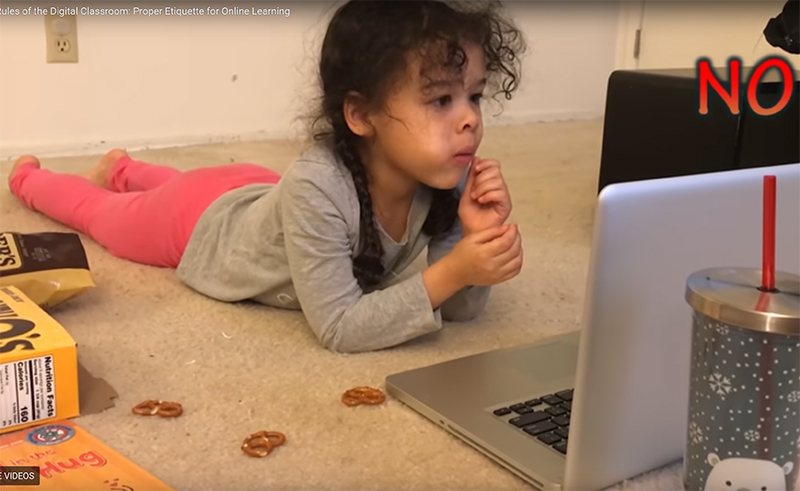
young girl doing school at home via Zoom
do not eat while Zooming for school

As Chocano points out, this video is nor really addressed to 5 year old girls, but rather to her parents.

Why would such a video be necessary?  Why does it make so much sense for school people to tell parents to watch it?

A long time ago (1984), McDermott and I wrote about a well known chore of 20th century modernity: “homework” that is school work to be performed at home. As children continue to do all their school work at home anthropologists should wonder anew about the relationship between home and school.  In 1984,  we argued that family education looks nothing like school education. In general, the organization of family education will always evolve through mechanisms that centralizing authorities cannot fully direct—even as they attempt to do so. Simply put, school teachers are licensed by the State, family teachers are not. School teachers are disciplined by assistant principals or “inspectors” (as they are called in France) to check whether they enforce the currently approved curriculum or pedagogy. Parents, in contrast, cannot be routinely disciplined-thus perhaps the need for a video on how to do school at home.

Our main goal in the 1984 paper was to highlight the reality of family education and particularly the paradox that this education shapes the actual performance of “homework” and easily trumps what the School attempts to do.  We were also trying to investigate an alternate, ethnographic and ethnomethodological, route to the analysis of the great school mystery: why is it that an institution designed to mitigate birth privilege as been such at failure at doing so.  Since the late 1960s at least, “big data” social scientists have established that the most powerful predictor of school success is family organization (Coleman 1966: 218ff).  Half a century later, not much has changed. How can that be?

The most common answer is the one Chocano learned in college.  As she tells us, while watching the video she was reminded of prisons and “big brother.” She then goes on to quote Michel Foucault about disciplining the body of children-as-pupil  to make “docile bodies” who “internalize” the discipline into adulthood and parenthood when they will reproduce it.   She might also have quoted Bourdieu on the production of an “habitus”  without noticing that reproduction through internalization is an altogether wild hypothesis.   This is not Chocano’s fault.  She was probably not taught that Foucault had radically discounted all evidence that the (let’s say French) State (of, say, the first half of the 20th century), however centralized and hegemonic over its provinces essentially failed in its task. The French State did discipline speakers of Provencal into speakers of French (as happened to my grandparents) and it did punish those who refused to send their children to school. But this State, like all other states, failed to so discipline families in their internal organization.  The State and its wardens (to develop what Foucault does not quite tell us is a metaphor) could not prevent families from appearing to satisfy wardens and inmates that they should not punished while they actually escaped the fate the institution prepared for them.

Readers of Foucault and Bourdieu should now focus on this failure of the School to control families.  McDermott and I, as cultural anthropologists have done since Boas at least, were trying to do by documenting the multiplicities of alternate ways families found to do what their schools was trying to discipline them to do.  In the language of the video, they did eat while doing homework, they danced when they should have been sober, and they doodled in the margins of their workbooks (like the little girl does when she fills a comment box with unicorn emojis!).

What I would now say McDermott and I were also doing was bringing out the way school work at home threatens internal familial dynamics and thus requires specific family work to encompass what the School requires. Transporting school into home makes a crisis that those who make this home must then deal with.  By proceeding in this fashion, from crisis to observation of the work of re-ordering, we were doing what anthropologists have always done and was made by Garfinkel into a fundamental methodological tool: we use disruption in the habitual to get a better sense of that particular order some human beings try to live by.  They rarely did.  But we are now living just such a crisis and it can tell us much about many of our institutions including, of course, all institutions in their educational roles.

As I argued earlier, C19 does not close schools, only some people can do this and, in the process, produce the local orders I label “Corona.”  But, as it is daily made evident, Corona, anywhere that it is getting institutionalized, is made up of different practices depending on whether one is acting as an agent of the School (say a person-as-teacher Zooming) or whether one is doing so as an agent of one’s family (say this teacher-as-parent setting up a child’s Zoom). Interestingly, the production channels are more complex as State agencies are themselves organized so that the part of the State dedicated to public health can impose matters on that other aspect of the State designed to shape schools and maintain this shape.   By enforcing the injunction “Stay Home! Stay Safe!” public health official created a crisis for school  governors who had little choice but to transport school into family.  And, as these governors knew well, by doing this they were also relinquishing much of their disciplinary methods … thus the production of a video that is clear evidence that these governors know very well that children-as-children will do all the things marked as “NO!” on the video (and much else that would not be shown on a “family-friendly” video).  And they know that their parents may let them do these NO things.  Parents may organize their child so that he could, should he decides to do it on his own, explore the Siberian Socialist Republic one one monitor while School Zoom drones  on the others.
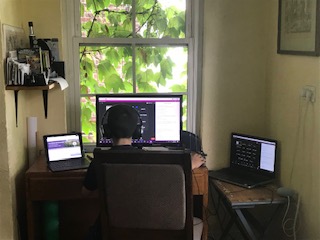
young boy doing school at home via Zoom
exploring the Siberian Socialist Republic while Zooming to school on another monitor

That parents may organize their children do what the school say they should not do may or may not be a problem.  As an anthropologist, I always err in the direction of celebrating the human capacity to find ways through crisis no other human being can imagine. One might even say transporting school into home is a step towards “deschooling” society (Illich 1970).  And yet, as a child of three centuries of “democratic” revolutions I also understand the concern about the reproduction of birth privilege through family processes that trump school processes.  Access to three monitors and a desk of one’s own is not something many parents can do.  C19 is also an occasion and justification to radically distance one’s children from all sort of undesirables to the parents—they might carry diseases! There was a good policy reason for “public” schools that radically separated children from their parents and local communities. Whether the aftermath of Corona will lead to a return to this kind of schooling that was already on the way out is something an anthropologist cannot say.

References

Coleman, James      1966 Equality of educational opportunity. Washington: U.S. Government Printing Office.

Foucault, Michel   [1975] 1978     Discipline and punish. Tr. by A. Sheridan. New York: Penguin Books.

Illich, Ivan 1970 Deschooling society. New York: Harper & Row.

McDermott, R.P., S. Goldman and H. Varenne   1994     “When School Goes Home: Some Problems and Defensive Tactics,” Teachers College Record. 85: 391-409.

[print_link]

On grades as statements: to whom?

Ray McDermott and Jean Lave once told me that they asked Rancière whether his writing influenced his teaching.  As they tell it, he looked surprised and answered something like “not at all!”  A reader of Successful Failure once asked me whether I still gave grades.  Besides stuttering, I said something like: “I am required to (by my university and New York State)” and/or “students would not accept my not giving them grades.”

Continue reading On grades as statements: to whom?

On education on Lake Wobegon

Everytime I introduce my work with Ray McDermott, I echo something he probably says more eloquently than I: “What schools all about? They are about determining which 50% of children are below average!”  Given that much of this is done through testing, and that the good test “discriminates,” then I sometimes say, to provoke, that schools are all about discrimination.

Such statements grab the attention of students, but I am not always quite convinced that the answer is more than a provocative quip.

And then I read paragraphs like one that introduced a recent story in the New York Times:

Ohio seems to have taken a page from Lake Wobegon, where all the children are above average. Last month, state officials releasing an early batch of test scores declared that two-thirds of students at most grade levels were proficient on reading and math tests given last spring under the new Common Core requirements. (October 6, 2015)

The story is of course not about how successful the schools of Lake Wobegon or Ohio are.  The story is about “the problem that a lot of policy makers and educators were trying to solve,” as “Karen Nussle, the executive director of the Collaborative for Student Success, a Common Core advocacy group,” is quoted as saying.  As summarized by the New York Times, “The Common Core was devised by experts convened by state education commissioners and governors to set uniform benchmarks for learning. … But as the results from the first Common Core tests have rolled out, education officials again seem to be subtly broadening definitions of success.”

In other words, as McDermott and I argued, success if indeed defined by failure (1998).  It is necessary to fail students in order to demonstrate that other students are successful.  It cannot be that all children (or even most, or even more than some measure of the average) should be “proficient.”  The label must apply only to a certain percentage.

The “debate” (though the New York Times is not really debating as the article clearly sides with Common Core policy makers) is thus about labels, statistical uniformity, comparability across the United States—and forms of unacceptable tinkering if not cheating.

The debate is not about learning, and even less about education.

“Only in America” am I tempted to say, except that, actually, there is something interesting going on here that a call to political theories of cultural arbitrary (as all theories of culture, from Boas onwards have been, when taken strictly) should highlight.  The story is also about a political struggle among the elites about precisely how America should work, in general, and in the detail of the lives of politicians, schools administrators, principals, teachers, parents and other adult who might express opinions or vote about all this—not to mention university professors designing tests, billionaires funding “school reform,” union leaders and many others.

I make this list to bring attention to the evidence that all these people, in the worlds that they inhabit will talk and act in ways that will often make problems for each other, and that they will do that purposefully (systematically and deliberately to cross-reference Cremin and my take on “education”).  In relatively neutral language they are conversing (which is not quite the same thing as “negotiating”) often with the hope of producing something different than the probable or expectable.  They are not simply acting in terms of their dispositions (habitus, etc.).

I make the list also to move further than where Ray McDermott and I were when we completed Successful Failure.  As Jill Koyama (2008) noted, we mentioned “America” but did not quite show how it actually produced what we observed, in temporality.  We had essentially worked by drawing a structural model of a historical moment (“culture”) that emphasized the relationship between democracy, meritocracy, the institutions that they produced, and the consequences for individuals (to simplify of course).  We were directly inspired by Louis Dumont (1980 [1961]) on the relationship between individualism and racism.

This kind of (Lévi-Straussian) structuralism can be helpful, but it never was able to specify how what was modeled actually came into reality in the day to day life of those caught by the culture.  So, more or less explicitly, social theorists implied or stated that what was modeled was real and powerful enough to generate what could be observed.  McDermott and I wrote extensively against this move to “structuring structures” (to quote Bourdieu’s jargon).  But we did not quite find a way to state how the democratic fight against birth privilege ends up producing discriminatory tests, the failing of teachers who do not “add value” to children and all other policies justified by calls to the discovery and reward of individual merit.

Thus my interest in following what the New York Times reports, and how it writes its reports.  I take these as statements within a conversation, in the same spirit as McDermott wrote about Rosa’s “I could read it”: the statement makes sense given the conditions but it is not produced by the conditions.  The conditions are set by earlier statements, most of them made by other people, far away and long dead, as McDermott and I like to say.  But the actual statement (act) is produced by a particular person, caught together with specific persons (consociates), at a given time.  In that perspective, it makes sense for bureaucrats in Ohio to move the boundary between proficient or not.  And it also makes sense for others powers-that-be to try and move it back.

What of course no theory of culture can answer is “why should it make sense?”  except perhaps if “a” culture (epoch, episteme, …) is understood, again, as a statement making sense in terms of earlier statements (culture…).  Thus, the shift to democracy, meritocracy, schools, testing, might be seen as a response to earlier discourses and institutions for elite production.  How to move the conversation to its next statement is our problem, as political actors and, I would say, as educators attempting to convince various audiences that they are on a track that may only make matters worse.

References

Dumont, Louis 1980 [1961] “Caste, Racism and ‘Stratification’.” Chicago: The University of Chicago Press.Tr. by M. Sainsbury. Rev. ed.. In his Homo hierarchicus

Koyama, Jill 2010 Making failure pay: For-profit tutoring, high-stake testing, and public schools. Chicago: The University of Chicago Press.


What about these schools in Port-au-Prince?

For students looking for a dissertation topic in anthropology and education: what about all these schools in Port-au-Prince?

a school in Haiti
Photo by Herve Varenne

This may have been my second surprise after I landed in Port-au-Prince and took a walk between the Hotel Olufson and the Champs de Mars: what about all these schools?  The walk down Rue Capois is about 15 blocks.  There are about one school every other block.  There are at least as many on the parallel Avenue Christophe and, I found out many many more in the neighborhood southwest of the hotel where I was driven.  This area is but a small area of the city and so I have no sense of what is happening, school-wise, in the rest of the city.

Continue reading What about these schools in Port-au-Prince?

on college education, snake oil, and Silicon Valley

My readers and students know my skepticism about the financial, or human capital, “value” of college education (December 12th, 2012; April 18th, 2013).  And they know I quote a lot of “anecdotal evidence,” including from my immediate family.

My point of departure often was a column by Thomas Friedman of the New York Times who echoed academic arguments, often from economists, about this very value.  This of course has been powerfully amplified by national politicians, cheered by universities dependent on student loan guarantees.

So it may interesting to wonder about the possibility that the conversation about college is entering a new phase.

For Friedman is now being educated by Google and he is wondering about what Google is doing might lead:

LAST June, in an interview with Adam Bryant of The Times, Laszlo Bock, the senior vice president of people operations for Google — i.e., the guy in charge of hiring for one of the world’s most successful companies — noted that Google had determined that “G.P.A.’s are worthless as a criteria for hiring, and test scores are worthless. … We found that they don’t predict anything.” He also noted that the “proportion of people without any college education at Google has increased over time” — now as high as 14 percent on some teams. At a time when many people are asking, “How’s my kid gonna get a job?” I thought it would be useful to visit Google and hear how Bock would answer. (How to Get a Job at Google, Part 2: April 19 2014)

Continue reading on college education, snake oil, and Silicon Valley

While reading Rancière’s Althusser’s Lesson

Last week, I read Rancière’s tract against Althusser (Althusser’s lesson [1974] 2011) and Karen Velasquez’s first full dissertation draft.  The first has almost mythical status in the scholarship on Rancière.  And I looked forward to the second for its promise (now about fulfilled) of giving us more of the kind of work we need to produce what Rancière started calling for in the late 1960’s and throughout his career as philosopher and polemicist.

What struck me most in Althusser’s Lesson is that it is a kind of time capsule of a time when, as a 20 year old, in May 1968, I looked in much bemusement at the antics of my fellow college students and their impenatrable marxiscist discourses.  Soon most of us went on vacation; I left for the University of Chicago; and I about forgot about “Mai ‘68″ as it faded into myth.  It took me a long time to realize how much of an event the two or three years that led to the riots, strikes and evaporation of whatever it had been, had been for many of the elite French intellectuals of the time.  As I kept reading “May ‘68 established that Sartre bested Lévi-Strauss in the debate the latter had waged in La pensée sauvage.”  What reading Rancière (very long after the events have receded) has given me is an opening on another debate that raged in the late 1960s and early 1970s among the Marxist intellectual elites between, to simplify following Rancière, those who wished to work through the Parti Communiste Francais as against the Maoist “gauchistes.”  As Rancière wishes us to see, this was a fight among the elite of the intellectural elites about another fight (that of the students and the workers of the time) about which this elite knew very little–given that all their practical knowledge was designed to produce … future readers of Marx in elite universities! (Reading Capital being, of course, the title of the book by Althusser to which Rancière contributed as a student).  This elite was produced by the series of famously difficult examinations that lead to admission to the Ecole Normale Supérieure.  The list of famous alumni (Sartre, Merleau-Ponty, Lévi-Strauss, Foucault, Bourdieu, etc.) is altogether astonishing: I do not think there is anything like it in the United States and perhaps the world.  How can one institution be so powerful?

The debate was also conducted in a particularly abstruse language which only advanced students in philosophy and Marxism could decipher.  Reading 1974 Rancière reminded me why I was so relieved and satisfied reading ethnography at the University of Chicago in September 1968.

What then struck me—and it is deeply buried—are Rancière calls to pay attention to what the workers and students were actually saying in the 1960s, in the sites and at the times of their struggles.  The whole weight of Rancière’s argument is brought to bear against Althusser’s stance that they could not possible know what produced their struggles, that their discourses revealed their misconceptions, and that only the “scientific” analysis that intellectual Marxists would conduct could reveal conditions and the appropriate discourses.  There, of course, is the Rancière who, later, uncovered Jacotot—and could finally write without tiresome disquisitions about bourgeois sociology (the worst insult he hurls at Althusser is that he was just another Durkheimian!).

Two quotes:

In Besancon, however, when Lip workers began to speak, what they put forward was a coherent discourse about their practices.  There were none of the words, cries of indignation or formulaic sentences that leftist practice cuts from the discourse of revolt and pastes onto the discourse of the spokesperson for the universal proletarian.  What they gave us, instead, was a veritable theory of what they were doing, a theory where the ideas of May 1968 joined hands with the syndicalist tradition, but also one where we recognized a new kind of ‘fusion’: that of the experience of the workers’ struggle with a Christian ideology that yearns, it seems, to be something other than ‘the sigh of the oppressed creature’. ([1974] 2011: 120-1)

‘When the prisoners begin to speak’, Foucault says, ‘they possessed an individual theory of prisons, the penal system, and justice.’  It will be pointed out, certainly, that prisoners are in a privileged position to theorize their condition. ([1974] 2011: 120)

{Note that the quote from Foucault conversation with Deleuze (1972) has a somewhat different tone from his discussion of the Panopticon in Discipline and Publish.}

Of course, I take the comments about the striking workers of the Lip clock factory as a call for detailed ethnographies of workers discourses in the sites of these discourses. Rancière, of course, never said that (that I know) and may have been skeptical of any activity that smacks of social scientism—including ethnography, I’d bet.  This is a frontier we need to explore.  This is where Karen Velasquez’s dissertation comes in.  As some of you know, it is about people from Latin America and Korea getting to work together in Queens restaurants.  What is wonderful about the work—and I do not want to steal her thunder—is her revealing, in detail, what Rancière assumed we would find: complex analyses of conditions, of what can be done about them and with them—in the here and now of various difficulties, in the short and perhaps even longer run.

On parents and school success, again

Nothing new for many of us in this summary of sociological research:

“Family income is now nearly as strong as parental education in predicting children’s achievement.” (Reardon 2011: 5)

Note the “now” for a study that essentially tells us that not much has changed since the Coleman report.  This rhetorical move may be what attracted the New York Times who highlighted the study at least twice since it was published.

I missed Reardon’s study when it was published, as well as the first editorial essay published in the Times about it.  The April 27th “Opinionator” piece by Reardon is thus not quite “news” but it does confirm the trend about what is to count as “fit to print” knowledge.  Reardon himself, as an academic sociologist on the faculty of the School of Education at Stanford, of course knows that what he is observing is not a new phenomenon and his paper is a good source for a brief history of the sociological research on family and school performance.  I will use the paper the next time I teach my course on family and education.

Continue reading On parents and school success, again

Spontaneous masses and the consciousness of the “educated representatives of the propertied classes.”

Last week, a discussion of Bourdieu in my doctoral seminar led me to recall something I must have learned as a spectator in the French politics of the 1960s.  I remembered rather vaguely as concerning the leadership position of the Communist Party in the struggles of the working class and, particularly the position of intellectuals in the Communist Party.  I am not much of a scholar of Marxism, but I remembers something about the “leading edge,” but could not come up with a citation or an author.  Later in the week one of the students, Laura Bunting, challenged me and I turned, as we intellectuals now do, sometimes with some shame, to Google.  In three or four steps ‘“leading edge”’, ‘communism’, ‘proletariat’ led me to a discussion of the following passage from Lenin:

“We have said that there could not have been Social-Democratic consciousness among the workers. It would have to be brought to them from without. The history of all countries shows that the working class, exclusively by its own effort, is able to develop only trade union consciousness, i.e., the conviction that it is necessary to combine in unions, fight the employers, and strive to compel the government to pass necessary labour legislation, etc. The theory of socialism, however, grew out of the philosophic, historical, and economic theories elaborated by educated representatives of the propertied classes, by intellectuals. By their social status the founders of modern scientific socialism, Marx and Engels, themselves belonged to the bourgeois intelligentsia. In the very same way, in Russia, the theoretical doctrine of Social-Democracy arose altogether independently of the spontaneous growth of the working-class movement; it arose as a natural and inevitable outcome of the development of thought among the revolutionary socialist intelligentsia. In the period under discussion, the middle nineties, this doctrine not only represented the completely formulated programme of the Emancipation of Labour group, but had
already won over to its side the majority of the revolutionary youth in Russia.”
(Vladimir Ilyich Lenin What Is To Be Done? 1901)

I suspect that Bourdieu’s readers could be assumed to be so well versed in Marxist scholarship that he did not have to quote Marx or Lenin when he started writing about “méconnaissance,” and the role of the sociologist.  For another systematic critique of the stance, look at Rancière’s The philosopher and his poor (2004 [1983]).

an education into Ritalin for college success

I am an altogether avid reader of Discover, a magazine about “Science, Technology, and The Future.” I find something interesting in almost every issue. Sometimes it is a bit of new knowledge interesting for its own sake. Often it is because it provides a brief glimpse of the actual doing of science, and thus help think further about the anthropology of science, and also anthropology as a science. Quite regularly, in recent years, it gives me a sense of a journalistic discourse about matters at the edge of science and politics–particularly, on the one hand in the common articles about ecology, global warming, etc., and, on the other hand, on human evolution and sociobiology,

In the April 2009 issue I found in passing a little of Americana directly related to my arguments about the uncontrolled education of the officially ignorant. In an article on “Building a better brain” (the title is not ironic, and gives a sense of the editorial attitude towards the story) that discusses about the great things “mind-altering drugs” might do for humanity, they write:

In a study published last year in Pharmacotherapy, researchers at the University of Maryland found that of 1,208 college students, 18 percent took ADHD medications like Ritalin and Adderall even though the drugs had not been prescribed. You might think the college students were taking stimulants mostly to party, but that is not what the researchers found. The students were taking the stimulants mainly to help with studying. (Baker, 2009)

The story is written in the “brave new world” discourse of enhanced possibilities (“Think of millions of workers in India or China cognitively enhanced with neuropharmaceuticals. Will the United States be able to compete?”). The original study took the opposite tack. The paper ended with warnings to physicians and parents about “overuse and/or diversion of stimulant drug” (Arria, Caldeira, O’Grady, Johnson, & Wish, 2008, p. 266).

Neither wondered about is my perennial question (Varenne 2008, 2009): where do the students find out about these drugs? What sort of conversations do they have about them? To whom do they talk about it? That is, how do they educate themselves about these drugs? What is the place of the race for school of success in these discussions?

Continue reading an education into Ritalin for college success