This year marks the 50th anniversary of the publication of one of many field defining papers by Clifford Geertz: “Religion as a cultural system” ([1996] 1973).
Last week, I asked students to read it. As I prepare the class, I saw again a quote I had marked but saw in a slightly different light as I also read the final draft of something I am writing with Michael Scroggins currently titled “Does (a) culture recapitulate itself?”. It is actually about the Phoenix like nature of the “culture of poverty” argument. The paper starts with a complaint I have made elsewhere against the move among the leaders of anthropology to distance themselves from “culture” (concept? ideal-type?). I had not noticed that Geertz was already complaining about what may then have been the beginning of the distancing:
The term “culture” has by now acquired a certain aura of ill-repute in social anthropological circles because of the multiplicity of its referents and the studied vagueness with which it has all too often been invoked. (Though why it should suffer more for these reasons than “social structure” or “personality” is something I do not entirely understand.). ([1996] 1973: 89)
More importantly, I had not noticed what follows as Geertz develops what looks very much like a definition:
In any case, the culture concept to which I adhere has neither multiple referents nor, so far as I can see, any unusual ambiguity: it denotes an historically transmitted pattern of meanings embodied in symbols, a system of inherited conceptions expressed in symbolic forms by means of which men communicate, perpetuate, and develop their knowledge about and attitudes toward life. Of course, terms such as “meaning,” “symbol,” and “conception” cry out for explication. ([1996] 1973: 89)
The American culture of the “culture of poverty” is alive and well. New York Times journalists still quote approvingly professors who tell them: “The poor lack two things: money and cognitive freedom.” And it appears that a major State actor, “the Obama administration,” relies on such experts for designing policies aimed at changing the behavior of those who do not act according to economic rationalism (e.g. do not save more for old age).
While preparing the class I taught at the Faculté d’Ethnologie of the Université d’État de Haiti, I stumbled again on one of those sentences that make Rancière so powerful:
Language does not unite people. On the contrary it is the arbitrariness of language that makes them try to communicate by forcing them to translate—but also puts them in a community of intelligence. (Rancière [1987] 1999 : 58)
Haiti, of course, is famous for a creole forged by the need to translate what others from around the world, often with the worst of motivations, were saying and then to do whatever new conditions might allow (a successful war against a colonial power), or require (a devastating earthquake). Living together in such conditions will put people in a “community of intelligence”—and will keep them there, at work, for a creole forged by contingent circumstances will itself become a language, Creole, that is arbitrary by its very nature as a language and so cannot unite people as it forces them, again, to try and communicate, try and survive in the new conditions of which it is now a part.
I thought about all this when reading Jonathan Katz’s passionate account of the 2010 earthquake and of the many blunders of the “international community” who ostensibly “came to help” but may have made things much worse (Katz 2013). Much of what he had to say about the famous (Bill Clinton, Sean Penn) and the less famous politicians, policy makers, staff of NGOs, confirmed what I started learning through Scott Freeman’s dissertation on the role of NGOs in the non-development of Haiti’s rural population. This, I learned, is now a theme in the anthropology of NGOs and their environmental impact.
One passage in Katz’s book struck me particularly. It has to do with the figures generally quoted by the “international community” regarding unemployment in Haiti. As Katz say, most of what Haitian actually do does not count as employment. Graphically, who in this photograph is employed? (besides the photographer)
Photo by Hervé Varenne
At least four of the seven people visible are clearly active making something (it is not clear what the others are doing). Everything is orderly. The garbage is bagged, debris is piled, the tires are stacked. In the background, there is what appears like a repurposed state school into an “Institut Superieur” and/or a “Centre de Formation Appliquee.” Even the advertisement of what may be an expensive mattress required extensive work to put it there. Putting it here, in a not very prosperous neighborhood, is an act of multiple arbitrariness: Who put it there? Who is the intended audience? What do the people in the photograph make of it?
Looking at the picture made me think of Kiran Jayaram’s dissertation (Columbia 2014) on Haitian migrants to Santo Domingo: determined intelligence in the worst of conditions when physical survival is immediately at stake.
About all the streets of Port-au-Prince I drove through are lined by such stands as in the photograph. Are they classified as “small businesses” rather than “employment” in certain statistics? The important thing is that the stands are there, with the people who put them up, and the people who use them, together at work. Katz reports that they reappeared in the first days that followed the earthquake even as the people were actively digging for survivors, and then reconstructing—when they were not hindered by efforts to help that create more catastrophic conditions, and more moments for the convening of “communities of intelligence.”
When the arbitrary occurs (earthquake, food distributed here but not there, diseases imported, new languages added to the mix, etc.) human beings will get together and translate. It is time to pay attention and bring out intelligence over disfunction, achievement over failure, heroic bricolage over engineering deficiencies.
Publicizing this work has to be the way to counter “culture of poverty” approaches to the plight of people in dire condition, whether in Haiti or elsewhere.
References
Katz, Jonathan 2013 The Big Truck That Went By: How the World Came to Save Haiti and Left Behind a Disaster. New York: Palgrave Macmillan
Ray McDermott and I were discussing, in our usual meandering way, the possible roots of Dorothy Holland’s work and what may or may not fairly be described as “psychological anthropology.” We wondered about d’Andrade and Romney, their relationship to the Parsonians and Boasians. As we veered into sorting out the various versions of Schneider’s writing about culture, I spotted on my bookshelves a book I had forgotten: Kluckhohn, Murray and Schneider’s Personality in nature, society and culture. This collection of papers from the preceding decade was first published in 1948. A second edition appeared in 1953. My copy is the thirteenth printing (dated 1971) of this edition. All this must be a testament to its use as summary of a field. This is not surprising given that the contributors include about everybody who was somebody then: R. Benedict, A. Davis, J. Dollard, E. Erikson, R. Havighurst, J. Henry, F. Kluckhohn, D. Lee, M. Mead, R. Merton, T. Parsons, H. Powdermaker, J. Whiting, and many others. This is the moment of convergence that coopts Boasian anthropology into the Parsonian scheme and transforms it into a simple concern with the shaping of personality.
In the book, there are papers on about everything that the editors classified as “determinants of personality formation” (36 if the 46 papers). That psychological anthropologists should worry about such “determinants” is probably what made me turn away from the field in graduate school and ever since. It may also be what Holland and many others are fighting against when they write about multiplicities of emergent identities.
But I think there is something to learn by wondering how it made sense for so many of the most influential sociologists and anthropologists of the 1940s to teach with such authority about “determinants of personality” and the corollary impact of formed personality on future behavior. I mention three papers. Two may be stereotypical. One stands outside. Continue reading The collective conscience of ‘personality’ in anthropology: 1948-1998→
Thanks to Beau Bettinger who sent me the following link (to something in the New York Times, no less) to a review of research entitled: Escaping the Cycle of Scarcity
The research quoted is “experimental” in just the way Geertz imagined all experimental research proceeded (1973: 22): given a constant (making decisions about alternatives) various conditions (prosperity/poverty) appear to make a difference thereby leading to an inference about the processes at work (cognitive overload). Nothing about this research makes sense, whether the concepts, the operationalization, the tests, or the inference. (And we will have to continue criticizing every one of these steps in this kind of research.)
Q: So what does an anthropology grounded in Boas/Garfinkel propose instead?
A: Any versions of what the powerful team Michael Cole once assembled proposed and conducted.
Jean Lave, a constitutive member of this team, has recently (2011) given a wonderful account of the steps she took, in the 1970s, to respond to Cole’s challenges. For several years, she re-designed alternate means of observing the activities of tailors. Again and again she revised what she had to do in her next field trip. And so she revealed matters, conditions, practices, that cognitive psychologists could not have imagined, that would resist conceptualization, and that, precisely, could not be transformed into a (correlational) theory–in the “grounded theory” sense. The point was to “make work visible” in the felicitous title of recent book edited by Whalen and Szymanski (2011). And, in the process, she also revealed constraints and possibilities in the very practical activity of conducting ethnographic research.
To do all this, one does need to imagine situations, to be shared together by the observer and the observed (i.e. ethnographic participant observation), that will reveal the kind of work, its conditions and constraints, that we cannot imagine but that we suspect, for good theoretical work, is taking place.
I have been gratified, over the years, by the number of research projects by students in our programs in anthropology at Teachers College, who have imagined such situations and revealed some possibilities of life in disability, immigration, poverty, that could not quite be imagined. For example, to mention only one among many, when Juliette de Wolfe (2013) spent a year following “autism warriors” she did not just “make available to us answers [to our deepest questions about humanity] that other shepherds, guarding other sheep in other valleys have given” (Geertz 1973: 30). She helped us answer deep questions about producing local and historically specific social orders when faced with dis-abling condition (that includes not only their children’s autism but a whole slew of other matters ostensibly involved in helping child and parent).
The shanty is black within and without … A black woman sits on a log, with half-a-dozen small specimens of humanity about her, and of all shades of black, brown, and yellow… ‘Where is your husband?’ … ‘Dunno, missis, don’t care, he may go to de debbil for I know and cares.’” (E. B. Emery Letters from the South, on the Social Intellectual and Moral Condition of the Colored People (Boston, 1880: 9-10) – as quoted by E. F. Frazier 1966 [1939]: 256)
Thus opens Chapter XVII of one of the most powerful book of the 20th century—as far as family and poverty policy is concerned at least.. Frazier uses here a classic anthropological rhetorical trick many anthropologists continue to use (and which I try to discourage among my students): He quotes a long extract from some text to introduce (illustrate? prove? enlighten?) some analytic statement. At the end of the paragraph following the quote, Frazier tells us “of course, such cases … are not typical” (1966 [1939]: 257). So why start in this manner a chapter discussing uncertain statistics about “illegitimacy among Negroes”? And why should it appear directly after the statement possibly most quoted by people like Moynihan who, twenty years later, expanded on Frazier to make a “Case for National Action’ “to strengthen the Negro family so as to enable it ro raise and support is members as do other families” (Moynihan 1967 [1965]: 93)? Frazier had written: “Family desertion among Negroes in cities appears, then, to be one of the inevitable consequences of the impact of urban life on the simple family organization and folk culture which the Negro has evolved in the rural South” (1966 [1939]: 255)I went back to Frazier and then Moynihan as Ray McDermott and I have been discussing the roots of the “culture of poverty” argument and the failure of the anthropological critique of this argument to have the long term impact we were sure, when we were in graduate school in the early 70s, it would have. In the late 70s and 80s, it was almost too easy to teach the critique. To students, it was simple, Frazier and Moynihan were “racist” and that settled that. Students were often surprised to learn that Frazier was one of the first PhD’s granted by the University of Chicago to Blacks. But learning this did not change much.
What strikes me now is how much the culture of poverty made sense for the most liberal of concerned sociologists and anthropologists, as it had made sense to ladies from Boston such as the “Miss E. B. Emery” (as her name is listed on the title page of her Letters from the South) whose book must have moved Frazier. Like her, they sought and brought out the most pathetic of experiences to justify any analysis of the “roots of the problem” (as Moynihan calls them). It made sense because, as I imagine their political contexts, Emery’s letters, like Frazier’s book (and the dissertation on which it was based), like Moynihan’s Report, are attempts to convince policy makers (from activist women in Boston, to the Congress in Washington) that “we must do something.”
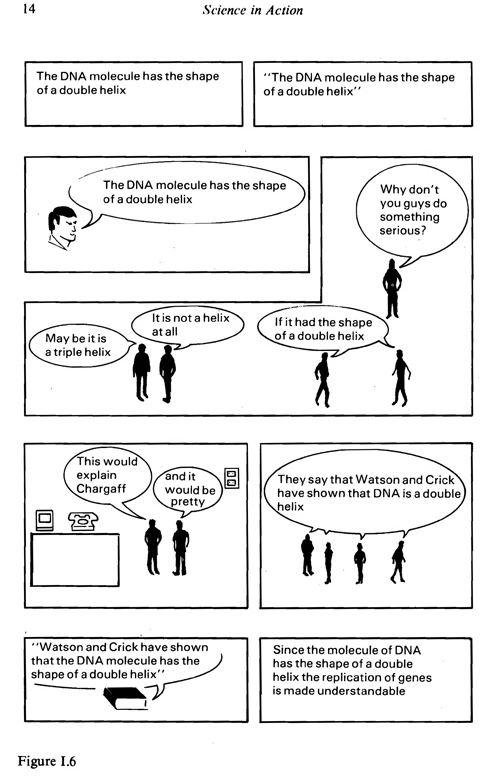
This missionary urge still moves students, like it moves policy makers, and blinds them to the dangers of unanalyzed pathos—particularly when it becomes the opening statement in a long chain of “if/then” argumentation: if the women had seven husbands (“small speciments … of all shades”) then there is something wrong with her; if there is something wrong with her it is because of her social conditions (cue here any version of socialization theory you prefer); given that there is something wrong with her, simply changing social conditions will not be enough to prevent her children from being wrong in the same way as she is wrong; thus, “we” must create programs to help her; but first we must diagnose what exactly is wrong with her… [TO MY READERS: if someone would try their hand at transforming this progression into the kind of cartoon Latour drew for the double helix, I would be most thankful!)
This argumentation can produce volumes of “research,” both fundamental and applied, and policies upon reformed policies along with endless “empirical research” providing “evidence based” suggestions about what “really works.” But what if there is nothing wrong with the woman Emery met? What if her very survival through many men, pregnancies, labors and deliveries, childhood diseases and death, etc., suggest complex strategies involving many people and many modes of acting? I am thinking here of Scheper-Hughes’s portrayal of Brazilian women (1992) and of her acknowledgment of the process that led them her pathos (leading to the urge to help) to understanding. The women were suffering but there is nothing wrong with them and we should not burden them with our pathos. We do not need to develop complex diagnostic tools, and the accompanying enormous bureaucracy, to help the women. As far as the kind of diseases that afflicted many of the children of the Brazilian women, clean water was all that was needed.
The best anthropological response to the culture of poverty argumentation was the accumulation of stories of survival, including the production of local patterns. I am thinking here of Carol Stack’s justly famous All our kin. But, as we found out, these stories are not enough. They get dismissed as “anecdotes,” “just so stories,” and altogether irrelevant to “the problem.” At worst, anthropologists can be accused to undermine policies. One of our student, Karen Velasquez, told me of her dismay when she was accuse of insensitivity to the plight of Mexican migrants in New York City, when she told the wonderful story of a mono-lingual Mexican man learning how to read bar codes in order to stock shelves in a Korean grocery.
In other words, it is not enough to publish alternate “letters from the South” (like Gundaker has done, 1998). We must also justify again why tales of “suitable” adaptation to difficult ecological conditions (to expand on Boas as Michael Scroggins and I have done recently) are necessary for interventions that are sensitive to local conditions unimaginable in their detail. The point of careful ethnography is not only to tell “what other shepherds have said” (Geertz 1973) but, more importantly, when the work is conducted in our own valleys, to help those who would help so that they do not make things even more difficult.
Musings about possibilities in the scholarly life of a professor of education and anthropologist