Category Archives: of the body

Corona as culture

Corona is neither simply juxtaposed to nor simply superposed over COVID-19. In a way, Corona substitutes itself to COVID-19, in another way Corona uses and transforms COVID-19 to realize a synthesis of a higher order.

The above is a translation of the best two sentences about culture and humanity ever written by an anthropologists. In the original Lévi-Strauss ([1949] 1969: 4)) possibly meant it optimistically (Boon 1982: Chapter 4). Translated into the Corona epoch, it may or may not be so. In any event it is essential for an anthropologist to keep the virus (that is the material and biological — C19 here) distinct from the human response (that is the social and cultural—Corona here). The response to C19 produced a “synthesis of a higher order,” Corona that has caught about all 7.8 billion human beings on the planet. For the million and a half who have been identified as carrying the virus, for their kin, and for those who treated them, C19 may be a matter of direct experience. For everybody else, what is experienced is Corona in the reports by the media, in the regulations by government, in conversations among kin, friends, colleagues. As an individual, I am lucky that noone in my first degree network has experienced C19. But we all have experienced, and continue to experience, Corona.

In an earlier post (March 28, 2020) I wrote that C19 might kill you and but it cannot close a restaurant. That is, and against some who wrote that illness is a metaphor (Sontag 1977), C19 is a “thing with agency” (in Latour’s sense). Actually it is a thing that is alive and will change as human responses begin affecting it (through vaccines, etc.). The naming of the virus “Crown,” in Latin, by whomever is, of course, a metaphor based on its appearance under an electron microscope.
C19 is not a metaphor though it will remain something about which metaphor will be made—along with much else in discourse, through speech acts and other means that will much more consequential than metaphors.
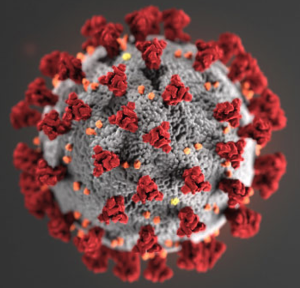
media image of the C19 virus
This is not a virus

The anthropological response to Corona will have to focus minimally on two aspects of the human response: how do humans get to “see” C19 and act directly on it. Most humans will never see it or act on it except for the few whom we can gloss as “scientists.” They will work mightily on that front. Anthropologists of science may or may not be helpful there. Where anthropologists will be useful is in the analysis of the spread of Corona, its consequences, and its evolution as it will morph given what will have been done earlier, and what was done elsewhere.

Consider: on April 6, as I write this, Euro-America is days into “isolation” and “social distancing.” When the regulations for this started depends on the nation-state under which one lives. Similarly, the exact nature of these regulations and their enforcement vary here and there, even though all governors (that is those involved in making the regulations) know what others are doing. In the US itself, resistance can take many public forms: compare the Hasidic in Queens to sheriffs in Idaho
In France, for example, all are required not to move more than 3/4 mile from their house and hand the police, when asked, a written, signed, document explaining why they are out. In New York City, one can still walk or drive to a grocery store or park. In France one can be fined and even arrested for transgressing the boundaries. In New York the policy will break groups of people larger than a few. There are now reports about some governors discussing what will be the modalities of de-distancing. One can be sure that these discussions will be acrimonious, with much disagreement, and that they will produce different measures here rather than there.

In other words, as with everything else that resist human beings, human beings will make culture and will live with what they have made. That is they will make some (many) things that will materially resist them. When Lévi-Strauss wrote about “synthesis of a higher order,” he was not writing about “interpretations” that live solely in the imagination. The synthesis is not a psychological event (though it may have psychological consequences) it is a social one. It takes shape in interaction, through conversation, instruction, punishment if necessary.

The challenge, in the anthropological study of Corona, will consist in figuring out who, in any particular place and at any particular moment, is involved in producing what aspect of Corona. To take the one example of the closing of a restaurant in a ski resort of Wyoming, one would need to trace the acts of the restaurant managers and the consequences for the managers and employees. To take another example, on March 28, I was told by the desk person at my hotel that I had either to leave or stay in my room for 30 days starting on March 30th. I did not investigate whether this was an accurate translation of the town council resolution, nor was I present when the regulation was passed down to the hotel. But, on the basis of the statement, I decided to leave the following day.

Many anthropologists might be interested in “why” I took this decision (or “why” is was in Jackson, Wyoming, of all places). They might look into my early childhood, into my personality or character, or into my identity. Some might emphasized that I had a good car, and that I was healthy enough to make the 4 days trip back to New York. Some might wonder why I decided to go back to New York at a time when everyone was being told that things were terrible there.

All that may be interesting if you are concerned with me. However, as an anthropologists, I am concerned with particular conditions that others make for me in my peculiar conditions.

That is the problem on which cultural anthropologists must continue to work.


References

Boon, James   1982     Other tribes, other scribes: Symbolic anthropology in the comparative study of cultures, histories, religions, and texts.. Cambridge: Cambridge University Press.

Lévi-strauss, Claude   [1949] 1969     The elementary structures of kinship. Tr. by J. Bell and J. von Sturmer. Boston: Beacon Press.

Sontag, Susan   1978     Illness as metaphor. New York: Farrar, Straus and Giroux.

[print_link]

On leaning on an absent Other

Today [July 9, 2019]] is one of these exceptional days in Aumage with almost steady rain, interspaced with rumbling thunder and sometimes a patch of blue sky. There are always two or three of those among the many bright dry summer days that are what one expects of the region. So, this exceptional is normal.

What is missing for me this summer is the Other to whom I addressed, for 47 years, statements of the obvious: “isn’t the ray of sunshine beautiful,” “look at the sheets of rain across the valley, they are coming for us,” “well maybe it will stay over there,” “it’s raining harder now,” “I hope it’s finished by tomorrow because I have a big wash to do,” “of course it will be over! And it will be much cooler.” Nothing of this carried much information. It ranged from the obvious, to the cliche, to the repetitive. And yet this “no-thing” was most salient as some, mysterious, perhaps indicible, Thing on wich I leaned—mostly without noticing it.

What is now missing, technically, is what is called “phatic talk”—a horrible word usually associated with beginnings of communicational sequences (phone calls, e-mail messages) when two parties establish that they are indeed in communication, and that they have now made a “community” of sorts, however briefly. The phatic phase is usually presented in the literature on communication as a brief moment in the movement towards saying or doing “why” the sequence was started in the first place.

But phatic talk (I do need a better word for this!) between long married husband and wife (I am sure this is true of many other relationships) is something else altogether. It still has the property of being actually about “nothing” in that no new information is being passed, and nothing specific gets done. Which may be why it is a kind of talk that is easy to miss … until it is not possible to do it, when the other, in her absence, truly stands out as the most “significant” Other she was for so long. Like what I have read about lost limbs that one still feels, the absent person remains a presence one keeps noticing at the times when one finds oneself leaning on the person, when one turns to her to state the obvious, a fleeting thought to externalize, a commentary on something that just happened.

What does one do, next, when the absence of such very particular, and very significant, Other is noticed, again?

I now understand why some visit the tomb of their now absent Other to tell her, perhaps aloud, of one’s day, of what so and so said or did, of the wonders or horrors in the latest news. This may appear saner than “talking to oneself” (in such a way as to being noticed by others, less significant others, that might become significant if they decide to sanction what they noticed). I know I will be told to find another other with whom to say nothings comfortably. Some will advise me to find concrete things to do (hobbies, bricolage) that will cancel the urge to phatic talk: spending 2 hours getting IIS to work on my Windows computer did work that way. I am likely to follow that advice.

But the dulling the pain, or layering it over, does not negate the reality of the movement of a whole body towards an Other who will never again be there, in the other room, surfing the web, reading theology, compiling shopping lists, calling family members on the phone. This movement may be an old habit (though its exact form changed a lot over 47 years), a “psychological” event for he who is doing it.  But I insist that the movement also reveals the external reality of the other as irreducible presence standing actively and resisting any “social construction” of this Other. Such others (and that there are many who may be more or less significant) are not a figment of the imagination, a social construct imposed by “my culture” (whatever that would be!!). Others who make such a difference that they are missed like severed limbs are both “subject” and “object” of action (“agents”?). They cannot be reduced to psychological shadows or to the historical properties of the “body” (community, polity) that two Others-to-each-Other did construct over their history together.

[print_link]

Taking on (socio-)biologists

Two of my favorite students, Michael Scroggins and (Dr.) Gus Andrews, have been manning (peopling? personing?) the defenses of cultural anthropology against Razib Khan (who “has an academic background in the biological sciences and has worked in software”).  One of Khan’s blog is published under the banner of Discover magazine, the popular science magazine I subscribe to (and which I have quoted in my blog).

Khan once wrote that “I want to aid in spreading the message [cultural anthropology] should be extirpated from the academy” (in bold no less).  Scroggins countered with a broad side against Khan now countered by Khan (and the exchanges continue).  Most of the commenters to Khan’s reply support him against “the anthropologists” except for Andrews who has joined the defense.  Not surprisingly, the issue has been simplified to a question of “believing,” or not, in genetic determinism.  Scroggins more subtle arguments about the production of knowledge have been, mostly, left aside–and particularly the production of anthropological knowledge which, perhaps like the production of biological knowledge, might be left to anthropologists (why not claim the scientific autonomy that is generally granted to the other sciences?).

I have been encouraging my students to engage the (socio-)biologists like Boas did more than a century ago.  Most of our publics are now hostile (including in the social sciences), and many of our colleagues have retreated unhelpfully from modernity into (literary) critical ivory towers.  Particularly to the extent that we might want to influence policy, quite like other scientists have done, then we must be on the offensive.  But how? With what weapons?

When I was in graduate school the University of Chicago, from 1968 to 1972, we laughed when we heard that some of our faculty, when conducting fielwork in the 1930s or 1940s, had been asked to take with them calipers and other anthropometric tools used by the first Boasians to counter the dominant socio-biological theories of the late 19th century.  We were told that none of them ever used these tools. I, personally, have never held them in my hands.  By our advisers’ graduate student times, the arguments had been won and we, a generation later, did not have to become experts in biological theory.

We were wrong.

And we dismissed, with superior shrugs, the publication of E. O. Wilson’s Sociobiology: The new synthesis (1975).  Marshall Sahlins did tackle it (1976) but some of us thought that it was not even worth the effort.  Sociobiology would die of its own.

We were naive, as well as wrong.

And then we went foolish when some of us took literally the metaphor “culture is text.” This metaphor could be used to focus our attention to the detail of semiotic processes, to the very practical act of “writing” (composing, producing) a career, to the production of culture and, indeed, its historical evolution from inescapable pasts to unpredictable futures.  Texts, when they are inscribed in history, are anything but abstractions.  Take the moment when a few human beings became lactose tolerant and spread this tolerance across northern Europe and, later, the Americas.  This development in the history of humanity, granting for the moment the underlying genetic biology, is a significant challenge to any of the disciplines concerned with what makes homo sapiens different.  It implies that biological evolution of the species has not stopped; and it suggests that some events in human history can impact this evolution in unimaginable ways.  Who could have predicted, 10,000 years ago, that the bunch of probably quite sick people who had to drink milk would be so successful, 10,000 years later, that they would impose their language (heavily transformed on the basis of linguistic processes) onto about all human beings over the globe?

Archeologists will have to weigh in.  Did the human beings who moved into the plains of Russia where they had to survive on milk did so because of wanderlust (?)? Were they pushed out by people with better weapons and military tactics?  What sort of kinship systems did they produce?  What political, religious, and moral systems did they develop?  Actually, we may have some information about this by looking, precisely, at the texts that some of these people left us 5,000 or 6,000 later in the Avesta and the Rigveda.

We do need to take the (socio-)biologists very seriously.  I suggest we not do so as political adversaries or on ideological grounds.  This has not worked.  It will not work.  And it would not have worked for Boas if he had not taken the (socio-)biologists with their own tools, with a deep knowledge of their discipline, as well as of the disciplines that would demonstrate the limits of their attempts to deal with human behavior from their perspective.  Which is why, I believe, Boas insisted that anthropologists also understand archeology (history), linguistics (semiotics), and evolutionary biology.  Of course, he insisted that we take on (socio-)biologists through ethnography, that is through the demonstration that what is most distinctive about humanity is not that, for example, we are driven by sexual instincts to mate and reproduce, but that, as Lévi-Strauss summarized, human beings distinguish between parallel and cross-cousins.  Move forward and wonder how the New York Metropolitan area, in the 1990s, would produce both Lady Gaga and Taylor Swift?

Then we can move the conversations with the audiences of (socio-)biologists from the realm of biological abstractions to the realm of, precisely, those facts that are both glaringly human and inexplicable, in their actual detail, in biological terms.  Not that biology is not involved, but that, as Lévi-Strauss once wrote, it has been transformed into something else plausibly labeled “culture” about which (socio-)biologists can say as little as we can say about their field.

constructing the gender of human bodies, literally

In the epoch of the clinic (as per Foucault, and not to challenge readers by writing about “Euro-American culture”) many human beings (we) have learned a lot about the peculiarities of sexual dimorphism (“males” without male genitalia; “females” with same; other chromosomal oddities, etc.) compounded by the mysteries concerning the origin and experiences of sexual attraction (not to mention sexual practices).  How this knowledge became facts in textbooks, the media, the law, and how it spread across miscellaneous populations, is a problem for historians.  Who knows what about all this, practically, at this particular moment in the life of a polity submitted to the regime of the clinic, is a problem for sociologists and anthropologists.  A version of the problem concerns the tracing of what is being done about it and what challenges are then faced given the possibilities that the epoch of the clinic have opened.

This brings me to the surgeons who perform “sex change” operations (search Google for “gender change” operations and find out all references are to “sex change”–another proof of Schneider’s conjecture about American kinship, 1980 [1968]).  It brings me particularly to one set of surgeons who, sometimes in the 1960s, performed the operation on “Agnes” who was made famous by Garfinkel (1967: Chapter V), and particularly on a few lines in a few notes about post-operative issues:

Immediately postoperatively, [Agnes] developed bilateral thrombophlebitis of the legs, cystitis, contracture of the urethral meatus, and despite the plastic mold which was inserted into the vagina at the time of surgery, a tendency for the vagina outlet to contract. She also required postoperatively several minor surgical procedures for modification of these complications and also to trim the former scrotal tissue to make the external labia appear more normal. Despite the plastic mold, the newly-made vagina canal had a tendency to close and heal, which required intermittent manipulations of the mold and daily dilatations. Not only were all of these conditions painful or otherwise uncomfortable but also, although minor, since they were frequent, they produced increasing worry that the surgical procedure would not end up with the desired result of a normal functioning and appearing set of female genitalia. Although these distressing conditions were carefully (and ultimately successfully) treated, at the time that she was well enough to go home these complications were still not fully resolved (Footnote 6)

 Sculpting new genitalia into a human body may be the ultimate in the (social) construction of new realities, the making of cyborgs, and the radical embodiment of a cultural arbitrary (in the service, some say, of making visible the ‘true nature’ of the subject body).  Historically, sculpting the live body (including all forms of plastic and reconstructive surgery), would not be possible in the absence of a host of well-organized people in hospitals, universities, government offices, etc.  And yet, at the moment of the surgery, the body as live object or thing (in Latour’s sense) resists.  Internal mechanisms attempt to heal what any number of cells, glands, and primitive parts of the brain, might interpret as a “wound” to be “healed” by any means necessary–if cells had access to meta-communicational discourses (remember that various parts of the body communicate with each other through many different channels).  Surgeons and nurses are well aware of this and organize themselves to resist the resistance as they use the body’s affordances “against” themselves, so to speak.

At the end, a block of marble, under Michelangelo’s hammers, yields a new David and “we” humans may say that we have won against the world and built a new reality.  But the marble, in its peculiar affordances, remains: what about the missing hormones?  The marble crumbles and museums curators fret.  Wounds heal; surgeons worry; they manipulate and dilate.

So, in effect, can “we” (those who care about such matters) tell David from the marble, Agnes from her body, the raw from the cooked?


Garfinkel, Harold 1967. Studies in ethnomethodology. Englewood Cliffs, NJ: Prentice-Hall.

Schneider, David 1980 American kinship: A cultural account.  Chicago: University of Chicago Press.  [first published in 1968]