Category Archives: parentings

Teachers College and “Family”

From Arts (practical), to Life (psychological), to Education (social) in the attempts to understand and analyze, in order to educate about, perennial concerns with the settings in which men, women, and children meet most intimately and extensively over the course of their lives—in a word “in families.” For a new re-integration.

This post was triggered by my hearing that the administration of the College is considering closing the Center on the Family as Educator. The creation of this Center was, as I see it, one of Lawrence Cremin’s signal academic achievements, I was moved to wonder wherefrom what moved much of my career at TC came from, dialogically. I may transform this into a fuller article.

In 1972, I joined the College into the Department of Home and Family Life, later to become the Department of Family and Community Education. I published much on matters of family and education. I did not necessarily think much about what was sustaining these concerns, institutionally. And so, now, I wonder what TC has been doing with “family” over the past century since it appears it has done much, or little. I wonder what has been included, or indexed. And I wonder whether it should continue to do something about “it” and, if so, what now. This question is partially historical, and partially programmatic.

In my beginning (Fall 1972):
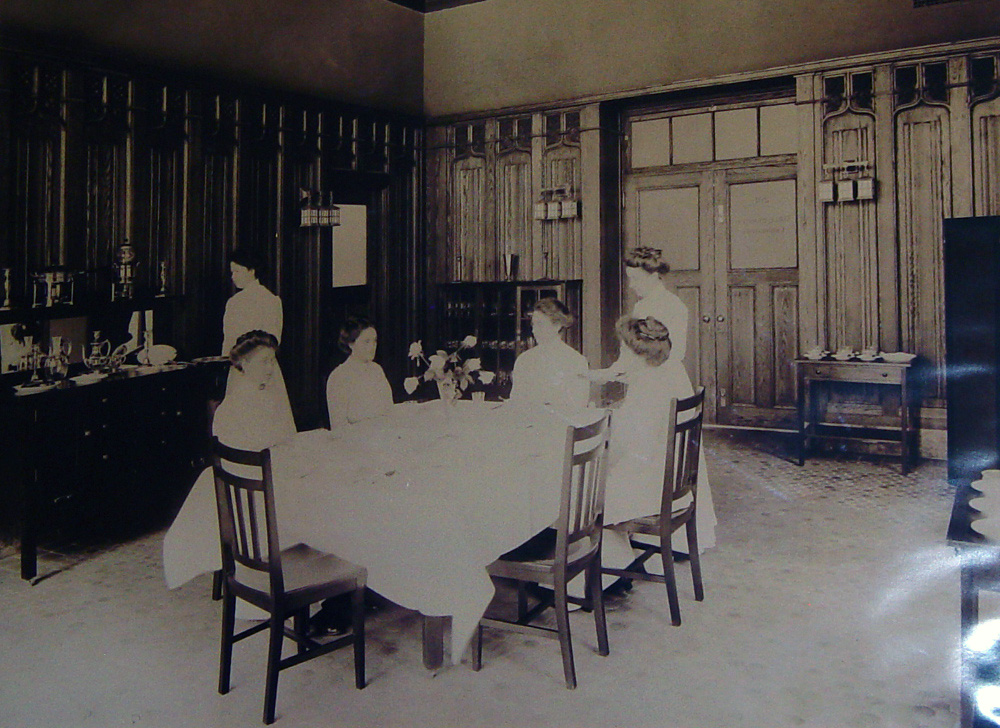
My first introduction to the informal history of Teachers College came when I was shown the closet within which, I was told, were kept the teaching tools of what I did not yet know as “the Table Service Lab.” This closet contained a full set of china and silverware that, by all evidence had not been used for many decades. The department I was joining, “Home and Family Life,” for a reason I did not immediately understand, was the inheritors by default of this closet and its content. young women learning how to serve formal dinnersI was also shown, and often used, the “Tudor Room” which, I was also told at some point was a copy of Miss Grace Dodge’s dining room. I was delighted when, decades later, I found out that this Tudor Room had been the Table Service Lab!
In TC’s beginning(s) (1880, 1884, 1889):
Once upon a time, in those days (1880), some philanthropists in New York, led by Miss Grace Dodge, created the “Kitchen Garden Association” for the “promotion of the domestic industrial arts among the laboring classes … the better to qualify them for domestic service” (Russell 1937: 4-5). Four years later this became the “Industrial Education Association” “to include ‘special training of both sexes in any of those industries which affect house and home directly or indirectly’” (Russell 1937: 9). And then, in 1889, the same principals “incorporated” a subsequent institution “under the name of Teachers College” (Russell 1937: 7). All versions of the history of this institution emphasize the shift to the education of teachers as the best route to helping the “laboring classes” (and particularly the arriving crowds from the poorest, most rural parts of Europe) succeed (survive?) in the United States. Much of the details in this post come from the Cremin, Shannon and Townsend history of Teachers College (1954) but this history does not go in much details about what must have extended and difficult conversations.

Histories of TC then most often jump to Dewey writing about “democracy and education” (in a book that should have been titled Democracy and Public Schooling), to Dewey’s debate with Thorndike, to difficult conversations with Columbia University, etc.

What becomes veiled in these accounts is the fact that some early concerns had not been discarded. It is significant that, among of the first buildings at the Morningside Campus were the building for the Industrial Arts (Macy), and, my focus here, Grace Dodge Hall erected so “that the ennobling arts of the home [would be] taught to coming generations” (from the plaque in the entrance to the building). dedication plaque for Grace Dodge HallWhat is also often veiled is the continued inclusion in the curriculum of matters related to these “ennobling arts.” As late as 1935, the TC catalogue listed in its fields of specialization “Household Arts and Household Arts Education” with courses in “Household economics,” “Cookery,” “Clothing,” “Teaching of Home Economics in schools.”

By 1937 the list of courses included courses in nutrition, health, child development and, most significantly given future history, a course in “family social relations.” Some of these were offered through different departments even as the old department was reorganized into a department of “Home Economics.” This department brought together most of the earlier matters but developed what became its full focus: psychological development and emotional life within a nuclear family. This transformation could probably be traced directly to the concomitant development of both Freudian therapeutic psychology (in its many transformations), and concerns with child development—as well as sociology. Ernest Osborne, who had earned a Ph.D. in Educational Psychology, was appointed in the Department of Curriculum and Teaching in the specialization in early childhood education. He started teaching a course in the “Psychology of Family Relations” (still taught as “Dynamics of Family Interaction”), and then became the prime mover of the new version of the venerable department which became, by 1953, the “Department of Home and Family Life” (Hey 1965: 134-5) . As Osborne put it in 1939:

It was once believed that parent education was a relatively simple thing limited to the instruction of parents in the proper ways of feeding, clothing, and training children . … Today .. . an increasing realization of the effects of relationship between family members on behavior is evident. (Quoted in Hay 1965: 134)

Over in Harvard, Talcott Parsons wrote a soon to become extremely controversial article on the family where women were to hold the “expressive role” in order to socialize children and stabilize adult personalities (1955: 16). Teachers College was again at the cutting edge in the transformation of an academic consensus into an educational program to apply this knowledge.

And then, as more time passed and Teachers College became my world:
I am not exactly sure what happened in the mid-1960s. I was told in my first years at TC, that, after Osborne died, the faculty of the programs in clinical psychology took umbrage at a program which appeared to give doctorate to people who would then engage in (family) therapy away from their own controls. At the same time, Lawrence Cremin got convinced that, as he put it, “education proceeds from many institutions” and particularly from families. He recruited Hope Leichter, a sociologist from the Harvard Department of Social Relations, whom he promoted, made chair of what was still “Home and Family Life” with the goal of transforming it into a department of “Family and Community Education.” This transformation was completed in 1976. Paul Vahanian, the last professor with a family therapy background, was not replaced when he retired. Rather, Leichter, Cremin and the others concerned with the matter invited anthropologists to join the evolving department (me from Chicago, and Ray McDermott from Stanford).

And then, in 1990, Teachers College, that is its administration on the basis of a recommendation by a faculty committee, closed the department and the faculty scattered.

I tell this story to make a point that keeps being obscured or, at best, side-lined: some at Teachers College always insisted that a school of education must pay attention to whatever one might want to call the institutions that take care of children when the children are not in school, or are the resting places of adults when they leave their salaried jobs.

A few at TC, I am sure, may still be willing to argue for what may have moved Grace Dodge even as she accepted that the institution she was fostering would focus on school teaching. It remains that, even in the 21st century, educators should not ignore the people who prepare the children for school, pick them up in the afternoon, clothe them, feed them, put them to bed, manage their health, and control, or not, what they read, what they watch, what they have access to in the social media of their times, etc. There is no point in rehearsing tired controversies about defining “family,” “home,” the “domestic,” etc. The reality is that, after two centuries of reformers proposing a world where children would be raised by the State, none of these utopias have survived long. Everywhere, children escape the State and yet, since the Coleman report at least (1966), and fully confirmed since, their familial experiences can challenge the State. One cannot understand “systemic privilege” without understanding the educative work of families, including their work educating themselves about schooling. This has been one of Ed Gordon (Varenne, Gordon and Lin 2009; Lin, Gordon and Varenne 2010) major contributions as he has been asking us to pay attention to what he has called “supplementary education.” It remains essential that it not be ignored.

In (temporary) conclusion, I wonder: how might we now integrate what is most easily told as a linear history: the joint concerns with the Arts of the domestic (economics, ecology, sustainability), Life with the most significant others (emotions, disabilities, cognition, development), and Education about all this (privilege, resistance, imagination).


Coleman, James et al. 1966 Equality of educational opportunity. Washington: U.S. Government Printing Office. (with et al.)

Cremin, Lawrence 1974 “The family as educator: Some comments on the recent historiography.”  Teachers College Record 76, 2: 250-265.

Cremin, Lawrence, David Shannon, and Mary Townsend 1954 A history of Teachers College, Columbia University. Columbia University Press.

Hey, Richard 1965 “Ernest G. Osborne Family Life Educator.” Journal of Marriage and Family , 27, 2: 134-138.

Lin, Linda, Hervé Varenne, and Edmund Gordon, eds. 2010 Educating Comprehensively: Varieties of Educational Experiences. Lewiston, NY: The Edwin Mellen Press,

Osborne, Ernest 1939 “Widening Horizons in Parent Education,” Teachers College Record, 41 p, 28.

Parsons, Talcott 1955 Family, socialization and interaction process. Glencoe, Ill.: The Free Press.

Russell, James 1937 Founding Teachers College. Bureau of Publications: Teachers College, Columbia University

Varenne, Hervé, Edmund Gordon and Linda Lin, eds. 2009 Theoretical Perspectives on Comprehensive Education: The Way Forward. Lewiston, NY: The Edwin Mellen Press.

[print_link]
The ultimate ignorant school master?

[ORIGINALLY POSTED ON FEBRUARY 17, 2024]

One of our doctoral students, Ms. Mako Miura, recently challenged me with a question I had never entertained. We were discussing Jean Lave’s model for learning through participation (1991). We were focusing on some of the examples Lave mentions that point to the asymmetry between those in the “peripheral” position and those in the “full” position. Prototypically, we have an apprentice, initially ignorant but granted the legitimacy to participate, and the master who granted this legitimacy and eventually gets the apprentice to “learn” through participation that which characterizes a particular “shop floor” (to index Garfinkel). I emphasized that Lave is building a “model” to help us through initial analyses of the “educational” (“instructional,” “learning”) aspects of the organization of any floor. And I proposed we approached the encounter between first time parents and their child as just such a floor where a very legitimate participant will be learning everything that already makes this particular “family” (to keep it simple): familial configuration, ethnic or regional particularities, language, “culture.”

As this point, Miura asked: “could we argue that, on this floor, it is the child who is at the center and the parents who are on the periphery as they will have to ‘learn’ parenting?”

I must say that, whenever I have taught Lave (& Wenger)’s book, I have never pondered whether we should also consider the possibility of a feedback learning whereas the apparently “full” person discovers what apprentices are like, how they are learning, and what these apprentices are doing with that. I do not think that Jean Lave (or Ray McDermott with whom I once participated with her in a joint seminar on “ignorance” ) ever considered such a possibility. And yet, particularly if we approach the issue after reading Rancière’s Ignorant Schoolmaster ([1987] 1999), as we did in the class, then the question is one we should take seriously.

The issue is a classic one in cultural anthropology, particularly in the Boasian traditions led by M. Mead and many others who build on what appears to be a common sense generalizations. Here is the way Geertz once put it:

One of the most significant facts about us is that we all begin with the natural equipment to live a thousand kinds of life but end up in the end having only lived one.” (1973, 45)

In other words related to ignorance and knowledge, one starts knowing nothing (but able to learn anything) and immediately gets taught in the language, styles, religion, etc., of one’s population, and infant on an educational floor: who is teaching what to whom and how? thereby limiting further and further what one can do with the rest of one’s life. Cultural anthropology is, also, about the ongoing restriction on possibilities (and the powerful ones reenforcing these restrictions).
Continue reading The ultimate ignorant school master?

Transporting school into home

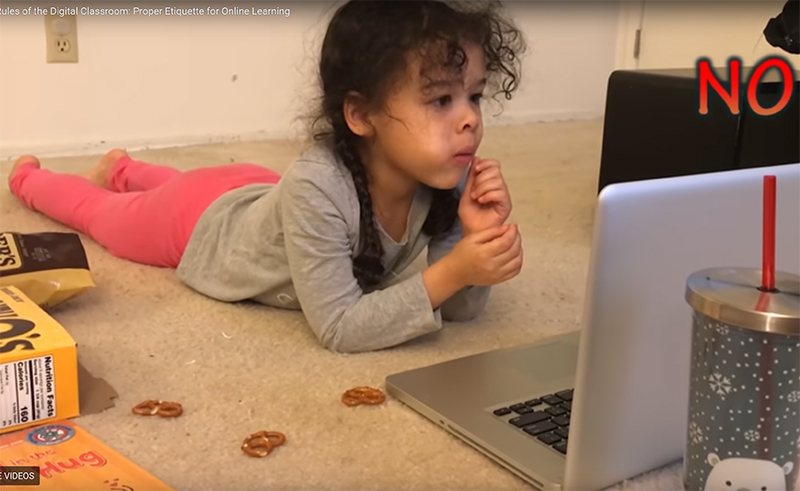
I rarely find a New York Times analysis that echoes something I wrote. On October 1, 2020, Carina Chocano did just that in a piece  on “Distance learning, with shades of big brother.” This was triggered by a wonderful awful video on what little girls should NOT do when Zooming school.

young girl doing school at home via Zoom
do not eat while Zooming for school

As Chocano points out, this video is nor really addressed to 5 year old girls, but rather to her parents.

Why would such a video be necessary?  Why does it make so much sense for school people to tell parents to watch it?

A long time ago (1984), McDermott and I wrote about a well known chore of 20th century modernity: “homework” that is school work to be performed at home. As children continue to do all their school work at home anthropologists should wonder anew about the relationship between home and school.  In 1984,  we argued that family education looks nothing like school education. In general, the organization of family education will always evolve through mechanisms that centralizing authorities cannot fully direct—even as they attempt to do so. Simply put, school teachers are licensed by the State, family teachers are not. School teachers are disciplined by assistant principals or “inspectors” (as they are called in France) to check whether they enforce the currently approved curriculum or pedagogy. Parents, in contrast, cannot be routinely disciplined-thus perhaps the need for a video on how to do school at home.

Our main goal in the 1984 paper was to highlight the reality of family education and particularly the paradox that this education shapes the actual performance of “homework” and easily trumps what the School attempts to do.  We were also trying to investigate an alternate, ethnographic and ethnomethodological, route to the analysis of the great school mystery: why is it that an institution designed to mitigate birth privilege as been such at failure at doing so.  Since the late 1960s at least, “big data” social scientists have established that the most powerful predictor of school success is family organization (Coleman 1966: 218ff).  Half a century later, not much has changed. How can that be?

The most common answer is the one Chocano learned in college.  As she tells us, while watching the video she was reminded of prisons and “big brother.” She then goes on to quote Michel Foucault about disciplining the body of children-as-pupil  to make “docile bodies” who “internalize” the discipline into adulthood and parenthood when they will reproduce it.   She might also have quoted Bourdieu on the production of an “habitus”  without noticing that reproduction through internalization is an altogether wild hypothesis.   This is not Chocano’s fault.  She was probably not taught that Foucault had radically discounted all evidence that the (let’s say French) State (of, say, the first half of the 20th century), however centralized and hegemonic over its provinces essentially failed in its task. The French State did discipline speakers of Provencal into speakers of French (as happened to my grandparents) and it did punish those who refused to send their children to school. But this State, like all other states, failed to so discipline families in their internal organization.  The State and its wardens (to develop what Foucault does not quite tell us is a metaphor) could not prevent families from appearing to satisfy wardens and inmates that they should not punished while they actually escaped the fate the institution prepared for them.

Readers of Foucault and Bourdieu should now focus on this failure of the School to control families.  McDermott and I, as cultural anthropologists have done since Boas at least, were trying to do by documenting the multiplicities of alternate ways families found to do what their schools was trying to discipline them to do.  In the language of the video, they did eat while doing homework, they danced when they should have been sober, and they doodled in the margins of their workbooks (like the little girl does when she fills a comment box with unicorn emojis!).

What I would now say McDermott and I were also doing was bringing out the way school work at home threatens internal familial dynamics and thus requires specific family work to encompass what the School requires. Transporting school into home makes a crisis that those who make this home must then deal with.  By proceeding in this fashion, from crisis to observation of the work of re-ordering, we were doing what anthropologists have always done and was made by Garfinkel into a fundamental methodological tool: we use disruption in the habitual to get a better sense of that particular order some human beings try to live by.  They rarely did.  But we are now living just such a crisis and it can tell us much about many of our institutions including, of course, all institutions in their educational roles.

As I argued earlier, C19 does not close schools, only some people can do this and, in the process, produce the local orders I label “Corona.”  But, as it is daily made evident, Corona, anywhere that it is getting institutionalized, is made up of different practices depending on whether one is acting as an agent of the School (say a person-as-teacher Zooming) or whether one is doing so as an agent of one’s family (say this teacher-as-parent setting up a child’s Zoom). Interestingly, the production channels are more complex as State agencies are themselves organized so that the part of the State dedicated to public health can impose matters on that other aspect of the State designed to shape schools and maintain this shape.   By enforcing the injunction “Stay Home! Stay Safe!” public health official created a crisis for school  governors who had little choice but to transport school into family.  And, as these governors knew well, by doing this they were also relinquishing much of their disciplinary methods … thus the production of a video that is clear evidence that these governors know very well that children-as-children will do all the things marked as “NO!” on the video (and much else that would not be shown on a “family-friendly” video).  And they know that their parents may let them do these NO things.  Parents may organize their child so that he could, should he decides to do it on his own, explore the Siberian Socialist Republic one one monitor while School Zoom drones  on the others.

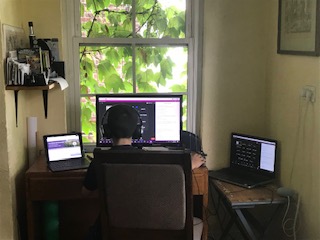
young boy doing school at home via Zoom
exploring the Siberian Socialist Republic while Zooming to school on another monitor

That parents may organize their children do what the school say they should not do may or may not be a problem.  As an anthropologist, I always err in the direction of celebrating the human capacity to find ways through crisis no other human being can imagine. One might even say transporting school into home is a step towards “deschooling” society (Illich 1970).  And yet, as a child of three centuries of “democratic” revolutions I also understand the concern about the reproduction of birth privilege through family processes that trump school processes.  Access to three monitors and a desk of one’s own is not something many parents can do.  C19 is also an occasion and justification to radically distance one’s children from all sort of undesirables to the parents—they might carry diseases! There was a good policy reason for “public” schools that radically separated children from their parents and local communities. Whether the aftermath of Corona will lead to a return to this kind of schooling that was already on the way out is something an anthropologist cannot say.

References

Coleman, James      1966 Equality of educational opportunity. Washington: U.S. Government Printing Office.

Foucault, Michel   [1975] 1978     Discipline and punish. Tr. by A. Sheridan. New York: Penguin Books.

Illich, Ivan 1970 Deschooling society. New York: Harper & Row.

McDermott, R.P., S. Goldman and H. Varenne   1994     “When School Goes Home: Some Problems and Defensive Tactics,” Teachers College Record. 85: 391-409.

[print_link]

on parents challenging schooling

Those who follow my work know that I look for evidence (empirical? evidential?) that Bourdieu’s hypothesis about habitus driving (mis-)consciousness is wrong as written. In this search, I prefer detailed ethnographic evidence (the kind sociologists dismiss as “anecdotal”). But descriptive statistics have their place as evidence opening routes for further exploration.

So, I am thankful to my colleagues Oren Pizmony-Levy and Nancy Green Saraisky for their report of a national survey they conducted on who opts out of standardized testing and why (Who opts out and why, August 2016). The media, particularly in New York State has been reporting on something that is often presented as new: parents (mostly prosperous) refusing to have their children take some high-stake tests. This may be a cultural innovation, either because more parents are doing it, because they have found out that opting out is actually possible, or because the media started paying attention, or for other political reasons. Historical research is needed. I would also relate this movement with other movements of parents organizing to do something those with official pedagogical authority (in Bourdieu’s phrase) wish they did not do. In New York City, Mayor de Blasio and others found out that their efforts to rein in charter schools would fail as parents, mostly inner city parent financially struggling, found a way to stop the reining in. At about the same time, other parents, many recent immigrants from China, many who could not speak English, appear to have stopped another movement by those with authority to change the admission requirements to the most academic public high schools. Elsewhere in New York City, other parents organize to home school their children, while others compete mercilessly to enrol their children in astronomically expensive pre-schools.

Whether all this is good for the children, for their parents, for the State, or for humanity is something else altogether. In any events, parents keep demonstrating that there are ways to resist the school-as-is, or the school-as-some-want-it, even as they participate in the evolution of schooling into un-imaginable forms.

Bourdieu and other structural-functionalists who keep Talcott Parsons alive might mark all this as a failure of early socialization into the practical acceptance of pedagogical authority. It could be that the schools have failed at reproducing whatever made Western schooling so successful for so many years and across the world. We may have a failure in maintaining homeostasis!

But it could also be that reproduction will always fail however determined the efforts to keep alive what was. It could be that (social) life will always be about constituting the heretofore unimaginable.

And so, as I like to say, we need a theory of culture that starts with the impossibility of cultural reproduction and sets aside concerns with enculturation. Instead, we need to pays close attention to the ongoing efforts both to preserve and innovate (Varenne 2007, 2011).

[print_link]

On parents and school success, again

Nothing new for many of us in this summary of sociological research:

“Family income is now nearly as strong as parental education in predicting children’s achievement.” (Reardon 2011: 5)

Note the “now” for a study that essentially tells us that not much has changed since the Coleman report.  This rhetorical move may be what attracted the New York Times who highlighted the study at least twice since it was published.

I missed Reardon’s study when it was published, as well as the first editorial essay published in the Times about it.  The April 27th “Opinionator” piece by Reardon is thus not quite “news” but it does confirm the trend about what is to count as “fit to print” knowledge.  Reardon himself, as an academic sociologist on the faculty of the School of Education at Stanford, of course knows that what he is observing is not a new phenomenon and his paper is a good source for a brief history of the sociological research on family and school performance.  I will use the paper the next time I teach my course on family and education.

Continue reading On parents and school success, again

On ecologically valid assessments

At some point during the mini-conference on the future of assessment (held on April 11, 2011), Ray McDermott raised questions about the validity of the kind of tests the Educational Testing Service and such design.  He told of the work he conducted in the late 1970s as part of Michael Cole’s Laboratory of Comparative Human Cognition.  Then McDermott, Cole and others wondered about the relationship between tests and the settings about which the tests were supposed to say something.  As they showed (1979, 1998: Chapter 1), the relationship between, for example, a reading test and baking banana bread by reading a recipe is tenuous, at best.  In the setting of a cooking club, so much else happens (from confused writing to interpersonal tensions) that ability to read is the least of the problem the children have to deal with.  The generalizability of these observations across settings and populations is now well established through repeated observations.

What has been left open in this work is the question of finding out what ecologically valid assessments would actually look like.

Soon after the conference, another participant, Katie Anderson-Levitt (U. of Michigan-Dearborn), suggested we look at Paradise and Rogoff’s recent paper about ongoing learning in families (2009).  In that paper, Paradise and Rogoff mention all the work done in the Cole tradition over the past 30 years with a new twist that fits well with my own sense of what I call ‘education.’  In everyday life, at home, “learning” is not a simple automatic matter proceeding below deliberation or symbolic expression.  In everyday life “teaching” (and assessing) is—probably—ubiquitous.

As I reflected on all this, I saw a route I have not yet quite explored and that could lead to further research expanding on the Cole, Lave, etc., traditions.  Starting with an expansion of the point Paradise and Rogoff made, I suspect that  the movement through publicized ignorance is accompanied by all sorts of speech acts, many of which fit in the paradigm of knowledge assessment.  Developing all this is also an expansion on Garfinkel, as I take him.

Garfinkel has kept arguing that maintaining any order requires ongoing work, including the work of figuring out what is going on.  Conversational analysts has given abundant evidence that this is indeed correct.  More recently, Garfinkel wrote about ‘instructions’ as a necessary aspect of this work.  The paper ends with one of my favorite quotes about screwing around and getting instructed (2002: 257).  What I do not think Garfinkel noted, and what I know I never noted myself, is that the instruction moments proceed either from an earlier assessment, or themselves constitute an assessment.  This is also an implication of Gus Andrews recent dissertation (2010) on blog comments when these are assessed as being “wrong” in some way that is specified by a later comment (“this comment does not belong here,” “you should not write your social security number here,” etc.).  In an interactional sequence (conversation?) utterance of the type “Do X differently!” are probably essential mechanisms for maintaining order, constituting emerging orders, moving participants into new positions, etc.

I am quite sure that such ongoing assessment is ubiquitous and should probably added as a function in Jakobson’s model of communication (1960 — though he might have classified it as an aspect of the metalingual function).  Much of the recent work on metapragmatics may also fit here.

In brief, and for our purposes, we could say that Ethno-methodology is at the service of ethno-science (what is the world made of?), and ethno-politics (how do we maintain the order within which we are now caught?), it also at the service of ethno-assessments. [or should we say that (ethno) Methodology is at the service of (ethno) Science, (ethno) Politics, and (ethno) Assessment?]

If this proves a useful direction for inquiry, it suggests that assessment is not an extra-ordinary task.  It also suggests how school assessment has drifted away from the ordinary [I am not sure that ‘drifted’ is the right work, but it will do for today].  The well known school-based QAE (Mehan 1979) model is formally equivalent to what might get known as the SARS model (Statement, Assessment, Re-statement) except that the former starts with the assessor’s question while the later starts with a seeker’s request that may then lead to an assessment (though this proposal may not have been presented as such).  In other words, the sequence starts with ignorance grounded in the here and now (“ecologically valid ignorance”?) and proceeds with statements of local knowledge that are themselves proposals for what it is that the seeker may plausibly not know (I am using the word ‘seeker’ rather than ‘learner’ since it will remain a question wether the subject whose ignorance is marked will learn anything out of the encounter).  This sequence is what I would now say my earlier statements about “productive ignorance” were about.

The question to designers of future tests is something like: how might you produce assessments that are triggered by acknowledgments of ignorance, whether generated by the subject (“I would like to know about X”) or by a co-participant in the polity (“you really should learn more about X”).  The challenge is to find the moment in the sequence of a life when the co-participant teachers will enter.  In everyday life it is a non-problem to the extent that co-participants or “consociates” have the built in or self-generated (legitimate) authority to assess (as siblings may have).  When social distance increases, that is when the network links between those who set what is to be assessed, what is to count as ignorance, and what should be done about include many persons in many institutions, then the problem gets acute.  It may even be unsolvable unless we find ways to reposition the official assessors within the network so they are closer to the performance in such a way that they can get a better sense, in real time, of the feedbacks that the seeker (learner) provides.

(More on what I am trying to formulate about network linkages later)