Category Archives: comprehensive education

Posts developing the approach to education, understood as a comprehensive and ubiquitous activity of all human beings in all their settings, which I have been developing since 2005.

ChatGPT as educator?

In my earlier post, I attempted to “assess” CG the way I might assess a student. This assessment led me to the uncomfortable conclusion, that, in this case, it was indeed a very good, albeit uninteresting, student. It was the kind who tells me exactly what I just taught them and then loop this back to myself. It was a perfect artificial student and I do not need any of those.

I closed the post with a question to open a different line of investigation. Shoud I treat ChatGPT (CG from now on, as type of a social fact often glossed as “AI”) as an “educator”? Or, at least, in Cremin’s phrase, an “educational institution.” The answer has to be “Perhaps…. but…”

What kind of educator might CG be? To answer this, an anthropologist wonders about what it is actually used for. By every account it is used for a lot of stuff, including some stuff many people think it should not be used to, or should be prevented from doing. I have used it most successfully for technical questions about programming details. I know advanced programmers use it extensively for this. I have collected stories from acquaintances about their use of CG. I watched generated videos on YouTube. I know of a young close relative of mine, who used it explore, while confined at home during “Covid,” marxism-leninism and the history of Russia, as well as neo-naziism around the world—with no guidance or control from any other person. Many use it to check their written English. And everyone, from government officials, to journalists, to everyone with whom I talked can be produce extended discourses about the good or bad of CG. It is undoubtedly a “total social fact” no one can escape.

The part of me who teaches Rancière to make students aware of all aspects of education that escapes the State can only celebrate all this. CG might be the ultimate “ignorant school master”—except that it is one that knows everything! So, CG is more like an infinite library open day and night, 24/7 to anyone interested to browse through it. It is a library with an altogether kind librarian that keeps close track of what one has explored and responds to further investigations with an encouraging “this a good question, let me think” before summarizing what one might have read and, perhaps, send one into a further investigation deepening the initial one.

But CG is not at all like the, Jacotot, the schoolmaster who inspired Rancière. This schoolmaster may be ignorant of the topic interesting to a student but he is actively involved in prodding their will to continue searching and reaching a new mastery. By contrast, so far at least, CG is silent until one asks. This silence is actually, for me, just what I want from a library, and an assistant librarian. I use CG regularly because it is indeed a a powerful tool for an intellectual, a major advance over Google.

But this silence or relative passivity also suggests that CG is not an “educator” in any of the usual senses. It is not a teacher. It is not a master. It is not a mentor. It does not have a curriculum. It does not mete consequences.

To push this, I asked ChatGPT “what should I know about the creationism museum”? Having visited it, I can say that answer was clear, succinct, as well as expanding on the controversies surrounding it. And CG ended as usual, with suggestions for further explorations: “If you want, I can also summarize how this museum is seen by scientific organizations or provide tips for visiting (hours, ticketing, best time to go).” There were links to further sources.for the theoretically inclined this is an instance of the “instruction writer” limits sketched by Garfinkel (2002: Chapter 6).
But there was no clear indication that using the answers “naively,” as one might use other answers, might land one in very dangerous interactional or political settings. CG, so far, does not (cannot?) know the social contexts within which its answers might be used.

“We” (teachers, professors, educators…) must, at least, warn our students…

Teachers College and “Family”

From Arts (practical), to Life (psychological), to Education (social) in the attempts to understand and analyze, in order to educate about, perennial concerns with the settings in which men, women, and children meet most intimately and extensively over the course of their lives—in a word “in families.” For a new re-integration.

This post was triggered by my hearing that the administration of the College is considering closing the Center on the Family as Educator. The creation of this Center was, as I see it, one of Lawrence Cremin’s signal academic achievements, I was moved to wonder wherefrom what moved much of my career at TC came from, dialogically. I may transform this into a fuller article.

In 1972, I joined the College into the Department of Home and Family Life, later to become the Department of Family and Community Education. I published much on matters of family and education. I did not necessarily think much about what was sustaining these concerns, institutionally. And so, now, I wonder what TC has been doing with “family” over the past century since it appears it has done much, or little. I wonder what has been included, or indexed. And I wonder whether it should continue to do something about “it” and, if so, what now. This question is partially historical, and partially programmatic.

In my beginning (Fall 1972):
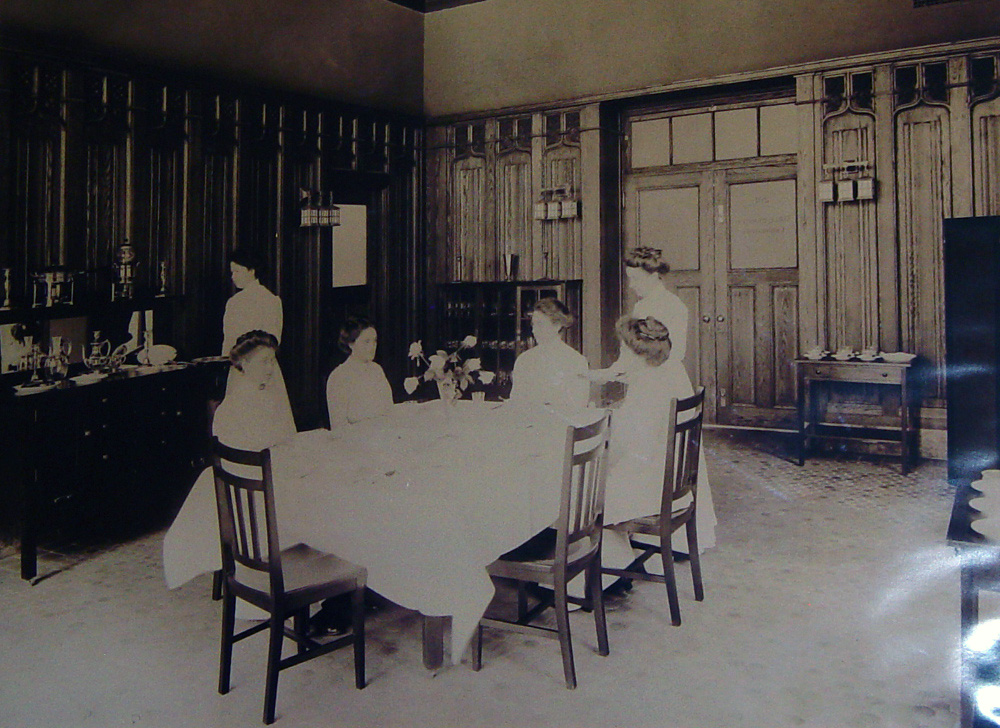
My first introduction to the informal history of Teachers College came when I was shown the closet within which, I was told, were kept the teaching tools of what I did not yet know as “the Table Service Lab.” This closet contained a full set of china and silverware that, by all evidence had not been used for many decades. The department I was joining, “Home and Family Life,” for a reason I did not immediately understand, was the inheritors by default of this closet and its content. young women learning how to serve formal dinnersI was also shown, and often used, the “Tudor Room” which, I was also told at some point was a copy of Miss Grace Dodge’s dining room. I was delighted when, decades later, I found out that this Tudor Room had been the Table Service Lab!
In TC’s beginning(s) (1880, 1884, 1889):
Once upon a time, in those days (1880), some philanthropists in New York, led by Miss Grace Dodge, created the “Kitchen Garden Association” for the “promotion of the domestic industrial arts among the laboring classes … the better to qualify them for domestic service” (Russell 1937: 4-5). Four years later this became the “Industrial Education Association” “to include ‘special training of both sexes in any of those industries which affect house and home directly or indirectly’” (Russell 1937: 9). And then, in 1889, the same principals “incorporated” a subsequent institution “under the name of Teachers College” (Russell 1937: 7). All versions of the history of this institution emphasize the shift to the education of teachers as the best route to helping the “laboring classes” (and particularly the arriving crowds from the poorest, most rural parts of Europe) succeed (survive?) in the United States. Much of the details in this post come from the Cremin, Shannon and Townsend history of Teachers College (1954) but this history does not go in much details about what must have extended and difficult conversations.

Histories of TC then most often jump to Dewey writing about “democracy and education” (in a book that should have been titled Democracy and Public Schooling), to Dewey’s debate with Thorndike, to difficult conversations with Columbia University, etc.

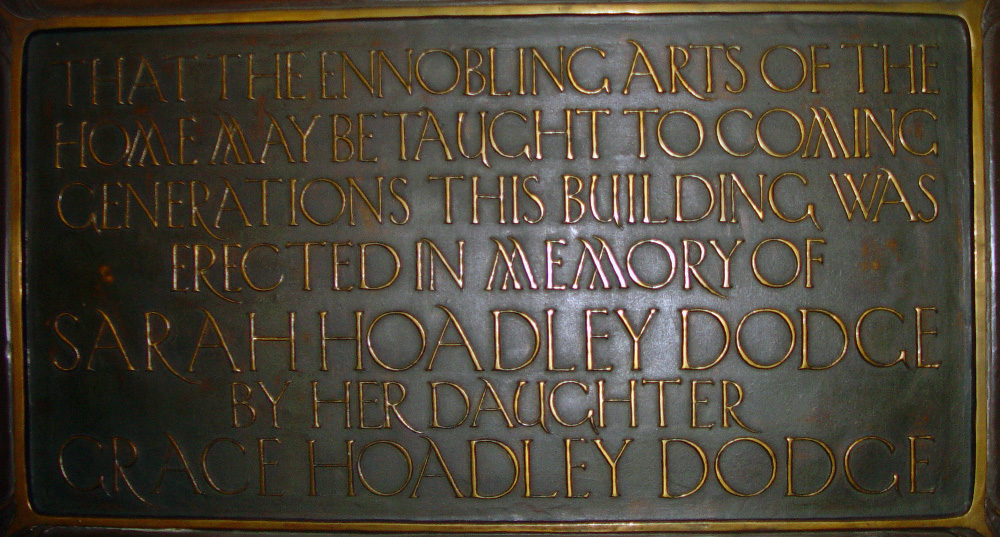
What becomes veiled in these accounts is the fact that some early concerns had not been discarded. It is significant that, among of the first buildings at the Morningside Campus were the building for the Industrial Arts (Macy), and, my focus here, Grace Dodge Hall erected so “that the ennobling arts of the home [would be] taught to coming generations” (from the plaque in the entrance to the building). dedication plaque for Grace Dodge HallWhat is also often veiled is the continued inclusion in the curriculum of matters related to these “ennobling arts.” As late as 1935, the TC catalogue listed in its fields of specialization “Household Arts and Household Arts Education” with courses in “Household economics,” “Cookery,” “Clothing,” “Teaching of Home Economics in schools.”
By 1937 the list of courses included courses in nutrition, health, child development and, most significantly given future history, a course in “family social relations.” Some of these were offered through different departments even as the old department was reorganized into a department of “Home Economics.” This department brought together most of the earlier matters but developed what became its full focus: psychological development and emotional life within a nuclear family. This transformation could probably be traced directly to the concomitant development of both Freudian therapeutic psychology (in its many transformations), and concerns with child development—as well as sociology. Ernest Osborne, who had earned a Ph.D. in Educational Psychology, was appointed in the Department of Curriculum and Teaching in the specialization in early childhood education. He started teaching a course in the “Psychology of Family Relations” (still taught as “Dynamics of Family Interaction”), and then became the prime mover of the new version of the venerable department which became, by 1953, the “Department of Home and Family Life” (Hey 1965: 134-5) . As Osborne put it in 1939:

It was once believed that parent education was a relatively simple thing limited to the instruction of parents in the proper ways of feeding, clothing, and training children . … Today .. . an increasing realization of the effects of relationship between family members on behavior is evident. (Quoted in Hay 1965: 134)

Over in Harvard, Talcott Parsons wrote a soon to become extremely controversial article on the family where women were to hold the “expressive role” in order to socialize children and stabilize adult personalities (1955: 16). Teachers College was again at the cutting edge in the transformation of an academic consensus into an educational program to apply this knowledge.

And then, as more time passed and Teachers College became my world:
I am not exactly sure what happened in the mid-1960s. I was told in my first years at TC, that, after Osborne died, the faculty of the programs in clinical psychology took umbrage at a program which appeared to give doctorate to people who would then engage in (family) therapy away from their own controls. At the same time, Lawrence Cremin got convinced that, as he put it, “education proceeds from many institutions” and particularly from families. He recruited Hope Leichter, a sociologist from the Harvard Department of Social Relations, whom he promoted, made chair of what was still “Home and Family Life” with the goal of transforming it into a department of “Family and Community Education.” This transformation was completed in 1976. Paul Vahanian, the last professor with a family therapy background, was not replaced when he retired. Rather, Leichter, Cremin and the others concerned with the matter invited anthropologists to join the evolving department (me from Chicago, and Ray McDermott from Stanford).

And then, in 1990, Teachers College, that is its administration on the basis of a recommendation by a faculty committee, closed the department and the faculty scattered.

I tell this story to make a point that keeps being obscured or, at best, side-lined: some at Teachers College always insisted that a school of education must pay attention to whatever one might want to call the institutions that take care of children when the children are not in school, or are the resting places of adults when they leave their salaried jobs.

A few at TC, I am sure, may still be willing to argue for what may have moved Grace Dodge even as she accepted that the institution she was fostering would focus on school teaching. It remains that, even in the 21st century, educators should not ignore the people who prepare the children for school, pick them up in the afternoon, clothe them, feed them, put them to bed, manage their health, and control, or not, what they read, what they watch, what they have access to in the social media of their times, etc. There is no point in rehearsing tired controversies about defining “family,” “home,” the “domestic,” etc. The reality is that, after two centuries of reformers proposing a world where children would be raised by the State, none of these utopias have survived long. Everywhere, children escape the State and yet, since the Coleman report at least (1966), and fully confirmed since, their familial experiences can challenge the State. One cannot understand “systemic privilege” without understanding the educative work of families, including their work educating themselves about schooling. This has been one of Ed Gordon (Varenne, Gordon and Lin 2009; Lin, Gordon and Varenne 2010) major contributions as he has been asking us to pay attention to what he has called “supplementary education.” It remains essential that it not be ignored.

In (temporary) conclusion, I wonder: how might we now integrate what is most easily told as a linear history: the joint concerns with the Arts of the domestic (economics, ecology, sustainability), Life with the most significant others (emotions, disabilities, cognition, development), and Education about all this (privilege, resistance, imagination).


Coleman, James et al. 1966 Equality of educational opportunity. Washington: U.S. Government Printing Office. (with et al.)

Cremin, Lawrence 1974 “The family as educator: Some comments on the recent historiography.”  Teachers College Record 76, 2: 250-265.

Cremin, Lawrence, David Shannon, and Mary Townsend 1954 A history of Teachers College, Columbia University. Columbia University Press.

Hey, Richard 1965 “Ernest G. Osborne Family Life Educator.” Journal of Marriage and Family , 27, 2: 134-138.

Lin, Linda, Hervé Varenne, and Edmund Gordon, eds. 2010 Educating Comprehensively: Varieties of Educational Experiences. Lewiston, NY: The Edwin Mellen Press,

Osborne, Ernest 1939 “Widening Horizons in Parent Education,” Teachers College Record, 41 p, 28.

Parsons, Talcott 1955 Family, socialization and interaction process. Glencoe, Ill.: The Free Press.

Russell, James 1937 Founding Teachers College. Bureau of Publications: Teachers College, Columbia University

Varenne, Hervé, Edmund Gordon and Linda Lin, eds. 2009 Theoretical Perspectives on Comprehensive Education: The Way Forward. Lewiston, NY: The Edwin Mellen Press.

[print_link]
What is anyone to do about GameStop? Who knows?

Or
On the ignorant in capitalistic action

Like about everyone else I started the week of January 25, 2021, from a position of total ignorance about GameStop, Reddit, the Robinhood “Commission Free Trading & Investing App,” and the epic battle between hedge funds and young ones (mostly men I believe) As far as I can tell this is the position of many besides grandfathers who are not any more “dans le vent” as I might have said of my grandfather half-a-century ago. I am just one among the hundreds of millions who, like me, were completely ignorant and were also altogether irrelevant since we were not participating in the battle. This irrelevance may be changing as some among this crowd, like me writing this blog post, are starting to participate though mostly as an audience to a drama playing itself on a distant stage.  As we watch we discover significant actors, their networks, their conflicts, their tactics, their armaments and their uncertainties in a very dubious battle.

The more interesting ignorance, for a social scientist, is that of the significant actors—those whose activities might have a direct impact on the activities of others.  Many of those actors probably thought, a few weeks ago, that they were knowledgeable experts, and then found out that this was not true at all. Among these actors are the millions who knew about Robinhood and used whatever it provides.  And there are also the smaller number who populate the “hedge funds” and also discovered their ignorance about actors they apparently had not noticed or had dismissed.  As an ethnographer, I would open what should not remain black boxes (“hedge funds”) to reveal their internal organization.  I might chose as my site Melvin Capital who appears in the media as one of those funds who lost the most last week (possibly half its value a month ago). According to  Google, Melvin Capital has several “chiefs” (Chief Investment Officer, Chief Operations Officer, etc.). It probably also has hundreds of employees many of whom are those I believe are known as “traders.”  I suspect many of those are hired young men (and now probably also some women) who are in charge of actually doing the work of the firm.  I am sure ignorance was well distributed among all those. I would also not be surprised to learn that some of the new traders have now been fired for not noticing what was happening and for having almost bankrupted the firm. At some point the chiefs must have become aware of the losses and then discovered who were the actors producing these losses. How could they have imagined that young (some as young as 13!) men (where are the women in this fight?) would find a way to organize to defeat a bunch of famous experts at their own game: make a lot of money with little investment by playing on obscure possibilities?

I am not saying here that the young ones are more knowledgeable. They appear not to have known that the chiefs could organize themselves to demolish the young ones’ positions for the few hours it would take to mitigate losses (and probably make a lot of the young ones loose money some of them might not have been able to afford). An early story in the New York Times (1/31/2021) only mentions young men making money, not losing it.
While Rancière might celebrate the fact that they are mostly “self-taught” (that is that their education was not controlled by any authority besides each other), the grandfather in me suspects that only a very few will end up with more money than they started with. As far as I know, one rarely wins battles against “the Market” (and those end up managers of hedge funds…). As it is often put, the young ones are going to “get an education”…

Money is being made and lost on a grand scale. If much of this money is not essential for survival anyway, then one suspects that all this is also “fun” in the way deep play can be. So, let’s leave aside the money aspect for a while, and recognize what has been happening as, also, involving active explorations of possibilities given what one might call the “affordances” of the epoch. This would include the affordances of new software, the collapse of schooling as control of young bodies for hours on end, Zoom boredom, social media dares that may be less dangerous than others (no sex, no Trump, just “ready money” that is not quite needed for survival). And then, as the young ones could no longer be dismissed by the chiefs, there is the chief own explorations of aspect of Wall Street affordances they had not noticed before. I am about sure that those the chiefs manage will now use what the young ones discovered. I am reminded of Souleles’s work on private equity funds that surprised Wall Street in the early 1970s (2019a, 2019b). At that time a few young men had discovered a possibility, and soon many followed suit.

But Souleles had to work from 40-year-old documents, and reminiscences from some of those who followed the pioneers. What I  hope will now happen is that someone will keep ethnographic tabs on the actors in this GameStop moment in order to develop better models of what I understand as ongoing education through collective difficult deliberations (2007, 2019). I trust this kind of research would help move the field away from easy “explanations” that end with the mention of “capitalism,” “neo-liberalism,” “greed,” “white privilege,” and any other such purported root cause. Obviously, the moment is part of a broader epoch that started with Reagan and Thatcher, or the Bretton Woods agreements, or Adam Smith, or … But none of these, as moments in the history of capitalism, are, precisely, causes. They are at most new conditions (constraints and possibilities) in an ecology with affordances that keep emerging and evolving. Neither the chiefs nor the young ones of the GameStop moment are just billiard balls with habitus careening on some billiard table.

So, I propose to look at the event as a sequence of moves by life forms responding poetically to various triggers. From my reading of media reports (and expanding on my post of January 28, 2021):

Time 1 — GameStop was a failing business.  Its stock was  moving lower, perhaps to 0;

Time 2 —  Some hedge fund managers (probably low level ones at first) noticed this, imagined that the “overly” high price was driven by the ignorant (see the young ones above), and decided to make money by betting that the price would go lower;

Time 3 —  young men in various basements continued buying the stock and its price kept on getting higher (I wonder why they would do this: ignorance of business fundamentals? Nostalgia from the time when the shop was their utopia where to spend Christmas money?)

Time 4 —  some of the young men noticed that they were bothering New York hedge funds and organized to buy even more stock (with the idea they would bankrupt the funds).

Time 5 —  the chiefs of the managers noticed that they were getting played and got together to apply raw economic power over the actual market place (Robinhood) where the buying was taking place and got the price to get down;

Time 6 —  the young ones mobilized further and exercised their own raw political power by making the media notice, thereby leading to a backdown from some actors—though after some of them had limited their losses;

Time 7 —  …….. [to come] ……….

To generalize, we have here a conversation or deliberation during which the ignorant teach each other new possibilities even as they make some new ones and there by produce consequences that are far more than “texts” or “narratives.”

References

Souleles, Daniel & Hervé Varenne   2019a   “Redesigning capitalism.” Chapter 4 of  Educating in Life by H. Varenne et al., 63-78.  New York: Routledge.

Souleles, Daniel 2019 Songs of profit, songs of loss: Private equity, wealth, and inequality. Lincoln, NE: University of Nebraska Press.

[print_link]

Educating into Corona, in life

In my case, and while on the road, about everything I have learned about the virus I learned through the media, mostly from the “traditional” media (New York Times, Le Figaro, etc.) and somewhat less traditional (Yahoo summaries, etc.). I have watched some television, mostly in restaurants where it was on. I hope that people in the medical profession, as well as various politicians and “officials” with power and authority, are learning from other sources—though we will never quite know where Trump or Pelosi, Cuomo or de Blasio, etc., are getting the information on which they base their decisions.

Obviously, no one among all those (except perhaps the medical people) learned any of all this at school, though some may remember some high school class, taken decades ago about viruses and the like.

So, this virus has not (yet) been taught in school. More interestingly, whatever one learns about it is not verified by a more knowledgeable person (say, a school teacher). There are no tests. And one receives no diploma for whatever knowledge one has gotten. The “media” (journalists, TV announcers and such) are the main teachers. But they are not school teachers. Not only can they not give tests, they have no way to control what their “students” are learning. It is not even clear to me where their “curriculum about the virus today” comes from and who vets it (producers? lawyers? “officials”?). They are all very much “distance teachers” with little feedback about their impact.

Most importantly, the students are not isolated from each other as they might be in a test-driven classroom where their knowledge is supposed to be assessed independently so that they can be sorted into more or less knowledgeable. The students (me, my family, my peers, people I briefly encountered in stores or hotels) talk to each other, and they teach each other. As soon as they hear or read something presented as “knowledge about the virus,” they start discussing this knowledge in all sorts of forums with different co-participants, etc. They dispute, disagree, criticize, suggest, cajole, enforce, etc.

All this could be said to be “Cremin 101″ (1976) as I and my students developed it recently (2019). I will be using “teaching/learning Corona” for the rest of my career. I strongly encourage students who might be reading this as the event still unfolds to keep an “educational journal” focusing not only on themselves but on the others with whom they engage (very significant others, parents, friends, etc.).

[Note that this is the first of a series of posts I will be making over the near future in my role as senior anthropologist of education. This will be accompanied by a developing web site with notes and further elaboration. Note also that everything said here is under my own responsibility and does not in any way represent the position of Columbia University, Teachers College, or my colleagues and peers]

References

Cremin, Larry   1975     “Public Education and the Education of the Public.” Teachers College Record 77:1-12

Varenne, Herve et al.   2019     Educating in life. Routledge


[print_link]

What about these schools in Port-au-Prince?

For students looking for a dissertation topic in anthropology and education: what about all these schools in Port-au-Prince?

a school in Haiti
Photo by Herve Varenne

This may have been my second surprise after I landed in Port-au-Prince and took a walk between the Hotel Olufson and the Champs de Mars: what about all these schools?  The walk down Rue Capois is about 15 blocks.  There are about one school every other block.  There are at least as many on the parallel Avenue Christophe and, I found out many many more in the neighborhood southwest of the hotel where I was driven.  This area is but a small area of the city and so I have no sense of what is happening, school-wise, in the rest of the city.

Continue reading What about these schools in Port-au-Prince?

on expert ignorance

A visit from Gus Andrews is always refreshing and invigorating as we explore some of the intellectual links in our mutual networks.  So, last Wednesday, February 12, we talked, among other things, about the efforts of the organization where she works (she will have to provide the link…) to convince people around the world to use encryption to communicate in ways that, perhaps, governments and other cannot listen in.  One of the problem is that it is hard to identify who are these people and, when members of plausible audiences are identified, convince them that this encryption is the solution to a problem many do not know they have.  Some already use VPN (whatever that is, and however it works–it will advertise my ignorance here) and tell representatives of the institution that this works well enough for their purposes.

Continue reading on expert ignorance

Trying to make it a good day when things fall apart

I hope that everyone left the conference last Saturday as invigorated as I was.  It was worth all the efforts that went into from so many.

Two moments were particularly salient for me.

Early on, Michael Scroggins read a passage from Cremin that I have read many time but which struck me as if I heard if for the first time.  The passage closes the section of the “definition of education” in his Public education but it goes much further.  Cremin wrote:

”Everyday in every part of the world people set out to teach something to others or to study something themselves. . . They deserve a theory specifically addressed to their problems and purposes, one that will assist them to act intelligently, ever hopeful of the possibilities but fully aware of the limitations and risks that attend their efforts.”(1976:30)

I take this as further evidence that Cremin was indeed part of the movement that keeps renewing what anthropologists of education are doing.  He wrote this at about the time when Ray McDermott was watching Adam and heard him say “Anybody who wants to try to make it a good day today, say ‘Aye’” (Varenne & McDermott 1998: 39).  Adam did not have a good day that day, but he was “ever hopeful,” and McDermott has been looking for the theory of education that people like Adam deserve.

The other salient moment for me came during the last session when Jill Koyama talked about her research into things that fall apart—particularly policies by institutional actors (in Latour’s sense) that stresses other actors to the point that everyone involved will have very bad days.  For Adam, it had been enlightened researchers attempting to undermine the grounding of intelligence testing and, in the process, making a space for the enactment of “education as race” with winners and crying legitimate losers.

Cremin was an optimist.  Koyama presents herself, I’d say, as a pessimist.  McDermott insists that kids (teachers, assistant principals, etc.) “make sense.”

But both Cremin and Koyama, like McDermott and all those I recruit into the “movement,”  insist that we build theories that will “assist” (note the verb) people “act intelligently.”  McDermott may have written “act ‘sensibly’” reminding us of course that people always make sense even when (particularly when?) their conditions are made difficult.

So, things fall apart (why-ever).  As Garfinkel once put it “when you screw around, then you get instructed” (2002: 250). That is, if a cafeteria line falls apart then everyone starts working on telling everyone what they should do next so that they can make it a good day (and not have to repair what ought not to be broken so that, perhaps, more complicated matters can get repaired).  The cost of that repair work is what Garfinkel was not concerned with.  Nor was he quite concerned with the work of those who dis-order (why-ever again; intentions is not the issue).  Not with the possibility that re-orderings (through instruction, etc.) might also producing dis-orderings (resistance, etc.).

A theory of education that may help us assist people as they educate themselves, will have to take into account these matters too and many of the papers presented at the conference are a step in that direction (as well as a demonstration indeed that data-driven research cannot possibly shed lights on these matters!),

Where do (psycho/socio)- metricians fit?

Recently, March 28 2012, I spent the afternoon at the plenary session of an “International Conference” on “Educational Assessment, Accountability, and Equity: Conversations on Validity around the World.”  The plenary speaker was Michael T. Kane, “The Samuel J. Messick Chair in Test Validity” at the Educational Testing Service.  He talked about validity as measurement scientists deliberate about it, and about some of their soul-searching when they consider the impact of their measurements.  Or, as I would put it, wearing my “anthropologist of Nacirema” hat, he talked about the misgivings of an obscure priesthood specializing in an abstruse numerology few understand outside their rarified convents.  Kane, as a master in this polity of conjurers of numbers, gave us, the uninitiated or very peripheral, a glimpse of his doubts and those of other masters as they discover that they are now at the very center of political storms where their more abstruse spells are thrown at opponents for all sorts of reasons having little to do with numerology.

NYC value added model for teachers

To the extent that I understand it (and I am very far at the periphery of numerology, or rather, I am at the periphery of the gravity well that might have made me, at some point in my career, a legitimate peripheral participant), it all has to do with the “interpretation” of the test that leads to its being used in a particular case.  But Kane and his peers are not quite where Geertz and his peers have been.  For one, Kane is deeply concerned with specifying and justifying the interpretive steps.  For another, he and his peers have, precisely been thrust into the center, while symbolic anthropologists are pushed even further away from it.

Continue reading Where do (psycho/socio)- metricians fit?

Putting 2 and 2 together, and following up

Here is an addition to my gallery of educational events.  Here is the story of someone(s) who figured out that plastic bottles can provide lighting…

plastic bottle in a roof

The link came to me through my son who got it from …. (probably a long list of referrals with mention of “amazing video”–and this is also an educational event)  Here is the link:

http://www.wimp.com/innovationfinest/

The story is told as one person coming up with an idea, refining it, and then convincing people in his “squatter area” (in English in the local language) to use it.  There was here a hint of network that transformed an individual act into a communal educational event.  And this, of course, is what is wonderful about the event. The editors of wimp.com provide a link to Isang Litrong Liwanak, a web site for the project.

This link reveals that, not so surprisingly anymore, the network has wildly expanded.  And that of course, suggest more educational events by more and more people.

This another case that would make a delightful research project.  Who did what when, for the first time, using what machines, and, most importantly, with whom?