Category Archives: learning/teaching

What is there to learn now, here, under maximum stress? (a problem for learning theory?)

Learning with others is, necessarily, a political matter. Thus my insistence on writing about “polities” of practice. Still, it remains that “learning” post participation risks being taken as a somewhat automatic process in the movement towards “fuller” (political) participation. Through participation one may move from apprentice to master but focusing, as we must, on movement does not tell us much about the everyday activities of the one who moves (or of the activities of those who encourage the movement—or put blocks on the way), and particularly about the activity of sorting out what to learn (what to prioritize, what to ignore, etc.).

I thought about this in the interstices of other activities I was not  able to escape these past weeks. I found myself, much against my will, and my hopes, in the position of apprentice to “next of kin” practices, first in in the neurological intensive care unit of New York/Presbyterian Hospital, and then in the regular neurological unit, and then in a rehabilitation center. At 70, it is the case that I have never been in that position, legitimately or otherwise, and that I have had much to learn even as I worried about much more than learning.

Continue reading What is there to learn now, here, under maximum stress? (a problem for learning theory?)

On educating a democratic public, democratically

Soon after Lawrence Cremin published Public education (1976), I gushed about the book to a senior colleague.  He did not like any aspect of the book because, as I remember he put it, Cremin made of education a form of “brain-washing.”  My colleague claimed Paulo Freire and, I guess, an alternate view of what it means to educate, democratically.

I must say I was astonished.  My take then, and I have not changed my mind, was that Cremin asks something surprising from us who are given the task to design education for the public.  He asks us to pay attention to what people are doing, in the streets and alleys of the world, far from the halls where pedagogy and curriculum are discussed.

I was astonished that my colleague had not noticed that Cremin was asking us to look at the crowds around us and was criticizing the John Dewey of Democracy and education ([1916] 1966) for not imagining any other educational institution than than the State sponsored school.  I could see how a very unsympathetic critic might notice that Dewey, as a philosopher who also read the psychologies and social sciences of his time, was quite sure as to what to teach the masses settling in the United States that they should learn to participate in an American democracy.  By Chapter 7, Dewey, unapologetically, claims an aim, a “Good Aim.”  In brief, in language Teachers College still uses (though we might wonder about mention of a “social ideal” and the measurement of “the worth of a form of social life”):
Continue reading On educating a democratic public, democratically

On grades as statements: to whom?

Ray McDermott and Jean Lave once told me that they asked Rancière whether his writing influenced his teaching.  As they tell it, he looked surprised and answered something like “not at all!”  A reader of Successful Failure once asked me whether I still gave grades.  Besides stuttering, I said something like: “I am required to (by my university and New York State)” and/or “students would not accept my not giving them grades.”

Continue reading On grades as statements: to whom?

on expert ignorance

A visit from Gus Andrews is always refreshing and invigorating as we explore some of the intellectual links in our mutual networks.  So, last Wednesday, February 12, we talked, among other things, about the efforts of the organization where she works (she will have to provide the link…) to convince people around the world to use encryption to communicate in ways that, perhaps, governments and other cannot listen in.  One of the problem is that it is hard to identify who are these people and, when members of plausible audiences are identified, convince them that this encryption is the solution to a problem many do not know they have.  Some already use VPN (whatever that is, and however it works–it will advertise my ignorance here) and tell representatives of the institution that this works well enough for their purposes.

Continue reading on expert ignorance

What’s a teacher to do?

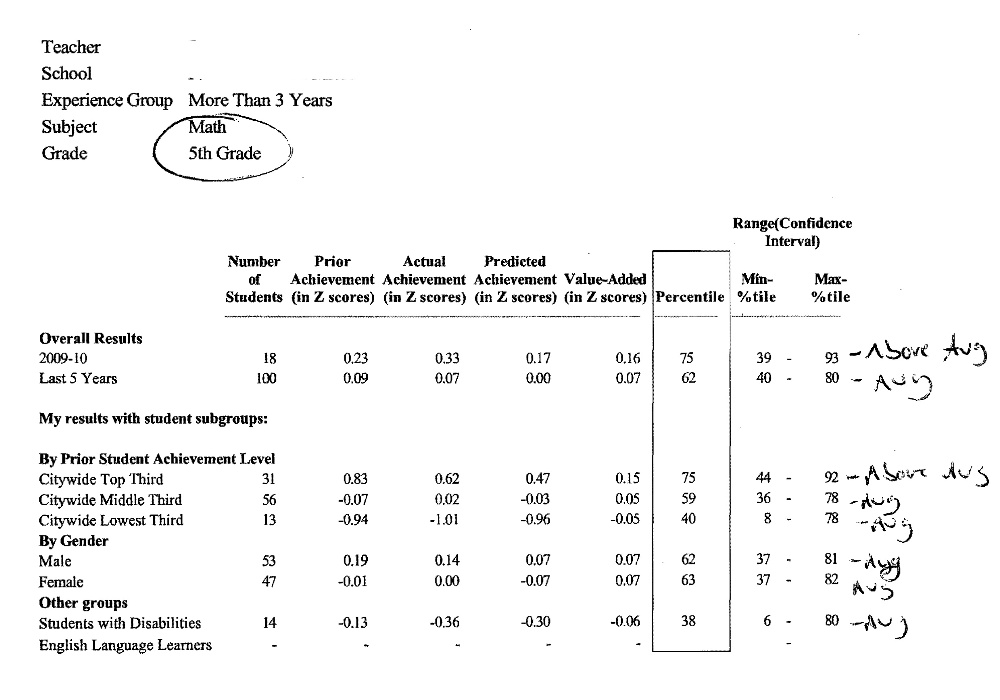
New York City found out on February 28 that an elementary school teacher I know well rates a “34 (7-73) 32 (5-84)” in Reading and a “63 (41-82) 77 (42-91)” in Math.

A few months ago, teachers had received from their school summary documents that looked like this:
Math result for a NYC teacher
What is an individual teacher to do about any of this?  What, on a day to day basis should a teacher do to “improve” on a 34 and maintain a 77?

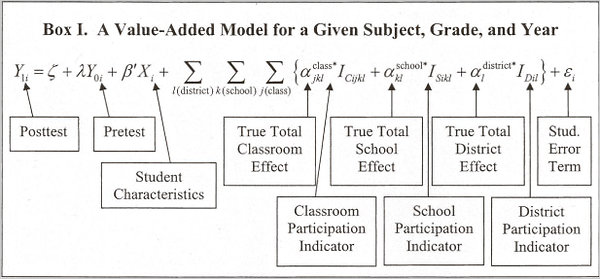
These numbers are somewhat related to the wonderful awful formula:

NYC value added model for teachers

What are the values of these variables for any particular teacher? Which of these variables are under an individual’s control?  On what day of the year?

I venture that neither common sense, habituation into any cultural world, guesswork, or any other process proceeding from the individual teacher as teacher or person, is likely to help in answering these questions.  I suspect that a whole new class of professional consultants is now being inducted into fuller and fuller participation in new polities in all sorts of institutions.  They will be sold as the interpreters of the ratings.  They will also be people with children and mortgages who will have ever more interest in keeping the formula opaque.  They will be joined by the psycho/socio-metricians tinkering with the formula to “improve” it so that they can report to the New York Post that “the complaints of the teachers have been addressed,” various software engineers, etc.  And the web keeping everybody in place will get tighter and more difficult to escape.

The question we need to raise is, of course, whether teachers should have to ask questions about manipulating variables on a formula.  The formula may be wonderful as a research tool, but it is awful as a method for hiding political decisions and making it appear that these decisions are removed from precisely political activity at all levels of schooling.  As a political tool it may be intended to take the place of a terminating Skynet where evaluation, like the response to some foreign threat.  Evaluation, it appears, is taken out of the political realm of principals meeting teachers in a school, and into the realm of automatized mechanisms noone quite understand but are un-impeachable, as well as altogether unaccountable.  That people will be hurt people is their problem will the newly powerful say: “good” teachers (the top 50%? 75%? 25%?) “have nothing to fear” and “bad” teachers should fear dismissal (unless the whole exercise is pointless).

Whether any of this will do anything to improve education in any of its senses in the question may be a question one asks at one’s peril.

MOOC: Education, degrees, careers?

I ended a recent paper for the Gordon Commission on the Future of Assessment with comments about the possible disassociation of schooling from assessment.  My argument was that the association between the two has been 1) good for schooling in that it has massively increased its reach and claim on resources, and also 2) terrible as it makes it less and less relevant to education.  The recent, and ongoing, controversy about publicizing teachers’ scores on invalid measures is a case in point: teacher-ing, with ever more symbolic violence (a.k.a “accountability”), is made into a skill for putting measurable bits into students’ head.  That teacher-ing might be about participating in shaping a mind is left aside as not a concern for the State.  But why, may we ask, should the State be concerned with education?  Well, of course, because

the tests
…..that lead to the degrees
……….that accredited  schools grant
……………that employers use to open or close doors to careers

are essential for the representation that a political system is indeed “democratic” and that state rewards are indeed distributed on merit rather than birth privilege (in its racial, ethnic, class, gender, etc. forms).

In many ways, as the people of the School have been saying, focusing on tests leading to degrees is a radical narrowing of what was the mission of schooling.  Arguable, the battle has been lost as much (most?) of what was included in this mission has now been distributed out to the family, the media, religious institutions, etc.  But schooling, as an institution, appeared to remain central because it has kept its monopoly on the granting of degrees.

What if this changed?  What if a successful challenge was mounted to legitimize other doors to adult careers than those controlled by the current schools, colleges and universities (and their teachers or faculty)?

In the past week, the New York Times published evidence that this challenge has started.  One is an opinion piece by Charles Murray asking an “energetic public interest law firm” to challenge “the constitutionality of the [bachelor’s degree] as a job requirement” (March 8, 2012).  The Supreme Court, I did not know, has made it unconstitutional to make test scores the key to employment unless there is a tight link between the test and the job.  Demonstrating the link between almost any college degree and almost any job might be difficult.

The other report may be a more immediate and less ideological challenge, and possibly much more difficult for school people to block (particularly since some of them are profiting from this challenge).  I am talking here about “Massive Open Online Courses” (MOOCs).  Stanford offered a classes for 160,000 students in 190 countries!  Another class, on Machine Learning, was given for 104,000 students with 13,000 completing the course.

The figures are astounding.  They are about something that is happening now and will have social and political consequences.  Of the 13,000 who complete the course on Machine Learning, most of them must have learned something but none got a State recognized certificate or a degree.  So, at this point, they completed the course “for nothing”–that is just for the education of it.  Some of them may also perform their professional tasks better.  I suspect those will not accept for very long to be passed for promotion by people who have a degree.

If the State finds ways to accredit (“give credit for”) the taking of MOOC (perhaps by asking a company like ETS to give an independent and controlled test), the implications for universities and their faculty are staggering.  The New York Times quote one of the Stanford professors who taught one of the MOOC as saying that he does not want to go back to teaching just twenty students in a small classroom.  When Stanford has found a way to charge people for the course, and reward the faculty member in commensurate fashion, the whole economic basis of colleges is transformed.

We may be seeing the end of schooling as we have known it (and for people of my generation profited from it).  It is going to be quite a ride.

On ecologically valid assessments

At some point during the mini-conference on the future of assessment (held on April 11, 2011), Ray McDermott raised questions about the validity of the kind of tests the Educational Testing Service and such design.  He told of the work he conducted in the late 1970s as part of Michael Cole’s Laboratory of Comparative Human Cognition.  Then McDermott, Cole and others wondered about the relationship between tests and the settings about which the tests were supposed to say something.  As they showed (1979, 1998: Chapter 1), the relationship between, for example, a reading test and baking banana bread by reading a recipe is tenuous, at best.  In the setting of a cooking club, so much else happens (from confused writing to interpersonal tensions) that ability to read is the least of the problem the children have to deal with.  The generalizability of these observations across settings and populations is now well established through repeated observations.

What has been left open in this work is the question of finding out what ecologically valid assessments would actually look like.

Soon after the conference, another participant, Katie Anderson-Levitt (U. of Michigan-Dearborn), suggested we look at Paradise and Rogoff’s recent paper about ongoing learning in families (2009).  In that paper, Paradise and Rogoff mention all the work done in the Cole tradition over the past 30 years with a new twist that fits well with my own sense of what I call ‘education.’  In everyday life, at home, “learning” is not a simple automatic matter proceeding below deliberation or symbolic expression.  In everyday life “teaching” (and assessing) is—probably—ubiquitous.

As I reflected on all this, I saw a route I have not yet quite explored and that could lead to further research expanding on the Cole, Lave, etc., traditions.  Starting with an expansion of the point Paradise and Rogoff made, I suspect that  the movement through publicized ignorance is accompanied by all sorts of speech acts, many of which fit in the paradigm of knowledge assessment.  Developing all this is also an expansion on Garfinkel, as I take him.

Garfinkel has kept arguing that maintaining any order requires ongoing work, including the work of figuring out what is going on.  Conversational analysts has given abundant evidence that this is indeed correct.  More recently, Garfinkel wrote about ‘instructions’ as a necessary aspect of this work.  The paper ends with one of my favorite quotes about screwing around and getting instructed (2002: 257).  What I do not think Garfinkel noted, and what I know I never noted myself, is that the instruction moments proceed either from an earlier assessment, or themselves constitute an assessment.  This is also an implication of Gus Andrews recent dissertation (2010) on blog comments when these are assessed as being “wrong” in some way that is specified by a later comment (“this comment does not belong here,” “you should not write your social security number here,” etc.).  In an interactional sequence (conversation?) utterance of the type “Do X differently!” are probably essential mechanisms for maintaining order, constituting emerging orders, moving participants into new positions, etc.

I am quite sure that such ongoing assessment is ubiquitous and should probably added as a function in Jakobson’s model of communication (1960 — though he might have classified it as an aspect of the metalingual function).  Much of the recent work on metapragmatics may also fit here.

In brief, and for our purposes, we could say that Ethno-methodology is at the service of ethno-science (what is the world made of?), and ethno-politics (how do we maintain the order within which we are now caught?), it also at the service of ethno-assessments. [or should we say that (ethno) Methodology is at the service of (ethno) Science, (ethno) Politics, and (ethno) Assessment?]

If this proves a useful direction for inquiry, it suggests that assessment is not an extra-ordinary task.  It also suggests how school assessment has drifted away from the ordinary [I am not sure that ‘drifted’ is the right work, but it will do for today].  The well known school-based QAE (Mehan 1979) model is formally equivalent to what might get known as the SARS model (Statement, Assessment, Re-statement) except that the former starts with the assessor’s question while the later starts with a seeker’s request that may then lead to an assessment (though this proposal may not have been presented as such).  In other words, the sequence starts with ignorance grounded in the here and now (“ecologically valid ignorance”?) and proceeds with statements of local knowledge that are themselves proposals for what it is that the seeker may plausibly not know (I am using the word ‘seeker’ rather than ‘learner’ since it will remain a question wether the subject whose ignorance is marked will learn anything out of the encounter).  This sequence is what I would now say my earlier statements about “productive ignorance” were about.

The question to designers of future tests is something like: how might you produce assessments that are triggered by acknowledgments of ignorance, whether generated by the subject (“I would like to know about X”) or by a co-participant in the polity (“you really should learn more about X”).  The challenge is to find the moment in the sequence of a life when the co-participant teachers will enter.  In everyday life it is a non-problem to the extent that co-participants or “consociates” have the built in or self-generated (legitimate) authority to assess (as siblings may have).  When social distance increases, that is when the network links between those who set what is to be assessed, what is to count as ignorance, and what should be done about include many persons in many institutions, then the problem gets acute.  It may even be unsolvable unless we find ways to reposition the official assessors within the network so they are closer to the performance in such a way that they can get a better sense, in real time, of the feedbacks that the seeker (learner) provides.

(More on what I am trying to formulate about network linkages later)
Utopias and dystopias: Futures for education, technology, and the assessment of authority over knowledge.

When we met last Monday (April 11, 2011) for the mini-conference on the future of assessment, we, of course, talked a lot about the impact of the new technologies.  Without much prodding from Robbie McClintock we mentioned the oft celebrated opening of access to knowledge as well as the distribution of the production of widely accessible knowledge.  The new technologies open routes to knowledge that do not pass through the gate-keepers we are familiar with: universities, research libraries, newspapers, state-controlled curricula, medical institutions (not to mention the theologians and priests who, until recently appeared to be fading as gate-keepers).

Someone then mentioned that all this has a very dark side.  With the distribution of access and production comes a distribution of the authority to interpret and constitute knowledge so that it can guide practical action in the world.  This can be scary.

Continue reading Utopias and dystopias: Futures for education, technology, and the assessment of authority over knowledge.

journalists are educators

[this was to have been published in April 2010]

Mostly, in my work, I celebrate what Linda Lin (forthcoming) felicitously labeled “untamed” education.  Sometimes, I also fear the untamed, particularly when I am asked to imagine “educational policy” as it might be built up with an acknowledgment of the limits of schooling.  And so I celebrated/feared Oprah as a later day Benjamin Franklin, and as a sometimes force for mis-education (from the point of view of the sober public intellectual).

All this came to me when reading another editorial in Newsweek, this time by Sharon Begley (March 29, 2010).  She titled it “Why scientists are losing the PR wars.” She criticizes “scientists” for not communicating well, and “Americans” who believe both in the absence of intermediaries between God and individual (no priests needed for salvation, no expert needed for knowledge) and in the wisdom of crowds.  Classically, she criticized the people of the United States for being both too individualistic and too conformist.  “No wonder so many Americans have decided that experts are idiots,” Begley concludes.

There is just one problem here.  After all scientists are not trained to be (public) “communicators.”  Actually it is trained out of them in graduate school and only a few may have the nerve, late in their career, to address those who are not their peers in a language they may be familiar with, or through the media they have access to.  As for the non-scientists (including scientists in other fields than their own), where do they get their information?  As far as I can tell from my own experience, and that of a rather extended network of kin and friends including several Ph.D.’s., MD’s, as well as office workers and laborers, over close to a century (since I include grand-parents I came to know well and who were born early in the 20th century), these two or three hundred people got all their scientific knowledge from journalists.

There are exceptions to that generalization.  My grandfather learned about growing tomatoes in Southern France from his father, and from long experience.  Cousins who are radiologists have a professional knowledge of radiation and the human body that do make them if not first level expert knowledge producers, but second level ones with direct entry into that level.  But they have no more direct entry into the world of climate scientists than I have.  Actually, I can say that my first lesson in climate science came to my grandmother who liked to repeat, each time the weather was not exactly what she expected that “ils nous ont détraqué le temps avec leurs bombes atomiques.”  Atomic bombs, she had learned, by exercising her intelligence with what she had read in the popular press, might have an impact on the weather.  Actually this was the time, in the mid-1950s when the movement to ban testing bombs in the atmosphere was starting to be discussed.  So, having ended her schooling at the 6th grade around 1910, and then working mostly at the edge of the unqualified working classes of Marseille, she was not far off.

Half-a-century later, her grandson, with his PhD, and appointment as Full Professor at Columbia University, is in the same position in relation to climate science (and about all other forms of science except the social sciences) as she was.  I do not read primary sources in climate science, and I suspect I would not know how to read them, or how to evaluate the evidence.

Science News Cycle
If this is the case for most of the human population, and every evidence suggests it is, then the major educators in the modern world are journalists, and we should take the cartoon by Jorge Cham that I have already mentioned, as a model for the network that, transforms what Latour might call a ????, within the world of science that produces Nobel prizes, into the personal knowledge of the scientist’s grandmother, and, more fatefully, the knowledge that the polity, and particularly a democratic one, will use as it deliberates its own evolution.