On the arbitrary and the contingent

While writing my last post on intelligence in the streets of Port-au-Prince, I tried to distinguish the contingent (e.g. an earthquake) from the arbitrary (e.g. a language like Creole, or making international help travel through NGOs).  I was attempting to distinguish the accidental (temporality or diachrony) the systematic (history as epochs in synchrony).  And put myself into an interesting theoretical bind.

It looked simple: On January 12, 2010 there was earthquake in Port-au-Prince.  Everyone had to do something that they did not have to do the day before.  “Everyone” is a very large crowd of people caught up with Haiti.  This includes “Haitians,” non-Haitians concerned with Haiti in an ongoing manner (e.g NGO staff, journalists), and those who became concerned with Haiti as calls for help were answered by people around the world.  The earthquake was, literally, a stone thrown in a lake, rippling far an wide but altogether NOT part of the lake, its shores and shoals.  The earthquake was contingent.
Continue reading On the arbitrary and the contingent

“Communities of intelligence” in the streets of Port-au-Prince

While preparing the class I taught  at the Faculté d’Ethnologie of the Université d’État de Haiti, I stumbled again on one of those sentences that make Rancière so powerful:

Language does not unite people. On the contrary it is the arbitrariness of language that makes them try to communicate by forcing them to translate—but also puts them in a community of intelligence. (Rancière [1987] 1999 : 58)

Haiti, of course, is famous for a creole forged by the need to translate what others from around the world, often with the worst of motivations, were saying and then to do whatever new conditions might allow (a successful war against a colonial power), or require (a devastating earthquake).  Living together in such conditions will put people in a “community of intelligence”—and will keep them there, at work, for a creole forged by contingent circumstances will itself become a language, Creole, that is arbitrary by its very nature as a language and so cannot unite people as it forces them, again, to try and communicate, try and survive in the new conditions of which it is now a part.

I thought about all this when reading Jonathan Katz’s passionate account of the 2010 earthquake and of the many blunders of the “international community” who ostensibly “came to help” but may have made things much worse (Katz 2013).  Much of what he had to say about the famous (Bill Clinton, Sean Penn) and the less famous politicians, policy makers, staff of NGOs, confirmed what I started learning through Scott Freeman’s dissertation on the role of NGOs in the non-development of Haiti’s rural population.  This, I learned, is now a theme in the anthropology of NGOs and their environmental impact.

Continue reading “Communities of intelligence” in the streets of Port-au-Prince

What about these schools in Port-au-Prince?

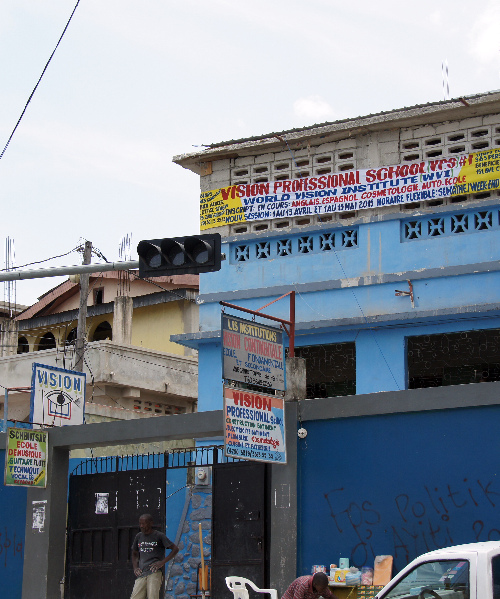
For students looking for a dissertation topic in anthropology and education: what about all these schools in Port-au-Prince?

a school in Haiti
Photo by Herve Varenne

This may have been my second surprise after I landed in Port-au-Prince and took a walk between the Hotel Olufson and the Champs de Mars: what about all these schools?  The walk down Rue Capois is about 15 blocks.  There are about one school every other block.  There are at least as many on the parallel Avenue Christophe and, I found out many many more in the neighborhood southwest of the hotel where I was driven.  This area is but a small area of the city and so I have no sense of what is happening, school-wise, in the rest of the city.

Continue reading What about these schools in Port-au-Prince?