All posts by Herve Varenne

On the arbitrary and the contingent

While writing my last post on intelligence in the streets of Port-au-Prince, I tried to distinguish the contingent (e.g. an earthquake) from the arbitrary (e.g. a language like Creole, or making international help travel through NGOs).  I was attempting to distinguish the accidental (temporality or diachrony) the systematic (history as epochs in synchrony).  And put myself into an interesting theoretical bind.

It looked simple: On January 12, 2010 there was earthquake in Port-au-Prince.  Everyone had to do something that they did not have to do the day before.  “Everyone” is a very large crowd of people caught up with Haiti.  This includes “Haitians,” non-Haitians concerned with Haiti in an ongoing manner (e.g NGO staff, journalists), and those who became concerned with Haiti as calls for help were answered by people around the world.  The earthquake was, literally, a stone thrown in a lake, rippling far an wide but altogether NOT part of the lake, its shores and shoals.  The earthquake was contingent.

Continue reading On the arbitrary and the contingent

“Communities of intelligence” in the streets of Port-au-Prince

While preparing the class I taught  at the Faculté d’Ethnologie of the Université d’État de Haiti, I stumbled again on one of those sentences that make Rancière so powerful:

Language does not unite people. On the contrary it is the arbitrariness of language that makes them try to communicate by forcing them to translate—but also puts them in a community of intelligence. (Rancière [1987] 1999 : 58)

Haiti, of course, is famous for a creole forged by the need to translate what others from around the world, often with the worst of motivations, were saying and then to do whatever new conditions might allow (a successful war against a colonial power), or require (a devastating earthquake).  Living together in such conditions will put people in a “community of intelligence”—and will keep them there, at work, for a creole forged by contingent circumstances will itself become a language, Creole, that is arbitrary by its very nature as a language and so cannot unite people as it forces them, again, to try and communicate, try and survive in the new conditions of which it is now a part.

I thought about all this when reading Jonathan Katz’s passionate account of the 2010 earthquake and of the many blunders of the “international community” who ostensibly “came to help” but may have made things much worse (Katz 2013).  Much of what he had to say about the famous (Bill Clinton, Sean Penn) and the less famous politicians, policy makers, staff of NGOs, confirmed what I started learning through Scott Freeman’s dissertation on the role of NGOs in the non-development of Haiti’s rural population.  This, I learned, is now a theme in the anthropology of NGOs and their environmental impact.

Continue reading “Communities of intelligence” in the streets of Port-au-Prince

What about these schools in Port-au-Prince?

For students looking for a dissertation topic in anthropology and education: what about all these schools in Port-au-Prince?

a school in Haiti
Photo by Herve Varenne

This may have been my second surprise after I landed in Port-au-Prince and took a walk between the Hotel Olufson and the Champs de Mars: what about all these schools?  The walk down Rue Capois is about 15 blocks.  There are about one school every other block.  There are at least as many on the parallel Avenue Christophe and, I found out many many more in the neighborhood southwest of the hotel where I was driven.  This area is but a small area of the city and so I have no sense of what is happening, school-wise, in the rest of the city.

Continue reading What about these schools in Port-au-Prince?

Crossing the street in Port-au-Prince

One thing I discovered does not happen in Port-au-Prince: traffic paralysis. How can this be given the about total absence of the traffic flow signs, lights, etc.?  Without these, one is told in Europe and the United States, cars and people cannot move in dense cities.  But they can, in Port-au-Prince!

It’s certainly not the case the traffic (cars, motorbikes, pedestrians) is light.  Quite the contrary, it may be more dense, per street area, than anywhere I have been.  The streets around my hotel were narrow, with small sidewalks on which cars park.  The layout is mostly on a grid with many crossings, and only two or three traffic lights in the about 100 square blocks I got to know.  Driving, turning, walking, all involve constantly checking what everyone else is doing who might prevent you from continuing (if not hit you).  To add to the challenge matters are major pot-holes, missing sewer grates, piles of gravel, etc.

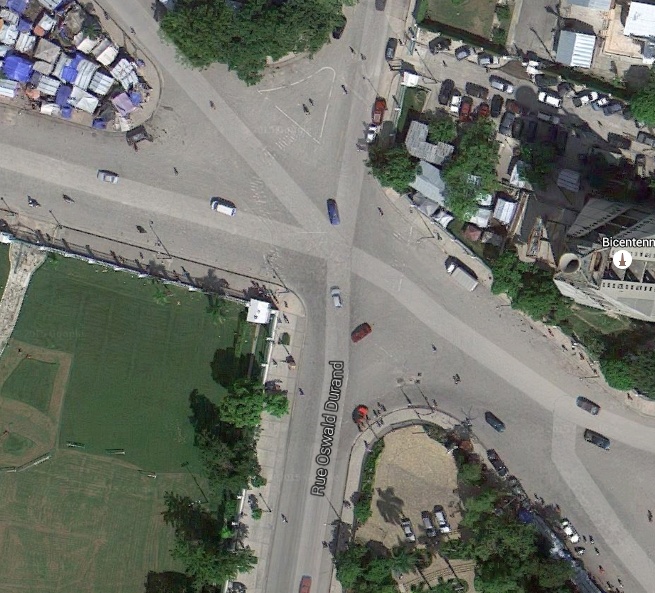
aerial view of carrefour
Google Earth image of carrefour

So what do people do at major intersections when several avenue intersect with none of the external help one might expect?

Continue reading Crossing the street in Port-au-Prince

Instruction, uncertainty, and meta-pragmatic repairing in medical education

When I teach Lave and Wenger’s (1991) altogether brief introduction to “legitimate peripheral participation,” I do not teach it as a theory of learning but as a model for social structuring in Lévi-Strauss’s sense (1962 [1952]).  But Lévi-Strauss was seeking to model a moment in the organization of a people while Lave, in a major development, seeks to model movement through social structurings when everyone and everything involved in the movement constitute this structuring as it will be available for the future.  By an implication that remains to be developed, Lave also opened the way for a modeling of culture change.

In brief, for those who do not know the background to this approach, Lave asks us to move from imagining participation in any position as dependent on earlier learning to imagining this participation itself as producing some personal learning.  Thereby she argues that a personal movement into a position is dependent on mechanisms other than learning (or socialization/enculturation).  These are the mechanisms that make the initial positioning “legitimate” and authorize the acknowledgment of movement.  Wondering about legitimacy and authorization leads to searches for the interactional, political forces that establish legitimate participation, authorize certain forms of leaning, and thus of course, refuse participation, does not acknowledge learning, etc.

Continue reading Instruction, uncertainty, and meta-pragmatic repairing in medical education

What some anthropologists who reply did, on a Thursday in February 2015

In my last post, I argued that “Applied Anthropology” is, to all of us anthropologists, a total social fact, a “thing”—both in Mauss’s and Latour’s senses.

But that does not tell us much about the actual practices of anthropologists who find themselves caught by this thing facted in a long history. So, today, I wonder about what was done, one Thursday in February 2015, in New York City, in a classroom of a Columbia building. Then and there, a bunch of anthropologists told each other what they do. What did they say?

In the first few minutes of the conference, Ray McDermott put it this way: “when someone says stupid or mean things about kids, I want them to know I will be at their door the next day.” This, he said, is “reply anthropology.” Replace “kid” with “mothers,” “haitian farmers,” or whomever is talked about in stupid ways, and variations on this presentation of self were made. Some argued that McDermott was simply saying, colorfully, what may have been the presentation of anthropology by Boas in the United States, Mauss in France, Malinowski in England, and many others: when someone says stupid, or at least mis-informed things, about human beings, anthropologists will notice, shudder, bring out obscure, and often actively obscured, practices through painstaking observation. They argue among themselves on how to interpret the observation and what observations to conduct next. Then anthropologists reply. And now, they examine the replies to their replies as others continue to mis-represent their work and, more significantly, the work of the people about whom the conversations are held.

Continue reading What some anthropologists who reply did, on a Thursday in February 2015

Reply anthropology (?)

After the end of the February 26, 2015 conference on “‘Applying’ anthropology,” Jean Lave wondered whether we had not “reified” applied anthropology by discussing what became, discursively, an “it” that stood against another “it” (unmarked, regular, academic, ivory tower anthropology).

Reification is of course the trap all critical discourses fall into, willy nilly: the more people say “I am (not) an applied anthropologist,” the more they affirm there is a such thing even when the object is to criticize IT.

But what were we to do? in the active practice of a particular critical discourse? in the second decade of the 21st century? within the confines of a State authorized institution dedicated, by statute, to “Applied Anthropology”?  I thought we would spend more time on alternate qualifiers.  Actually, we did not, much.  The fundamental issue, I guess we all agreed, is not a matter of qualification but one of whether there is anything to qualify.  In that sense at least, we all feared what Lave said we did do, and that is reification through questions about the classification of many different kind of actual research and publishing practices as, more or less, “marked anthropology” and thus NOT [unmarked] anthropology. [Ftn 1]

The fear of reification is not irrational, or matter of feelings or beliefs.  We all know that reification blinds, can lead us to make mistakes, can be used against us.  Reification puts us in a place that is no less real for being the cultural production of a time and population.  But we, as the kind of anthropologists who participate in a conference on “‘applying’ anthropology” cannot really NOT stay in this place we fear.  We must stand our ground (to develop the geographical metaphor) if only because acting on this fear could send us back (or be pushed back) into small ivory towers of irrelevance—and that would be ironic indeed since [applied] anthropology may have been, at times, a response to calls by students and others for relevance (engagement, etc.)!

But standing our ground does not mean that we cannot struggle towards some reconstruction, if not relocation.  To that end, I’d say we were giving examples of our practices over longer or shorter careers as professional anthropologists, and we were examining more carefully how these practices, as they are publicized, link with other practices both within and without the discipline.
Continue reading Reply anthropology (?)

Neo-liberal (?) discursive esthetics

Cultural anthropologists must appreciate the following job description, as local (in time and place) work of linguistic
artifacting?
artificiality?
artfulness?
arbitrary?

The Director of Enterprise Applications Service is responsible for application planning, development, testing, support and operations and project management of Teachers College’s application architecture and strategy. The Director of Enterprise Applications will forge sustainable relationships with IT directors in the business units and provide consultative support to the business units. This position will report to the Chief Information Officer and will interact across the academic and administrative technology services leveraging people, process, technology across the college by analyzing existing enterprise applications portfolio and define the road map for that portfolio as the college’s needs and opportunities change. This position will also be responsible for the college data warehouse and business intelligence environments.  (Retrieved from LinkedIn on February 18, 2015)

Whether the formal esthetics of this description is “neo-liberal” (as temporarily label for an epoch perhaps following “post-modernism”) or not, it will remain a product of a time and place: 2015 in some global sphere.  I suspect Teachers College has never had a “Director of Enterprise Applications Service” and that it will never have another one (as classifications and procedures change).

Continue reading Neo-liberal (?) discursive esthetics

Is this what neoliberalism is all about?

In a recent post, I wondered whether this post is “mine,” I puzzled the apparent devolution by the “Sovereign” (people, nation, state) of some of its political controls onto alternate “non-governmental” agencies, such as Corporations instituting Policies over their “Employees” (rather than laws over their citizens).

Is this what people who rant against “neoliberalism” intuit (even when they use the word simply as the kind of generalized insult where my generation used “capitalism”)?

Most people actually rant against a few politicians (Reagan, Thatcher, Pinochet) and a few university professors (Hayek, Friedman, etc.) who, as it is told, destroyed an earlier world to the profit of a very few.  That professors might be so influential, or even so useful for whatever purpose, is flattering to one among them.  But there has to be more.

I have another history for neoliberalism in which the economic actually yields to the political in the never ending deliberations about what to do about the catastrophic consequences of earlier political deliberations.  Thus, greatly to caricature, the glorification of the “people” and its “nation” typical of the 19th century leads to the 20th century 30 Year War (1914-45) that starts with four Sovereigns and ends with a version of man-made global devastation human beings should work not to reproduce.

This is a fast summary of the history I learned, though I was not quite taught it in school: France, Germany and Great Britain had greatly misbehaved themselves and their sovereignty, that is the sovereignty of their people as it can be manipulated by local (“national”) forces, should be reigned in.  I continue to admire Jean Monet (and de Gaulle and Adenauer) for having started a political process that involved manipulating the economic to produce massive political change: the end of France (and Germany, etc.)!  Monet succeeded in getting French and German politicians to create the “European Coal and Steel Community,” a supranational organization to which was devolved a small piece of national sovereignty.  This would lead to the founding of the Common Market, more devolution, and then the European Community and the Euro.  Half-a-billion people now find themselves in an unprecented political entity: an empire with a huge bureaucracy of policy-makers, and no emperor!

Two points here: 1) in 1950, the general population did not care about coal and steel, few saw where it might lead, and there was no serious political opposition to the subsequent devolution of sovereignty—until recently; 2) this devolution opened new opportunities for many interests that may or may not have been hampered by national sovereignty—particularly multinational corporations that could now operate more broadly around Europe and then the globe by using supranational organizations and policies as weapons against national organization and their politics.  If this is correct, then Thatcher, General Motors, Apple did not produce a current order that was a political response to a political problem.

Many critics in Europe do not think this is correct.  The more vociferous European critics of neoliberalism and globalization argue all this is the product of American imperialism (Zemmour 2014).  Whether the American generals and others who led all international meetings in the 1940s could foresee all this, may be besides the point.  The devolution of the national State to Supranational organizations (including, of course, the IMF, the World Bank, but also the ever multiplying “Non-Government Organizations,” big ones and small ones who now mediate much effort to make the world a better place) has been good to the United States (not to mention China, etc.).

It has also been good to the huge number of people who were able to move across the globe to fend for themselves whatever new difficulties they might encounter when they settled among more or less welcoming populations.  As one of this number, I appreciate the “freedom” (that is partial release from some constraints) that has allowed me to make a career and family in America.

So, I remain skeptical about any simple rant against neoliberalism that does not take into account the conditions within which its production has made sense.  Still, seventy-five years into what morphed, for much of the globe, into what might be called the post-nation-state era, the exact mechanisms of this era cannot just be imagined.  They must be investigated at the local levels dear to anthropologists.

What are the constraints (and possibilities) that ongoing cultural production of the devolved state, make real, concrete, and factual over future action?

In my locality, in an American College, I keep wondering—as I have been doing in several of these posts 4/18/2013, 4/23/2014.  Anthropology, some anthropologists like to say, was the handmaid of the national colonial State.  What if this State has faded? Who should support anthropology materially?  To be crass, who should pay for it and on what basis?  Is academic anthropology, after all, (intellectual) “property” (human capital) to be evaluated in the market place (for example on the basis of the willingness of young people to indebt themselves to pay tuition?)?  As I put it the first time I actively engaged with the issue does a College have a value? Or is it a price? (Varenne 2000)

Zemmour, Eric
2014     Le suicide français. Paris: Albin Michel.

Is this blog “property”?

Is this blog “property”?  If so, whose? And who controls the answers to these questions (and the consequences thereto attached)?

Once upon a time (let’s say about three months ago), I thought the answers obvious enough: “in America,” this blog is “mine.” It is expression which I could transform it into property if I decided to commercialize it and/or sell it.  It all had to do with “freedom of expression” and particularly “academic freedom,” privileges granted by the Constitution to individuals.

And then I was taught by PtBs at Teachers College about “work for hire laws.”  As summarized in a work for hire document written at the request of a corporation developing a “policy on intellectual property” (note the word “property,” not “knowledge”) the law says:

Under the Copyright Law, the copyright to a work created by a person in the course of his or her employment is Work for Hire, which belongs to the employer rather than to the individual creator.

Continue reading Is this blog “property”?