Category Archives: on schooling policy

On policies about the organization of schools and related matters (testing, teacher evaluation, organization. etc.)

Where do (psycho/socio)- metricians fit?

Recently, March 28 2012, I spent the afternoon at the plenary session of an “International Conference” on “Educational Assessment, Accountability, and Equity: Conversations on Validity around the World.”  The plenary speaker was Michael T. Kane, “The Samuel J. Messick Chair in Test Validity” at the Educational Testing Service.  He talked about validity as measurement scientists deliberate about it, and about some of their soul-searching when they consider the impact of their measurements.  Or, as I would put it, wearing my “anthropologist of Nacirema” hat, he talked about the misgivings of an obscure priesthood specializing in an abstruse numerology few understand outside their rarified convents.  Kane, as a master in this polity of conjurers of numbers, gave us, the uninitiated or very peripheral, a glimpse of his doubts and those of other masters as they discover that they are now at the very center of political storms where their more abstruse spells are thrown at opponents for all sorts of reasons having little to do with numerology.
NYC value added model for teachers

To the extent that I understand it (and I am very far at the periphery of numerology, or rather, I am at the periphery of the gravity well that might have made me, at some point in my career, a legitimate peripheral participant), it all has to do with the “interpretation” of the test that leads to its being used in a particular case.  But Kane and his peers are not quite where Geertz and his peers have been.  For one, Kane is deeply concerned with specifying and justifying the interpretive steps.  For another, he and his peers have, precisely been thrust into the center, while symbolic anthropologists are pushed even further away from it.

Continue reading Where do (psycho/socio)- metricians fit?

What’s a teacher to do?

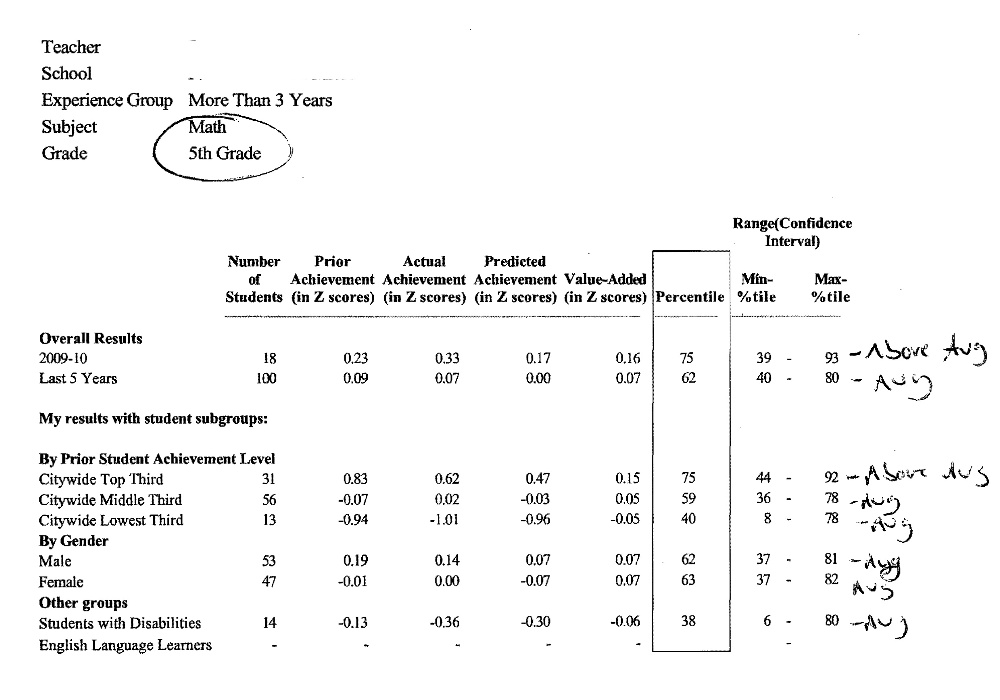
New York City found out on February 28 that an elementary school teacher I know well rates a “34 (7-73) 32 (5-84)” in Reading and a “63 (41-82) 77 (42-91)” in Math.

A few months ago, teachers had received from their school summary documents that looked like this:
Math result for a NYC teacher
What is an individual teacher to do about any of this?  What, on a day to day basis should a teacher do to “improve” on a 34 and maintain a 77?

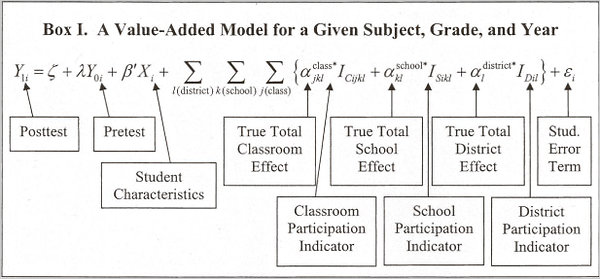
These numbers are somewhat related to the wonderful awful formula:

NYC value added model for teachers

What are the values of these variables for any particular teacher? Which of these variables are under an individual’s control?  On what day of the year?

I venture that neither common sense, habituation into any cultural world, guesswork, or any other process proceeding from the individual teacher as teacher or person, is likely to help in answering these questions.  I suspect that a whole new class of professional consultants is now being inducted into fuller and fuller participation in new polities in all sorts of institutions.  They will be sold as the interpreters of the ratings.  They will also be people with children and mortgages who will have ever more interest in keeping the formula opaque.  They will be joined by the psycho/socio-metricians tinkering with the formula to “improve” it so that they can report to the New York Post that “the complaints of the teachers have been addressed,” various software engineers, etc.  And the web keeping everybody in place will get tighter and more difficult to escape.

The question we need to raise is, of course, whether teachers should have to ask questions about manipulating variables on a formula.  The formula may be wonderful as a research tool, but it is awful as a method for hiding political decisions and making it appear that these decisions are removed from precisely political activity at all levels of schooling.  As a political tool it may be intended to take the place of a terminating Skynet where evaluation, like the response to some foreign threat.  Evaluation, it appears, is taken out of the political realm of principals meeting teachers in a school, and into the realm of automatized mechanisms noone quite understand but are un-impeachable, as well as altogether unaccountable.  That people will be hurt people is their problem will the newly powerful say: “good” teachers (the top 50%? 75%? 25%?) “have nothing to fear” and “bad” teachers should fear dismissal (unless the whole exercise is pointless).

Whether any of this will do anything to improve education in any of its senses in the question may be a question one asks at one’s peril.

On Political Deep Play – a coda on experimentation

My entry from March 2 played, very seriously, with the kind of deep play policy makers in the world of schooling engaged in when they released invalid scores purported to tell how well individual teachers taught.  On March 9th, James B. Stewart of the New York Times, asked “Would Americans be better off if General Motors and Chrysler had simply gone bankrupt, without benefit of taxpayer assistance?” and he raised the question of the kind of evidence one could use to answer such a question.  What picked my curiosity is the following comments:

Unlike a science experiment, in which variables can be changed and the experiment repeated, we can’t turn back the clock, let the auto companies go bankrupt and compare the results with what we have today, which is an American auto industry that is, by nearly all measures, healthier than it’s been in many years. G.M. and Chrysler, not to mention Ford, which didn’t get taxpayer money but benefited indirectly, are profitable, hiring more workers, competing more effectively, gaining market share and building better cars and trucks.

He then proceeded to make comparisons with other companies that were, or not, helped by the government when they face bankruptcy.  Essentially, he was using history rather than “evidence-based” empirical research to argue in favor of a political decision.

Now, of course, history, like anthropology, is precisely not an experimental science and yet it may more useful to “politic” makers, that is politicians, as actors, rather than “policy” makers as advisors to the actor.  The very small group (Obama, Geithner, ??) who decided to bail out General Motors could not rely on “evidence.”  They had to rely, in the best sense of all these words, their ideology, their common sense, and the conversations they must have had.

In other words, they placed a major bet.  It looks like they won.  But this was about the deepest of deep plays.  The only deeper I can imagine is Roosevelt or Wilson getting America into World Wars.

Back in New York, it is probably the case that Bloomberg made a similar bet when he had the test scores released.  He could not wait for the “evidence” that this release would lead to better teaching.  By the time this evidence was in, then the political problem would probably have been moot.  We can disagree with his decisions.  We can note the irony that people who have prided themselves on being “data-driven” made a major decision in the absence of data.  But we see the decision for what it is, a political decision, not a policy decision.  And as one approaches political decisions, history, and anthropology, may be more useful than “experimental” social sciences.

How can we convince policy/politic makers that evidence-based research is not the way to a better democracy?

MOOC: Education, degrees, careers?

I ended a recent paper for the Gordon Commission on the Future of Assessment with comments about the possible disassociation of schooling from assessment.  My argument was that the association between the two has been 1) good for schooling in that it has massively increased its reach and claim on resources, and also 2) terrible as it makes it less and less relevant to education.  The recent, and ongoing, controversy about publicizing teachers’ scores on invalid measures is a case in point: teacher-ing, with ever more symbolic violence (a.k.a “accountability”), is made into a skill for putting measurable bits into students’ head.  That teacher-ing might be about participating in shaping a mind is left aside as not a concern for the State.  But why, may we ask, should the State be concerned with education?  Well, of course, because

the tests
…..that lead to the degrees
……….that accredited  schools grant
……………that employers use to open or close doors to careers

are essential for the representation that a political system is indeed “democratic” and that state rewards are indeed distributed on merit rather than birth privilege (in its racial, ethnic, class, gender, etc. forms).

In many ways, as the people of the School have been saying, focusing on tests leading to degrees is a radical narrowing of what was the mission of schooling.  Arguable, the battle has been lost as much (most?) of what was included in this mission has now been distributed out to the family, the media, religious institutions, etc.  But schooling, as an institution, appeared to remain central because it has kept its monopoly on the granting of degrees.

What if this changed?  What if a successful challenge was mounted to legitimize other doors to adult careers than those controlled by the current schools, colleges and universities (and their teachers or faculty)?

In the past week, the New York Times published evidence that this challenge has started.  One is an opinion piece by Charles Murray asking an “energetic public interest law firm” to challenge “the constitutionality of the [bachelor’s degree] as a job requirement” (March 8, 2012).  The Supreme Court, I did not know, has made it unconstitutional to make test scores the key to employment unless there is a tight link between the test and the job.  Demonstrating the link between almost any college degree and almost any job might be difficult.

The other report may be a more immediate and less ideological challenge, and possibly much more difficult for school people to block (particularly since some of them are profiting from this challenge).  I am talking here about “Massive Open Online Courses” (MOOCs).  Stanford offered a classes for 160,000 students in 190 countries!  Another class, on Machine Learning, was given for 104,000 students with 13,000 completing the course.

The figures are astounding.  They are about something that is happening now and will have social and political consequences.  Of the 13,000 who complete the course on Machine Learning, most of them must have learned something but none got a State recognized certificate or a degree.  So, at this point, they completed the course “for nothing”–that is just for the education of it.  Some of them may also perform their professional tasks better.  I suspect those will not accept for very long to be passed for promotion by people who have a degree.

If the State finds ways to accredit (“give credit for”) the taking of MOOC (perhaps by asking a company like ETS to give an independent and controlled test), the implications for universities and their faculty are staggering.  The New York Times quote one of the Stanford professors who taught one of the MOOC as saying that he does not want to go back to teaching just twenty students in a small classroom.  When Stanford has found a way to charge people for the course, and reward the faculty member in commensurate fashion, the whole economic basis of colleges is transformed.

We may be seeing the end of schooling as we have known it (and for people of my generation profited from it).  It is going to be quite a ride.

On ecologically valid assessments

At some point during the mini-conference on the future of assessment (held on April 11, 2011), Ray McDermott raised questions about the validity of the kind of tests the Educational Testing Service and such design.  He told of the work he conducted in the late 1970s as part of Michael Cole’s Laboratory of Comparative Human Cognition.  Then McDermott, Cole and others wondered about the relationship between tests and the settings about which the tests were supposed to say something.  As they showed (1979, 1998: Chapter 1), the relationship between, for example, a reading test and baking banana bread by reading a recipe is tenuous, at best.  In the setting of a cooking club, so much else happens (from confused writing to interpersonal tensions) that ability to read is the least of the problem the children have to deal with.  The generalizability of these observations across settings and populations is now well established through repeated observations.

What has been left open in this work is the question of finding out what ecologically valid assessments would actually look like.

Soon after the conference, another participant, Katie Anderson-Levitt (U. of Michigan-Dearborn), suggested we look at Paradise and Rogoff’s recent paper about ongoing learning in families (2009).  In that paper, Paradise and Rogoff mention all the work done in the Cole tradition over the past 30 years with a new twist that fits well with my own sense of what I call ‘education.’  In everyday life, at home, “learning” is not a simple automatic matter proceeding below deliberation or symbolic expression.  In everyday life “teaching” (and assessing) is—probably—ubiquitous.

As I reflected on all this, I saw a route I have not yet quite explored and that could lead to further research expanding on the Cole, Lave, etc., traditions.  Starting with an expansion of the point Paradise and Rogoff made, I suspect that  the movement through publicized ignorance is accompanied by all sorts of speech acts, many of which fit in the paradigm of knowledge assessment.  Developing all this is also an expansion on Garfinkel, as I take him.

Garfinkel has kept arguing that maintaining any order requires ongoing work, including the work of figuring out what is going on.  Conversational analysts has given abundant evidence that this is indeed correct.  More recently, Garfinkel wrote about ‘instructions’ as a necessary aspect of this work.  The paper ends with one of my favorite quotes about screwing around and getting instructed (2002: 257).  What I do not think Garfinkel noted, and what I know I never noted myself, is that the instruction moments proceed either from an earlier assessment, or themselves constitute an assessment.  This is also an implication of Gus Andrews recent dissertation (2010) on blog comments when these are assessed as being “wrong” in some way that is specified by a later comment (“this comment does not belong here,” “you should not write your social security number here,” etc.).  In an interactional sequence (conversation?) utterance of the type “Do X differently!” are probably essential mechanisms for maintaining order, constituting emerging orders, moving participants into new positions, etc.

I am quite sure that such ongoing assessment is ubiquitous and should probably added as a function in Jakobson’s model of communication (1960 — though he might have classified it as an aspect of the metalingual function).  Much of the recent work on metapragmatics may also fit here.

In brief, and for our purposes, we could say that Ethno-methodology is at the service of ethno-science (what is the world made of?), and ethno-politics (how do we maintain the order within which we are now caught?), it also at the service of ethno-assessments. [or should we say that (ethno) Methodology is at the service of (ethno) Science, (ethno) Politics, and (ethno) Assessment?]

If this proves a useful direction for inquiry, it suggests that assessment is not an extra-ordinary task.  It also suggests how school assessment has drifted away from the ordinary [I am not sure that ‘drifted’ is the right work, but it will do for today].  The well known school-based QAE (Mehan 1979) model is formally equivalent to what might get known as the SARS model (Statement, Assessment, Re-statement) except that the former starts with the assessor’s question while the later starts with a seeker’s request that may then lead to an assessment (though this proposal may not have been presented as such).  In other words, the sequence starts with ignorance grounded in the here and now (“ecologically valid ignorance”?) and proceeds with statements of local knowledge that are themselves proposals for what it is that the seeker may plausibly not know (I am using the word ‘seeker’ rather than ‘learner’ since it will remain a question wether the subject whose ignorance is marked will learn anything out of the encounter).  This sequence is what I would now say my earlier statements about “productive ignorance” were about.

The question to designers of future tests is something like: how might you produce assessments that are triggered by acknowledgments of ignorance, whether generated by the subject (“I would like to know about X”) or by a co-participant in the polity (“you really should learn more about X”).  The challenge is to find the moment in the sequence of a life when the co-participant teachers will enter.  In everyday life it is a non-problem to the extent that co-participants or “consociates” have the built in or self-generated (legitimate) authority to assess (as siblings may have).  When social distance increases, that is when the network links between those who set what is to be assessed, what is to count as ignorance, and what should be done about include many persons in many institutions, then the problem gets acute.  It may even be unsolvable unless we find ways to reposition the official assessors within the network so they are closer to the performance in such a way that they can get a better sense, in real time, of the feedbacks that the seeker (learner) provides.

(More on what I am trying to formulate about network linkages later)

Practical assessments, perhaps

This is my third entry developing some of the points we discussed during the mini-conference on the future of assessment (held on April 11, 2011).  The first two entries (on audiences, and on utopias), and in my initial one before the conference (on political philosophy) were essentially analytic with a definite pessimistic lean.  (School) assessments are bad for the health, and yet they are here to stay given all the powers they serve—including idealistic ones.

Robbie McClintock re-started me on a different track I briefly explored in my last contributions (2010) to the series on Comprehensive Education Ed Gordon and I edited (2008, 2009, 2010).  There I mused about possibilities for forms of institutionalized education that did not proceed from schools.  I am convinced that adults gain their most significant knowledge (about, say, health, emerging scientific and engineering developments, trends in high and popular culture, etc.) from institutions (for example, journalists and television reporters or producers) that are not controlled by the State.  Most of these institutions do not present themselves as primarily in the education business.  But perhaps they should, and draw the consequences.

McClintock emphasized the Web as another source of an education that is not necessarily packaged as, precisely, “education” but perhaps only as “information,” “entertainment,” etc.  Some writers and producers for the Web may present themselves as educating but none, at this moment assess what one may learn by reading their offerings.  Yet, as McClintock pointed out, the new technologies, as they are evolving, afford for possibilities for ongoing, real time assessment that older technologies (for example the printing press) do not afford.

This is intriguing.  Time for a little science fiction.

Imagine a new Google service.  At this moment, Google answers questions of the type “where can I find about X?”  Whether the seeker is satisfied or not with the answer, whatever the seeker does with answer, Google remains silent after providing a list of possible answers ranked by Google’s best guess as to the seeker’s intent.  If the seeker is dissatisfied, he may ask again and Google will answer, but Google has no memory of what this seeker asked and Google’s answers will not evolve as answers do evolve when, say, a child ask a parent about X.  So, last week, while writing my preceding blog entry, I looked for the creationism museum I had read about.  I entered “creationism” in the Google box (search page saved on of 4/20/2011), clicked on the first of 3,150,000 results (a suspiciously ‘round’ number), and found myself in the Wikipedia entry that started, on that day, with “creationism is the religious belief …”  There are no links to the museum in that entry, and so I asked Google again, found that it was second in its list of possibilities (and I also found out, serendipitously, a “Conservapedia” with an entry on creationism that is close but interestingly different from Wikipedia’s.  I am, of course, on my way to educating myself about creationism—not so much as a belief but as an institution with, among others, curricula experts quite deliberately teaching that which School people are quite sure should not be taught.  But Google never intervened in my education.

Imagine that Google did intervene.  Imagine that Google, as run by some revolutionary government, traced my queries, adapted its answers to my renewed queries and, mor or less insistently started asking me about my beliefs and worked at correcting them.  Parents do this with their children.  And school teachers do this with their pupils.  Why shouldn’t Google?

I suspect that the technological infrastructure of such a service is already in place and that it would not take much tweaking of the various flavors of social software already available to make them serve the new function.

The challenge is multiply institutional.  Who is to start it? Fund it? Control it?  Who is to credential (authorize) the persons or software assessing self-sought knowledge in real time?  Who is to establish the curriculum and it goals to which seekers are to be brought back even as they explored far and wide?  Individuals, clubs, associations, etc., may already provide feedback in the sense that their web sites are less informational than argumentative.  For example, the fifth set of links to ‘creationism’ on Google mostly lead to “atheist” web sites specifically addressing creationist links and debunking the claims.

I have never heard of States getting into this as deliberately as States get in the business of setting school curriculum.

The libertarian and anarchist in me whispers: why would you want the State to get involved?  The school critic from the left and the neo-liberal from the right might ask the same question.  States have a wonderfully awful (or is it awfully wonderful?) track record of setting the curriculum for the mass populations they govern.  Why would they do better with real time ongoing assessment than they have with the usual forms of test or examination based assessments for which schools are (in-)famous?

The statist in me begs to differ.  Free, state regulated, public schools have done much that is good in transforming what is to count as the knowledge on which public and private lives should be based, as well as the means for the production of such knowledge.  Rationally based, modernist (?) expertise should probably remain at the core of what States support, propagate, and assess as, precisely, rationally based.  If Latour (1993 [1991]) is correct, “We may never have been modern.”  Modernism itself is a cultural construction that must be reconstituted on an ongoing basis to remain the order of the day.  True enough, but what else might we wish to build?

What ongoing assessment software should be now build?

Utopias and dystopias: Futures for education, technology, and the assessment of authority over knowledge.

When we met last Monday (April 11, 2011) for the mini-conference on the future of assessment, we, of course, talked a lot about the impact of the new technologies.  Without much prodding from Robbie McClintock we mentioned the oft celebrated opening of access to knowledge as well as the distribution of the production of widely accessible knowledge.  The new technologies open routes to knowledge that do not pass through the gate-keepers we are familiar with: universities, research libraries, newspapers, state-controlled curricula, medical institutions (not to mention the theologians and priests who, until recently appeared to be fading as gate-keepers).

Someone then mentioned that all this has a very dark side.  With the distribution of access and production comes a distribution of the authority to interpret and constitute knowledge so that it can guide practical action in the world.  This can be scary.

Continue reading Utopias and dystopias: Futures for education, technology, and the assessment of authority over knowledge.

Assessing audiences: identifying reachable designing assessors

In an earlier post, I mentioned my confusion when I was asked by Ed Gordon to consult for a “Commission on the Future of Assessment” he is convening.  The first meeting of this commission is to happen in June and I am now expected to write a few pages based on a mini-conference held last Monday (April 11, 2011) at Teachers College.  A longer paper is to be written later.

The mini-conference brought together Robbie McClintock, Ray McDermott, Kathryn Anderson-Levitt and half-a-dozen recent doctorates (Gus Andrews, Alex Posecznick) and students.  A grand intellectual time was had by all, and I will be writing about various highlights of the conversation in future blogs entries.

Continue reading Assessing audiences: identifying reachable designing assessors

on the political philosophy of educational assessments

Ed Gordon has asked me to consult for a “Commission on the Future of Assessment” he is convening.

Dilemma: My work, particularly with Ray McDermott, has mostly been about ferreting the noxious side-effect of … assessments, and particularly of what follows even the most well conducted assessments by the most dedicated professionals.    McDermott and I are convinced that these noxious side-effects are structural features of assessments as currently sequenced within the life of a person as caught within a particular polity.  By this we mean that the consequences are not the product of the quality of the assessment (whether of the test or of the tester, of its validity or reliability).  They are the product of the way a test is required (when, by whom, for whom) and by the way the test results are subsequently used to inflect the career of a person in this or that direction (school tracking or admissions, treatments, therapies, not to mention employment).  In fact, from our point of view, the better the assessment as assessment, the more serious the consequences since they cannot be legitimately challenged.

Formally, this is a problem in the politics of assessment at the most philosophical level since it concerns the very organization of the good society and, in our times, of democracy.

The question Gordon is now asking me to address concerns the possibility of finding different ways to sequence assessments given my sense that the most powerful educational processes are not those controlled by schooling.

Let me indicate briefly whence I would start looking.  I have become somewhat bothered by all reports trumpeting the important of college graduation not only for personal happiness but also for material benefit.  When this is combined with arguments about the wealth of the nation in the competition between American and China, the arguments seem unimpeachable until one starts wondering about exactly what it is about “college graduation” that produces all these benefits—particularly in the United States where colleges are so varied in their curricula, pedagogies, not to mention “reputation.”  The issue soon becomes pathetic, if not politically explosive, when one reads about very small colleges, often in urban settings recruiting struggling working class people by using academic research to demonstrate that the enormous indebtedness the students are assuming will soon be repaid.  The admissions officials in such colleges do not quite tell potential students that colleges in the fourth rank are likely not to be those that were used in academic research (Posecznick 2010).  At the limit this is akin to selling very expensive snake oil aided and abetted by the federal government through its student loan programs.

All this might be something we should accept if we were sure that colleges do produce the experiences and skills businesses need, or that colleges are the most efficient way of gaining these experiences and skills.  But we must doubt this.  One has but to look at the school profile of many workers in the internet world to realize that a business that needs a good web site is more concerned with the product than with the credentials of the person who design it.  More research is urgently needed in what businesses actually do need, with subsequent discussions of where people should be prepared, or who should fund what part of the training (the person? the State? the business?)

One aspect of the possible shift from college graduation as a sort of general proxy is the question of how the business is going to assess whether the person has the needed skill.  Developing a special test for assessing this is quite a different thing than using “college graduation” as proxy.  What many do not consider is that the assessments that lead to college graduation (from grades to tests assessing the aptitude of people for college work) have a lot do with what interest colleges (and their faculty) and possibly little to do with whatever it is that we talk about when we talk about national wealth.

I will confess that I prefer a student excited about literature and philosophy than in a student excited about book keeping.  I am glad to have been part of a generation that pressured students to say there were excited by literature and philosophy so that they could become book keepers.  And yet, as I step out of my tower and into the market place, I am so glad for the many magnificent book keepers (insurance agents, car salesmen, mortgage brokers, real estate agents, bank assistants) that have helped me sell my apartment and buy a new house, and whose eyes have glazed when they hear that what I teach at Columbia is “cultural anthropology”…