All posts by Herve Varenne

Peirce on habit: another ancestor for normal anthropology?

Seth McCall, a student in my seminar on the production of culture, commented on Garfinkel by bringing in something Charles Sanders Peirce wrote about doubt.  It sounded as it could neatly balance Garfinkel on trust (1963).  One could argue that the very need to trust has to be related to the (ethno-)methodological suspicion that one should always doubt, even if one does not mention, at the time of the interaction, the doubt given the competing need not to stop the development of an interaction.  In brief, trust allows for the pragmatic (“let’s do this!”) without a call to the meta-pragmatic (who is “we” here? What is “this”?) even as this call is always ready to be activated as another form of “screwing around” (as all those who have tried to perform one of Garfinkel’s “experiments” have experienced).

Continue reading Peirce on habit: another ancestor for normal anthropology?

On anthropological impotence

Experiments by Professor Shafir [Shah, Mullainathan & Shafir 2012] at Princeton and others have documented how poverty itself leads people to make self-destructive decisions, perhaps by forcing them to focus attention on satisfying immediate needs to the exclusion of other considerations. (New York Times, February 24, 2016)

The American culture of the “culture of poverty” is alive and well. New York Times journalists still quote approvingly professors who tell them: “The poor lack two things: money and cognitive freedom.” And it appears that a major State actor, “the Obama administration,” relies on such experts for designing policies aimed at changing the behavior of those who do not act according to economic rationalism (e.g. do not save more for old age).

Continue reading On anthropological impotence

On the (mis-)use of anthropology

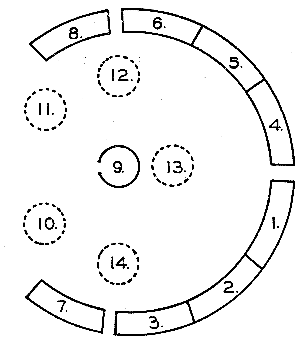
model of Ge village
(Nimuendajû 1942: 17)

Last week, I heard a most interesting paper by Oren Pizmony-Levy and Gita Steiner-Khamsi about, of all things, school reform in Denmark! It may seem strange that I resonated to such a topic.[Ftn 1] But it should not appear so: in graduate school, I also resonated to reading ethnographies of Ge people of Central Brazil! People over all the world do amazing things and “school reform” is one of them.

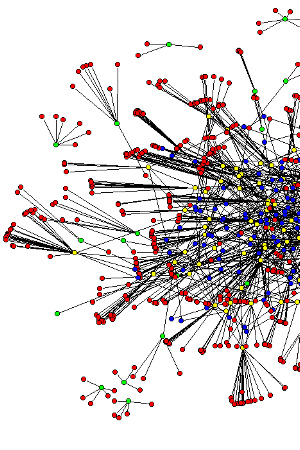
representation of a network
Network by Steiner-Khamsi and Pizmony-Levy
using UCINET

Last week, I particularly resonated to the methodology. Nimuendajû, the great ethnographer of the Ge, in his time, modeled Šerente villages on the basis of his local observations. Pizmony-Levy and Steiner-Khamsi have found a way to make visible networks involved in the production of “school reform,”[Ftn 2] on the way I suspect to modeling how such reforms proceed. Their work is part of a broad movement in the social sciences, and anthropology in particular (at least in the networks who attempt to build on Jean Lave’s work as transforming social structural analyses). The goal is to trace movement and change (or return to the old normal) in position, and perhaps even in the field of positions within which people move (including school organization). The current consensus, backed by much ethnography, is that these changes do not “just happen” as effect following some cause. It proceeds through deliberate action by emergent polities. Nimuendajû did not have the tools needed to trace how the Šerente came to do something that could be modeled as he did. But these tools are now available.

More on this another time.

What surprised in me most Oren Pizmony-Levy and Gita Steiner-Khamsi’s paper was that the most quoted document in the network of people and institutions who performed “school reform” in Denmark was …. an ethnography, of a school, by Danish anthropologists!

Anthropology of education, actually applied for what appears positive change!
Continue reading On the (mis-)use of anthropology

“Contingent Configuration of Resources” (culture?)

Last Monday, Stanton Wortham gave a wonderful talk on his work in Norristown, Pennsylvania.  There he got to know a first generation of Mexicans moving to the town for all sorts of wonderful, deeply human, reasons and making something new with much that was old–including, most recently, the very history of a movement that is now involving a second generation while people keep arriving.

In his conclusion, Wortham used the phrase “contingent configuration of resources.” The phrase spoke to me as a particularly apt way to capture the general implications of what anthropologists notice in their field sites: something “contingent,” something “configured,” something that has to do with the ‘resources” people find as they make their life.  In my terms, as I expand on Wortham:

1) contingent: not necessary, not quite predictable on the basis of earlier experiences, arising here but not there, now but not then, not reducible to rational functionality, arbitrary, made-up for the occasion, artifactual if not artificial;

2) configured: arranged, making a figure through the relationships between the parts that make something else that may then constrain further arrangement as the new gets coopted into the figure;

3) resources: a deceptively simple terms that include not only the material (ecology, economics) but also the symbolic, the interactional, the institutional and the political, and also the psychological, not to mention … chance.

Wortham presented his study through the career of an Italian plumber meeting a Mexican entertainer in Acapulco, wooing her, accepting the suggestion of one of her kin that she might have a hard time by her Mexican self in Pennsylvania, and moving her two sisters with him after marrying her.  They are followed by brothers and sisters, nephews and nieces, sleeping on sofas in basement, and then opening shops, restaurants, and otherwise establishing themselves economically even as they married, raised children (and, I suspect, fought among themselves, and made other kinds of mistakes that made life even more difficult).

This is the anthropological “anecdote” at its best: apparently a single case, involving hundreds of human beings linked with each other in very concrete ways, and unique at the level of detail characteristic of ethnographic research and essential to anthropology.  This is not a controlled experiment but an occasion that reveals fundamental processes among human beings (Varenne 2014, 2015).

As those who know my work will see coming, I heard the phrase “contingent configuration of resources” as a more precise way of talking about what the word “culture” should index—unless it is that this is the way I have always understood “culture” though I may never have used the phrase.
Continue reading “Contingent Configuration of Resources” (culture?)

Policy? or Politics?

Could the hegemony of “policy” be coming to an end?

For many years state officials, “private” foundations, benevolent billionaires, academia and a certain elite media have been telling everyone else what is what in “education”.  (For one sense of this set look at Brill’s 2010 story in  the New York Times magazine).  In the world of academia where I live, this will have been the decade of “data-driven” “policy” “studies.”  We keep being told, repeatedly, such “narratives” (stories? fiction?) as:

In Rhode Island schools, a multidisciplinary effort helps teachers to quickly understand what skills their students have already grasped and which subjects need more attention. In Houston, a regional alliance has noticed signs of students going off-track on higher-level math skills and acted to intervene.

What do these stories have in common? Success here derives from access to data, or big data as it’s sometimes called. The examples above come from the Data Quality Campaign, a nonprofit effort driving education outcomes through hard numbers.
(GovTech November 2014, retrieved in December 2015)

What interests me here, of course, is the hint of an “actor-network” of local schools and a corporation “e.Republic, Inc.” “The nation’s only smart media and research company focused exclusively on public sector innovation for state and local government and education” (retrieved in December 2015)

One problem with just sketching an actor-network (an excellent thing to do) is that it can end with an altogether static map and little sense of the movements through it, or the temporalities that assemble and then sometimes dissemble the network.

So, recently, I have tried to write about such networks as acting (and revealing themselves) through crowded conversations (deliberations).  I am experimenting with generalizing conversational analyses (somewhat like Latour generalized ethnomethodology when he moved from looking at the production of knowledge in short interactions among a few people (Garfinkel et al. 1981;  Goodwin 1995), to looking at a laboratory (Latour 1979), to looking at the scientific enterprise as a whole (Latour 1987).

And so, once upon a time, we had Senator Kennedy and President Bush (as symbolic leaders) producing “No child left behind” after very long conversations that started at least 20 to 30 years earlier –unless it is 200 years (Varenne 2007, 2011).

And then, a few years later, President Obama and Arnie Duncan, his secretary of education, started new conversations which, among other things,  privileged “data-driven policy.”  I am necessarily wrong in suggesting that they were the sole authors who literally started these long-turn taking sequences.  But they can stand as markers of a new sequence with somewhat different participants and discursive order as the original metaphor (a child is like a sponge) developed into practical conceit (regulations, the attendant bureaucracies, the texts to be produced among the various actors, etc.).
Continue reading Policy? or Politics?

on maintaining order in difficult spaces

After 40+ years of American Anthropological Association meetings, I cannot pretend that they are not familiar.  I registered  in the same booths the association has used for many years.  And as I walked I recognized sounds, topics, physical styles, rhythms.

My own rhythms, by now, are anything but not familiar.  As I mentioned before (), I play “session roulette”: I open a door to a session room without checking printed title, sit down at the back, and listen.  I continue to recommend this to students as a way to, one hopes, making serendipity work.  Sometimes I stay.  but, mostly, I leave as it sounds all too familiar, including phrases and jargon that would surely appear strange to perhaps every human being on the planet—except perhaps professional anthropologists (“this post-neo-liberal moment”?!?!!).  “Ontology” has replaced “post-modernism” which had replaced. … and …., but pretentious obfuscation of limited ethnography remains.  The tribal order remains even as name tags get bigger (they are now the size of small bibs!), last name are obscured and American communal individualism gets reproduced in symbolic practices even as the multiple hierarchies that move people in and out of anthropology remain (as any one concerned with job applications well knows).

Continue reading on maintaining order in difficult spaces

On grades as statements: to whom?

Ray McDermott and Jean Lave once told me that they asked Rancière whether his writing influenced his teaching.  As they tell it, he looked surprised and answered something like “not at all!”  A reader of Successful Failure once asked me whether I still gave grades.  Besides stuttering, I said something like: “I am required to (by my university and New York State)” and/or “students would not accept my not giving them grades.”

Continue reading On grades as statements: to whom?

On not defining “kinship”

What is a book about when it is titled The elementary structures of kinship (Lévi-Strauss 1967 [1949])?  For about thirty years, and during my graduate years at the University of Chicago, it was about “elementary structures” and we debated endlessly what that might mean.  But I also took courses from David Schneider as he was elaborating his most famous book, A critique of the study of kinship (1984).  He taught us that Lévi-Strauss’ book, ostensibly about “kinship,” was actually about NO THING that could be studied cross-culturally.  Schneider’s book, as a version of the history of the near present often say, marked the end of the study of kinship in anthropology and the disappearance of the field as foundational to the discipline.

Continue reading On not defining “kinship”

On education on Lake Wobegon

Everytime I introduce my work with Ray McDermott, I echo something he probably says more eloquently than I: “What schools all about? They are about determining which 50% of children are below average!”  Given that much of this is done through testing, and that the good test “discriminates,” then I sometimes say, to provoke, that schools are all about discrimination.

Such statements grab the attention of students, but I am not always quite convinced that the answer is more than a provocative quip.

And then I read paragraphs like one that introduced a recent story in the New York Times:

Ohio seems to have taken a page from Lake Wobegon, where all the children are above average. Last month, state officials releasing an early batch of test scores declared that two-thirds of students at most grade levels were proficient on reading and math tests given last spring under the new Common Core requirements. (October 6, 2015)

The story is of course not about how successful the schools of Lake Wobegon or Ohio are.  The story is about “the problem that a lot of policy makers and educators were trying to solve,” as “Karen Nussle, the executive director of the Collaborative for Student Success, a Common Core advocacy group,” is quoted as saying.  As summarized by the New York Times, “The Common Core was devised by experts convened by state education commissioners and governors to set uniform benchmarks for learning. … But as the results from the first Common Core tests have rolled out, education officials again seem to be subtly broadening definitions of success.”

In other words, as McDermott and I argued, success if indeed defined by failure (1998).  It is necessary to fail students in order to demonstrate that other students are successful.  It cannot be that all children (or even most, or even more than some measure of the average) should be “proficient.”  The label must apply only to a certain percentage.

The “debate” (though the New York Times is not really debating as the article clearly sides with Common Core policy makers) is thus about labels, statistical uniformity, comparability across the United States—and forms of unacceptable tinkering if not cheating.

The debate is not about learning, and even less about education.

“Only in America” am I tempted to say, except that, actually, there is something interesting going on here that a call to political theories of cultural arbitrary (as all theories of culture, from Boas onwards have been, when taken strictly) should highlight.  The story is also about a political struggle among the elites about precisely how America should work, in general, and in the detail of the lives of politicians, schools administrators, principals, teachers, parents and other adult who might express opinions or vote about all this—not to mention university professors designing tests, billionaires funding “school reform,” union leaders and many others.

I make this list to bring attention to the evidence that all these people, in the worlds that they inhabit will talk and act in ways that will often make problems for each other, and that they will do that purposefully (systematically and deliberately to cross-reference Cremin and my take on “education”).  In relatively neutral language they are conversing (which is not quite the same thing as “negotiating”) often with the hope of producing something different than the probable or expectable.  They are not simply acting in terms of their dispositions (habitus, etc.).

I make the list also to move further than where Ray McDermott and I were when we completed Successful Failure.  As Jill Koyama (2008) noted, we mentioned “America” but did not quite show how it actually produced what we observed, in temporality.  We had essentially worked by drawing a structural model of a historical moment (“culture”) that emphasized the relationship between democracy, meritocracy, the institutions that they produced, and the consequences for individuals (to simplify of course).  We were directly inspired by Louis Dumont (1980 [1961]) on the relationship between individualism and racism.

This kind of (Lévi-Straussian) structuralism can be helpful, but it never was able to specify how what was modeled actually came into reality in the day to day life of those caught by the culture.  So, more or less explicitly, social theorists implied or stated that what was modeled was real and powerful enough to generate what could be observed.  McDermott and I wrote extensively against this move to “structuring structures” (to quote Bourdieu’s jargon).  But we did not quite find a way to state how the democratic fight against birth privilege ends up producing discriminatory tests, the failing of teachers who do not “add value” to children and all other policies justified by calls to the discovery and reward of individual merit.

Thus my interest in following what the New York Times reports, and how it writes its reports.  I take these as statements within a conversation, in the same spirit as McDermott wrote about Rosa’s “I could read it”: the statement makes sense given the conditions but it is not produced by the conditions.  The conditions are set by earlier statements, most of them made by other people, far away and long dead, as McDermott and I like to say.  But the actual statement (act) is produced by a particular person, caught together with specific persons (consociates), at a given time.  In that perspective, it makes sense for bureaucrats in Ohio to move the boundary between proficient or not.  And it also makes sense for others powers-that-be to try and move it back.

What of course no theory of culture can answer is “why should it make sense?”  except perhaps if “a” culture (epoch, episteme, …) is understood, again, as a statement making sense in terms of earlier statements (culture…).  Thus, the shift to democracy, meritocracy, schools, testing, might be seen as a response to earlier discourses and institutions for elite production.  How to move the conversation to its next statement is our problem, as political actors and, I would say, as educators attempting to convince various audiences that they are on a track that may only make matters worse.

References

Dumont, Louis 1980 [1961] “Caste, Racism and ‘Stratification’.” Chicago: The University of Chicago Press.Tr. by M. Sainsbury. Rev. ed.. In his Homo hierarchicus

Koyama, Jill 2010 Making failure pay: For-profit tutoring, high-stake testing, and public schools. Chicago: The University of Chicago Press.


On the limits of human rationality when confronted to human practical intelligence

The programmers at Google (mostly human, I will grant) have a problem: how to make their robot (car) make eye contact with non-robotic drivers so the robot does not get paralyzed at four way stops.

Actually, some humans (particularly of the French kind, at apéritif) are sure all humans must have this problem since it rationally impossible to determine who has priority when four cars approach together a four way stop.

Practically, of course, there is no problem: humans, in each case, make up a way to solve the “problem,” one four way stop at a time, using all their tools (eye contact, inching forward to assert right of way, withdrawal to avoid possible confrontation, etc.).

Anthropologically (in the broadest sense of finding out what humanity is all about), all this is about the tension between rationalism and pragmatism: do human beings act from rules or do they make it up as needed?

More than a century ago, this is a tension that must have haunted Durkheim and led him to give a full course on it (“Pragmatisme et sociologie.” Cours dispensé à La Sorbonne en 1913-1914).

Continue reading On the limits of human rationality when confronted to human practical intelligence