This world is a wild and startling place, which might have been quite different, but which is quite delightful... Before this wildness and delight one may well be modest and submit to the queerest limitations of so queer a kindness. (Chesterton [1908] 2011: 63)
B - Lévi-Strauss, Claude Wild thought. Chicago: University of Chicago Press. 2021. [first published in 1962] (Chapters 1, 2, 3, 4, 6, 8, 9)

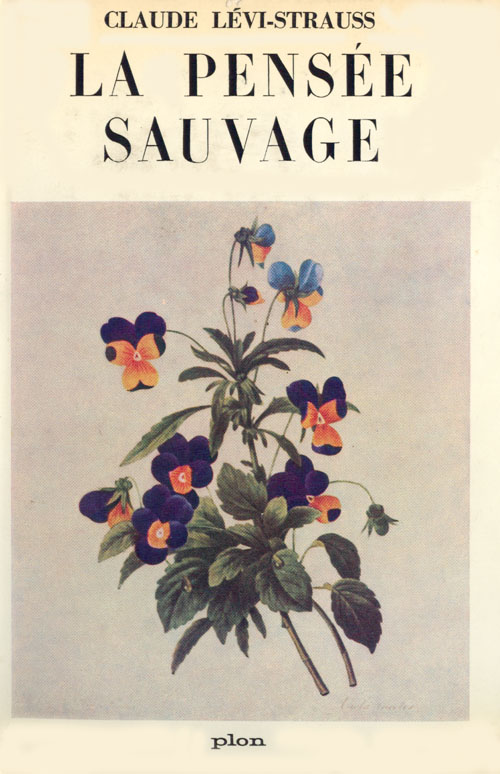
- The radical
 ("I" in Chinese)
rather than the (encultured) "me"
("I" in Chinese)
rather than the (encultured) "me"
- George Herbert Mead on the 'I' that cannot be caught (1934: 174).
- The controversy with Sartre (and by implication Geertz)
- Note that Lévi-Strauss never discusses cultureS (in the plural). He is mostly concerned with
the production of what future human beings then have to deal with.
- echoes of Marx on the production of life but without the determinism or the discounting of the "symbolic" that is in fact central to communication and thus to life
- "a spectacularly untranslatable pun" (Geertz [1967] 1973: 357) on the first translation of the book published in 1966
- Let's try
- Savage Mind (the translation Lévi-Strauss refused, thus the absence of a mention of a translator who asked her named by removed)
- Wild Thinking
- Wild Thought
- Wild Mind
- Human Mind
- Unless Lévi-Strauss might have titled the book, without play
- Comment les hommes pensent
- Comment les hommes transforment le monde qui leur est donné
- Personally, and tendentiously, I wish he had titled it something like
- Imagination in action
- Describable and accountable, not imaginable (Garfinkel...)
- The wild, the tame, and the feral in humanity (and expansion on Lévi-Strauss's culinary triangle)---with thanks to Michael Scroggins (2017)
- and as it was finally retranslated under the title Wild thought (still an unsatisfying title as it does not quite index that "pensée" is more "thinking" than "thought."
- Let's try
- Thinking (not mind?)
- Possibilities rather than interpretation
- Humanity (that is life) rather than mind
- Imagination rather than determination or function (on totemism)
- but little on the consequences of imagination
- And specifically: The openness of classifications (segmentation) and associations (poetry, imagination)
- The "world" (plants, diseases, people) as the occasion for transformations that makes a new world that humans inhabit and continue transforming.
- ethnographic detail as evidence against functionalism
- and by implication structural-functionalism
- bricolage, NOT engineering
- note that Lévi-Strauss is not discussing what actual engineers do, rather he is emphasizing certain properties of myths about rationality to make the point that rational planning in terms of structures and functions is not the way of humanity.
- the poetry of politics: colors, social structure, identification
- And the unstability of all this:
The classification tends to be dismantled like a palace swept away upon the flood, whose parts, through the effect of currents and stagnant waters, obstacles and straits, come to be combined in a manner other than that intended by the architect. (p. 233)
For more on my take on the fundamental issue see my blog entry
Varenne, Hervé "The ongoing production of 'conscience individuelle'" November 5, 2014
And, for fun, Lévi-Strauss's "Father Christmas executed." in Unwrapping Christmas. Edited by D. Miller. Oxford: Clarendon Press. pp. 38-51. [1952] 1993
Concluding notes
Latour & Lévi-Strauss on assemblage
Latour vs. Lévi-Strauss on starting with concerns (rather than wonder)
The dangers of not starting with concerns is that it might divorce research from political life.
The dangers of starting from concerns is that it might obscure what the people of concern actually may do.