
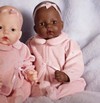
 Remember the famous doll study of the 1950s?
Kenneth B. Clark, the psychologist and educator studied the ways in which racial segregation destroyed the self-esteem of black children. His report influenced the U.S. Supreme Court to hold school segregation unconstitutional in Brown v. Board.
Clark and his wife, Mamie Phipps Clark, also a psychologist,
conducted their doll study in Clarendon County, South Carolina.
They studied 16 black children, ages 6 to 9. They asked the children
their perception of a white doll and a black doll. Eleven of the
students spoke negatively of the black doll and nine spoke highly of
the white doll over the black. 
They
chose Clarendon County because the public schools there, at that time,
had enrolled three times as many black students as white students. But
white students were receiving more than 60 percent of the educational
funding in a school system that was entirely segregated. Thurgood
Marshall, then an attorney for the NAACP Legal Defense and Educational
Fund, cited Mr. Clark’s work as proof of the doctrine’s damage to the
self-image of black children.


On May 17, 1954, Chief Justice Earl Warren read the decision of the unanimous Court:
We come then to the question presented: Does segregation of children in public schools solely on the basis of race, even though the physical facilities and other "tangible" factors may be equal, deprive the children of the minority group of equal educational opportunities? We believe that it does...We conclude that in the field of public education the doctrine of 'separate but equal' has no place. Separate educational facilities are inherently unequal. Therefore, we hold that the plaintiffs and others similarly situated for whom the actions have been brought are, by reason of the segregation complained of, deprived of the equal protection of the laws guaranteed by the Fourteenth Amendment.
The Supreme Court struck down the "separate but equal" doctrine for public education, ruled in favor of the plaintiffs, and required the desegregation of schools across America. Clark’s doll test was one of his citations as proof of the psychological damage on black children.
When Dr. Clarke died in May 2005, at least one psychologist called for an update. Julia Hare, a psychologist in San Francisco opined that, if the doll study were done today, it might produce even worse results.
 Now, this young filmmaker, Kiri Davis, has taken up the call for that
update. Her high school documentary has audiences at film
festivals across the country talking.
Now, this young filmmaker, Kiri Davis, has taken up the call for that
update. Her high school documentary has audiences at film
festivals across the country talking.
http://www.komoradio.com/home/video/5001856.html?video=YHI&t=a
In the film, Kiri asks this adorable black preschooler: 
Can you show me the doll that looks bad?


The little girl quickly chooses a black doll over a White one that is identical in every respect except skin tone.
And why does that look bad?
Because she’s black, the little girl answers.
And why is this the nice doll? Kiri asks.
Because she’s white.
And can you give me the doll that looks like you?
The little girl points to the black doll -- the doll she has just labeled as bad.
The children in Kiri's film are not from the segregated south of the 1950s but instead are from a Harlem Day Care Center in 2006. Fifteen of the 21 children surveyed preferred the white doll over the black one.
Julia Hare, the San Francisco psychologist, was not suprised: “If you keep doing what you have always done, you’re going to keep getting what you have always had. Our children are bombarded with images every day that they see on television screens and on coffee tables—either the light-skinned female that everybody is pushing or they give preference to the closest to White images.” (See BlackPressUSA.com)
Much has changed since Dr. Clark's study and the Brown decision. But, as Kiri's film shows, much remains the same.
JFlo
THE MOVIE
Terms & Privacy guidelines