- Latour, Bruno and Steve Woolgar Laboratory life: The construction of scientific facts. Princeton: Princeton University Press 1979 (Chapters 1, 2, and postcript)
This is the second in a series of notes
to eleven lectures for my class Technology
and Culture.
- First principles: things or human beings, together?
- the classic chicken and egg: what comes first:
- the stones out which arrow-heads are to be made? (the silicon out of which chips will be made, ...?)
- the human activity that makes stones nto arrow-heads? (the engineers transforming silicon into chips, ...?)
- an issue not be summarily dismissed
- history
- of pre-human "nature"
- of man-made "nature" (not necessarily "culture")
- cultivation
- instruction
- acceptance/understanding -- or not
- next statement -- probably not the expected, unless the un-expected was the whole point (e.g. when questioning)
- inscription and factualization
- "evolutionary" feedback
- "new" objects or the reconstitution of old ones in a way that takes into account the attempt to evolve, thereby evolving
- thus history, and culture
- history
- with implications with the search for systematic knowledge about the transformation of technologies and their transformative powers
- macro historical correlations (e.g. irrigation systems and politics)
- hypothetico-deductive (experimental, "empirical") correlations at the personal level (e.g. literacy and human development)
- detailed examinations of the use of tools and the development of new technologies and scientific knowledge
- material culture studies in anthropology
- the sociology (anthropology) of science and technology
- the classic chicken and egg: what comes first:
- A question of en-bodied methods: where shall we put our investigative bodies?
- Can science be studied sociologically?
- pragmatically:
- Thomas Khuhn and the (social) Structure of scientific revolutions (1962) (history)
- Abraham Kaplan on the (public, communal) Conduct of Inquiry (1964) (local logics)
- critically:
- Bourdieu
- social interactionally ( ethno-methodologically)
and thus ethnographically
- Garfinkel, Harold "... pulsar ..." (1981)
- Goodwin, Chuck (1994, 1995)
- Latour, Bruno
- etc.
- pragmatically:
- of course, how? (where? when? and with whom?)
- Latour & Woolgar, Chapter 2 and the classic anthropological gambit:
- "when the anthropological observer enters the field ... he ..."
(p. 43)
... "confronted to a strange tribe" (p. 49)
- beyond the gender issue (see Latour 1987:53 for an indirect response) note
- note, in Latour's spirit, the abstract third person, the movement of this person "into" a field (boundaries?), temporality (when is "when"?)
- L&W did not write "we first came into contact with people at the lab on [date] and started writing notes ..."
- strangeness
- "our familiarity"
(p. 43)
- whose?
- what "familiarity"?
- opening a door to Bourdieu's critique about habitus and placing oneself within a long tradition of work in American cultural anthropology.
- "when the anthropological observer enters the field ... he ..."
(p. 43)
... "confronted to a strange tribe" (p. 49)
- but of course!
- the inscription of space (p. 46) that is also an inscription of people-as-related-to-spaces
- inscription devices: the evolution of graphic representation and the endless document-ing with its attendant production of records to organize and archive (filing clerks, filing cabinets and the spaces to place them, inspectors and the economic resources to pay their salary, ...)
- the "distinct culture (or 'paradigm)" (p.55) of the lab: neuroendocrinology
- a poor choice of word given the history/evolution of "culture" in the social sciences
- a good definition (though possibly too "1970s" with its continuing use of the word "belief") "we use culture to refer to the set of arguments and beliefs to which there is a constant appeal in daily life and which is the object of all passions, fears, and respect" (p.55) as long as it is understood that it applies at all "levels" of interaction and that a better term should be found to refer to very local and partial "sets of arguments" (acting networks I would say, to play with Latour's later work). As McDermott and I would say, "culture" might be reserved to the larger of the sets in order to preserve a way to maintain a link with the tradition of work on "culture"
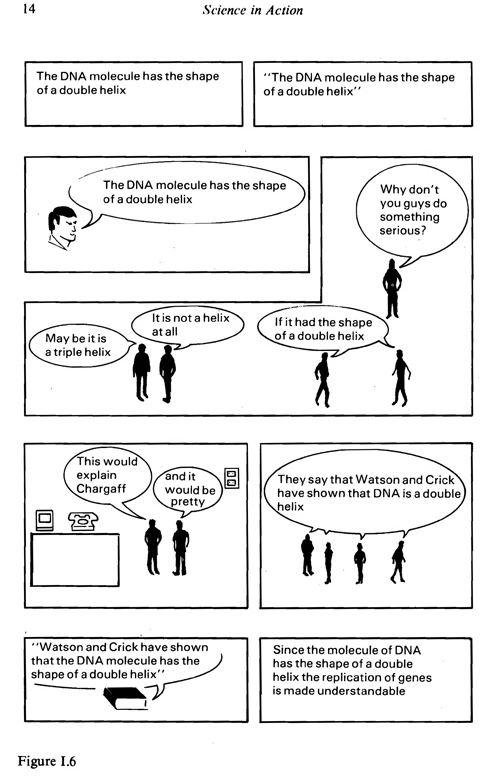
- forgetting the technological production of the "things" lab activity produces -- i.e. "articles based on the product of inscription devices."
- facts!
- publicized: the lab encounters its most significant others who control its ongoing constitution as a proper lab
- and thus language as statements (not simply as transport of information)
- p. 82
- Latour 1987:14
- and just for a laugh and also for what we need to investigate more carefully: the science news cycle, from your dissertation to your grand-mother, via your university's Public Relations office, news wire organizations, bloggers, and television
- Latour & Woolgar, Chapter 2 and the classic anthropological gambit:
- Can science be studied sociologically?
- Latour on [science labs]
[schools] [...]
- as facts re-constituted by the day to day practices of all involved (not only the scientists)
- rules of method 1987: Appendix 1, particularly Rule 7 on networks and a different definition of culture as "the set of elements that appear to be tied together when, and only when, we try to deny a claim or to shake an association" (1987:201) and "people map for us and for themselves the chains of associations that make-up their sociologics. The main characteristics of these chains is to be unpredictable--for the observer" (author's italics. 1987:202)
- these quotes are from pages indexed as "network"
- rules of method 1987: Appendix 1, particularly Rule 7 on networks and a different definition of culture as "the set of elements that appear to be tied together when, and only when, we try to deny a claim or to shake an association" (1987:201) and "people map for us and for themselves the chains of associations that make-up their sociologics. The main characteristics of these chains is to be unpredictable--for the observer" (author's italics. 1987:202)
- Bourdieu's critique
- subverting the autonomy of science and denying the power of the habitus (p 94)
- the constitution of what must be constituted
- de-constructing black boxes
- re-constructing the boxes so that they can better do what they are supposed to do
- as facts re-constituted by the day to day practices of all involved (not only the scientists)
- Immortal facts (things made by human beings, together)
- things
- as facts one cannot kill and in relationship to which one must change one's behavior
- thus the "agency of objects" (Latour 2005)
- people
- people and things linked that together become things ("black boxes") for others
- e.g. The School
- things
| Some questions in the context of this lesson If you want to respond to these you can do so by posting comments through the page for this lesson on StudyPlace |
|---|
|